Prof. Aaron Mike Oquaye, the former Speaker of Parliament and a renowned fellow at Institute of Economic Affairs (IEA), has called for fundamental amendments to Ghana’s constitutional framework to safeguard national mineral resources and halt the country’s recurring dependence on external financial bailouts.
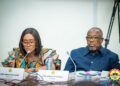
Speaking during an Institute of Economic Affairs (IEA) press briefing on the government’s stance regarding the Constitutional Review Committee, he stressed that the existing governance structure has failed to translate the country’s vast mineral wealth including gold, bauxite, manganese, lithium, and crude oil into sustainable socioeconomic development.
According to him, embedding specific, binding developmental protections directly within the supreme law of the land remains the only viable path to financing critical social interventions like Free Senior High School (SHS) without compromising sovereign fiscal independence.
“And we want to develop and pay for our free SHS, etc., etc., and we don’t benefit from our gold, bauxite, manganese, lithium, oil, and so on and so forth. We should be able to find what is the problem and make amendments in our constitution so that the constitutional framework would answer our developmental challenges. In order to do this, for example, we need to have a commission that is independent, mainly one of institutional redefinition again, the institution of engineering, the statistical, and so on and so forth.”
Prof. Aaron Mike Oquaye
While expanding on this position, the veteran legal scholar argued that Ghana’s structural economic vulnerability is evidenced by its frequent recourse to international financial institutions.

He pointed out that the nation has sought assistance from the International Monetary Fund (IMF) seventeen times across various political eras, spanning both civilian democratic regimes and military administrations, without achieving long-term economic stability.
To break this cyclical reliance on external credit, Prof. Oquaye advocated for an ambitious regime of constitutional engineering designed to insulate long-term economic and extractive policy from the short-term influence of partisan politics.
Central to his proposal is the establishment of independent, technocratic oversight commissions whose appointments and tenures are legally decoupled from the four-year presidential election cycle.
Entrenching Autonomy in Extractive Sector Management
The proposed constitutional engineering focuses primarily on restructuring how key state institutions and regulatory bodies are constituted.
Under the blueprint articulated by Prof. Oquaye, key appointments to state economic, statistical, and engineering bodies should not be made at the discretion of the sitting President.
Instead, relevant professional bodies and civil institutions should delegate their representatives “as of right,” guaranteeing operational autonomy and ensuring that long-term natural resource management remains guided by professional expertise rather than political allegiance.
Fostering Civic Discourse and Institutional Renewal
To achieve lasting legal reforms, the framework stresses that civic and advisory bodies must actively drive public policy discussions.
Prof. Oquaye noted that institutions like the National Commission for Civic Education (NCCE), working alongside policy think tanks, must be empowered by the executive to lead nationwide consultations.
He emphasized that the executive must hold continuous discourses to ensure that the NCCE and broader civil society can “continue to debate this matter and bring out a kind of constitution that will answer the challenges facing our country,” thereby ensuring the resulting amendments truly reflect the collective interest of the citizenry.
Addressing the Root Causes of Economic Vulnerability
The demand for comprehensive constitutional amendments stems from a growing national consensus that traditional fiscal management models have failed to optimize revenue from the extractive industry.
Despite being one of Africa’s top producers of gold and possessing rich deposits of critical energy transition minerals like lithium, Ghana continues to confront severe fiscal constraints and rising debt burdens.

By legally establishing institutional tenure “that is not in tandem with that of the president,” these proposed constitutional reforms aim to establish a stable, professionalized framework for mineral governance one capable of ensuring that revenues generated from finite natural resources directly fund lasting national infrastructure, economic self-reliance, and public welfare.
READ ALSO: Bank Fraud Units Get New Powers Under New BoG Directive