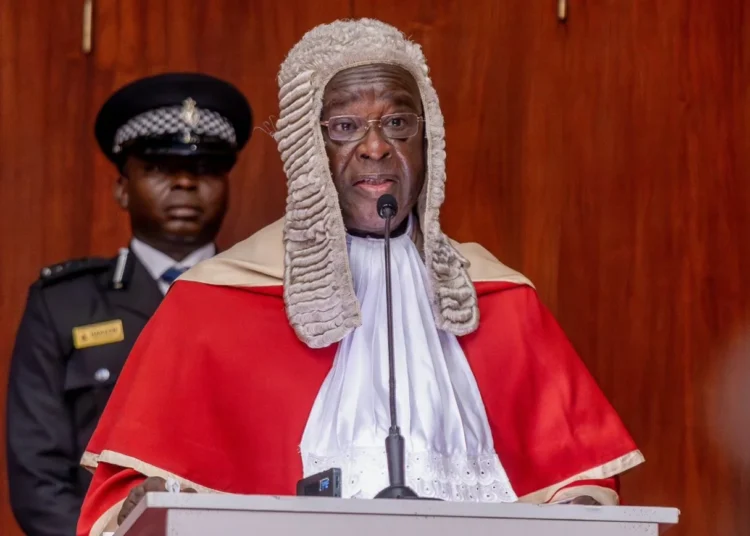
Ghana’s Chief Justice Paul Kwadwo Baffoe-Bonnie has warned newly called lawyers that political allegiance must never override professional principle. He delivered the warning at the 2026 call to the Bar on Friday, October 9, 2026, organised by the General Legal Council at the ICGC Christ Temple on Teshie Bush Road in Accra.
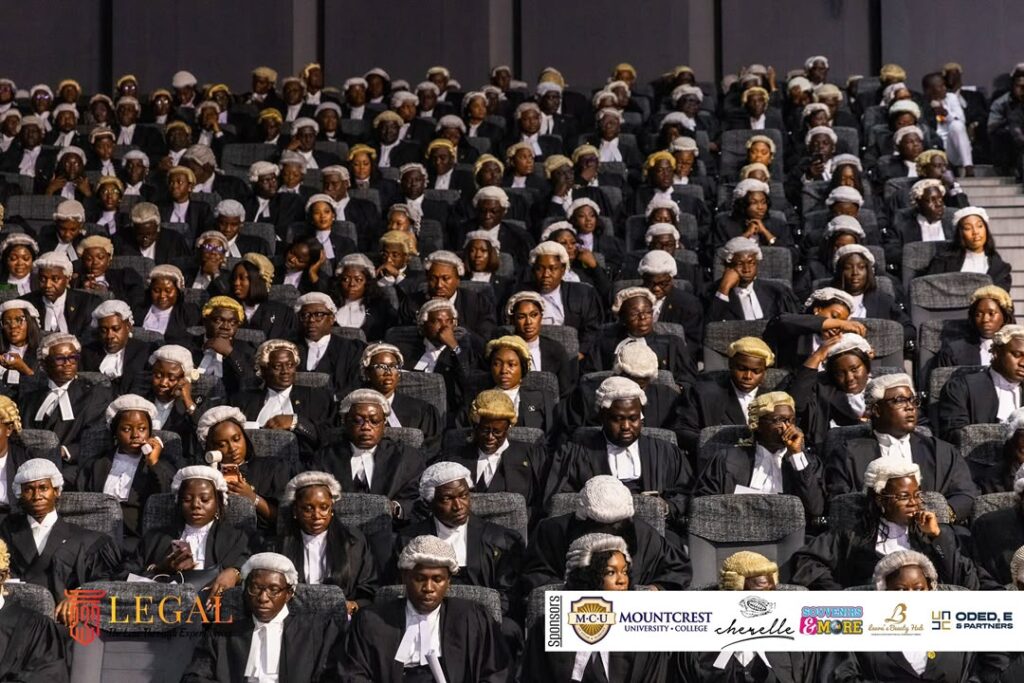
Justice Baffoe-Bonnie argued that being a lawyer places no one above the law, and he insisted that lawyers must stand between power and abuse. He framed the law as a public trust within a constitutional democracy, and he asked the 1,568 new lawyers to confront the profession’s imperfections with courage.
“May you use the law to protect the weak, restrain the powerful, settle disputes, defend liberty, and enlarge the space in which justice can live.”
Chief Justice Paul Kwadwo Baffoe-Bonnie
Justice Baffoe-Bonnie placed the warning within his closing request to the class. He asked them to make him proud by becoming lawyers who will not allow political loyalty to decide professional principle. The speech did not name any party or individual, and it offered no specific example.

He stated that the new lawyers should be “lawyers who will not sell their conscience for a brief.” In the same breath, he asked them to remember where the law’s loyalty lies, with the person in need and not with the person in power.
The Law as Shield, Not Sword
The Chief Justice described the law’s proper role in clear terms. The law, he stated, “must remain a shield for those who have little power of their own and not a sword for the powerful.”
He tied that principle to the lawyer’s own conduct. Representing a client faithfully does not mean surrendering ethics, he explained, and he told the class: “Represent your client faithfully, but do not allow your client to become the author of your professional ethics.” Being a lawyer, he added, “does not place you above the law. It places you under a higher obligation to it.”
Justice Baffoe-Bonnie reminded the class how much authority the profession holds. A lawyer can affect a person’s liberty, shape public policy and challenge the exercise of state power. He suggested that 1,500 new lawyers could mean 1,500 more people capable of standing between power and abuse.
He insisted that power carries duty. The law gives influence so that lawyers may become useful, he explained, not so that they may become important. He added that power is a responsibility imposed on whoever holds it, and he asked the new lawyers to remember that responsibility whenever influence tempts them.
A Public Trust in a Constitutional Democracy
The Chief Justice described the setting in which these lawyers will work. They inherit institutions that must be strengthened, he explained, and laws that will need interpretation and sometimes reform.
The health of a constitutional democracy depends in no small measure on lawyers who understand that the law is more than a career. “It is a public trust.” He asked the class to carry the question beyond the ceremony: what can they do with the law for Ghana?
Justice Baffoe-Bonnie acknowledged that the profession has a proud history and also imperfections that require courage to confront. He urged the new lawyers to practise with courage, competence, humility, compassion and integrity, and he reminded them of the solemn promise they made at the ceremony.

He also asked for restraint in public speech. Lawyers must verify before they speak, he explained, because the public should know that a lawyer who speaks has done the work. He added that there will be occasions when silence is more professional than comment.
Baffoe-Bonnie closed by wishing the class long and honourable careers. One day, he noted, another generation will stand where they stand and inherit the profession they build, and he urged them to build it well.
READ ALSO: EU, China Reach Preliminary Trade Agreement After Talks