
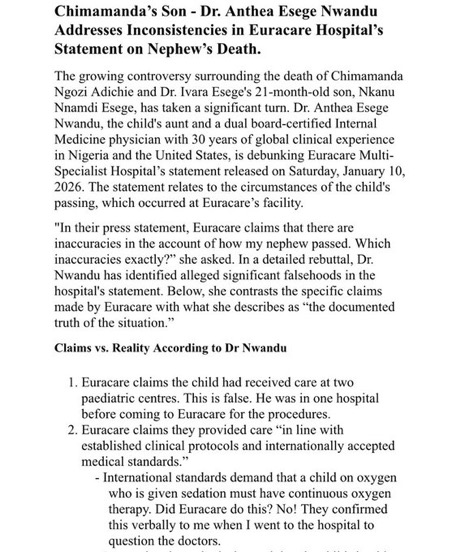
In January 2026, celebrated Nigerian author Chimamanda Ngozi Adichie and her husband, Dr Ivara Esege, suffered the devastating loss of their 21-month-old son, Nkanu Esege. The child died at Euracare Multi-Specialist Hospital in Lagos following medical procedures.
The family has since alleged medical negligence, claiming that an excessive dose of sedatives combined with inadequate oxygen supply led to cardiac arrest.
The tragedy prompted the opening of a coroner’s inquest to examine the circumstances of Nkanu’s death. On Monday, the Lagos State High Court removed a significant obstacle to that inquiry when it dismissed an application by the hospital seeking to halt the proceedings.
Justice Aishat Opesanwo struck out the motion filed by Eurapharma Care Services Nigeria Limited, operators of Euracare Multi-Specialist Hospital. The hospital had asked the court for orders of certiorari and prohibition, arguing that the cremation of the child’s body made a post-mortem examination impossible and therefore deprived the coroner of jurisdiction.
It also challenged the planned order of receiving evidence and claimed a breach of its right to fair hearing.
The judge rejected these arguments. She held that under Section 15(2) of the Lagos State Coroner’s System Law 2007, an inquest is mandatory when a death occurs in a medical facility under circumstances amounting to death in custody. Jurisdiction, she ruled, is determined by the place where the death occurred, not by whether the body remains available at the time of the hearing.
“The provision gives no room for the exercise of discretion once a death results from any one of the nine situations specified and occurs within the area designated as the coroner’s district,” Justice Opesanwo stated. She added that the subsequent cremation of the body did not extinguish the statutory duty to investigate.
The court emphasised that a coroner’s inquest is a fact-finding process. Its purpose is to establish the identity of the deceased and the how, when and where of the death. It is not a criminal or civil trial designed to determine liability or punish any party.
Nkanu Esege died on 7 January 2026. In the months that followed, his parents pursued accountability through the formal channels available under Lagos State law. The hospital’s legal challenge had delayed the progress of the inquest. After hearing full arguments on 28 September, the judge reserved her decision until 12 October.
In the ruling delivered this week, she upheld preliminary objections raised by the respondents, which included the coroner, relevant state officials and the child’s parents, and struck out the hospital’s application.
The decision means the coroner’s inquiry can now proceed without further interruption from this particular legal challenge. Medical staff and others connected to the child’s treatment are expected to give evidence as the process continues.
About the Author
Chimamanda Ngozi Adichie is one of Africa’s most prominent literary voices. Her novels, including Half of a Yellow Sun and Americanah, and her essays on feminism and identity have earned global recognition. The sudden loss of her young son earlier this year drew widespread public sympathy and attention to questions of medical care and accountability in private hospitals.
For the family, the inquest represents a formal mechanism to establish a clear public record of the events leading to Nkanu’s death. For the wider public, it underscores the role of coroners’ courts in cases where a child dies in a medical facility.

The court’s insistence that the absence of a body does not automatically end the inquiry reinforces the mandatory nature of such investigations under Lagos law.
Legal Observation
Legal observers note that the ruling draws a clear distinction between the limited fact-finding role of an inquest and the determinations made in full civil or criminal proceedings. While the hospital had expressed concern that proceeding without a body risked speculative conclusions, the court found that the statutory framework anticipates situations in which physical remains may no longer be available.
With the High Court application now dismissed, attention returns to the coroner’s court. Further dates for the taking of evidence are expected in the coming weeks. The inquiry will continue its work of examining the medical care provided to Nkanu Esege and the circumstances that resulted in his death.
The loss of a child remains an intensely personal tragedy. The legal developments this week ensure that the formal process of inquiry, requested and supported by the parents, can move forward.
READ ALSO :US Ambassador To Greece Denies Allegations Of Misconduct