North Korea has threatened to resume anti-Seoul propaganda broadcasts along its heavily militarised border with South Korea, escalating psychological warfare as tensions rise following land mine blasts that injured three South Korean front-line soldiers.
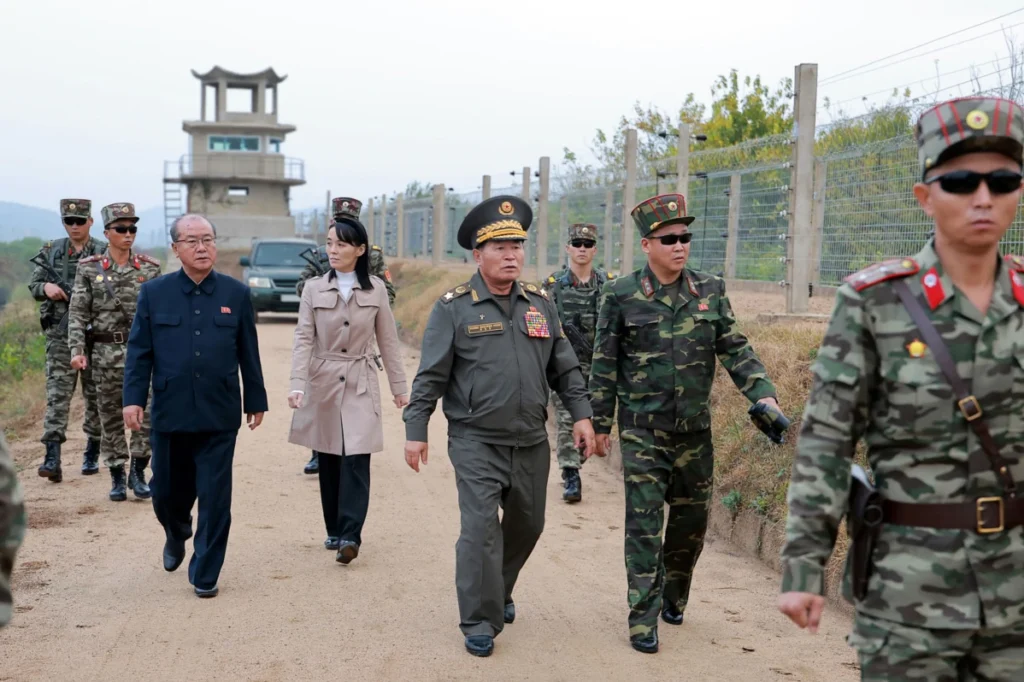
Kim Yo Jong, the sister of North Korean leader Kim Jong Un and a key spokesperson on relations with Washington and Seoul, announced the plan on Wednesday after visiting border areas where North Korean troops are strengthening fortifications.
In a follow-up statement today, she said that Pyongyang would place “new counter means” on alert along the border and have its loudspeakers on standby within days.
Kim also renewed warnings of retaliation against any South Korean actions that North Korea considers a threat to its border fortification efforts, signalling a further deterioration in relations between the two countries. “Our tactical hunting teams are taking new positions, and within October, the loudspeakers for psychological warfare against the ROK will be in operation along the whole border,” she said, referring to South Korea by its official name, the Republic of Korea.
The proposed broadcasts would revive a psychological warfare tactic that the two Koreas have periodically employed against each other during periods of heightened tension.
Kim Yo Jong Warns Seoul Against Border Provocations
North Korea has been reinforcing its border with South Korea through the installation of land mines, barbed-wire fences, anti-tank barriers and other defensive structures.
The work forms part of Kim Jong Un’s policy of permanently severing ties with Seoul, which he has designated North Korea’s most hostile adversary amid a prolonged diplomatic stalemate with Washington.

During her inspection of the border area alongside Marshal Pak Jong Chon, a senior North Korean military official, Kim Yo Jong described the fortification campaign as a “sacred and great undertaking” supporting her brother’s policy.
She also warned that South Korean warning shots, which Seoul says are intended to push North Korean soldiers back across the border when they approach the military demarcation line, could trigger retaliation if they endanger North Korean personnel or territorial security. “If South Korean warning shots cause ‘actual harm to our territorial security and our service persons’ safety,’” she warned, North Korean border guards “will show no mercy for the armed gangsters bereft of reason.”
Kim also told soldiers that North Korea’s military leadership had emphasised the need to demonstrate the readiness of its forces along the border. “Our military leadership underlined the need to make those rogues aware that our new firepower units have taken their firing positions,” she said, reminding troops of Kim Jong Un’s order to make the border with the “enemy … eternally impregnable.”
Pak, who accompanied Kim during the inspection, accused South Korea of making what he called “deliberate, premeditated and absurd” claims to shift responsibility for the growing tensions.
He threatened an “overwhelming response” to South Korean provocations and denied that North Korean soldiers had crossed the border while carrying out fortification work. “Our army knows where our borderline is better than any others,” Pak said, according to North Korea’s state-run Korean Central News Agency (KCNA).
Seoul Warns Of Proportionate Response
South Korea has signalled that it will respond to North Korea’s latest moves, although it has not disclosed what measures it may take if the threatened broadcasts resume.
Asked about Kim Yo Jong’s announcement, South Korean Defence Ministry Spokesperson Chung Binna said today that Seoul would need to take “proportionate measures” in response to developments along the border. She did not elaborate on the specific actions under consideration.
The latest escalation follows land mine explosions on September 21 that injured three South Korean soldiers near the border. After conducting an inspection with the US-led United Nations Command, Seoul formally blamed North Korea for planting the mines and called on Pyongyang to apologise and remove those remaining in the area.
North Korea has denied responsibility for the explosions and warned of strong retaliation if provoked.
South Korea’s military has also reported that North Korean soldiers crossed the Military Demarcation Line 50 times this year while carrying out fortification work. Seoul says it responded with warning shots and broadcasts.
Kim Yo Jong has rejected South Korea’s account of the alleged crossings, describing the claims as a “false pretext” and accusing Seoul of escalating provocations beyond what she called the “red line” following the mine blasts.
South Korea’s Joint Chiefs of Staff Chairman, Jin Yong-Sung, has described Kim’s threats as “intolerable” and instructed the military to “sternly respond” to potential provocations from the North.
Revival Of Cold War-Era Psychological Warfare
The threatened resumption of loudspeaker broadcasts would mark another development in the shifting use of psychological warfare between the two Koreas.
South Korea’s liberal government, led by President Lee Jae Myung, halted its broadcasts after taking office last year in an effort to improve relations with Pyongyang. North Korea subsequently stopped its own broadcasts.

The latest threat comes as Kim Jong Un continues to pursue a hard-line approach towards Seoul, cutting off diplomatic engagement and cooperation and declaring South Korea a permanent enemy.
Efforts to revive diplomacy with Washington have also remained stalled amid prolonged disagreements over North Korea’s nuclear programme.
The planned broadcasts, alongside the ongoing border fortifications and threats of military retaliation, reflect the fragile state of relations between the neighbouring countries.
With both sides maintaining opposing accounts of the border incidents, the prospect of renewed propaganda broadcasts adds another source of tension to an already heavily militarised frontier.
READ ALSO: Trump Launches ‘Super Intelligence Force’ To Lead US AI Push