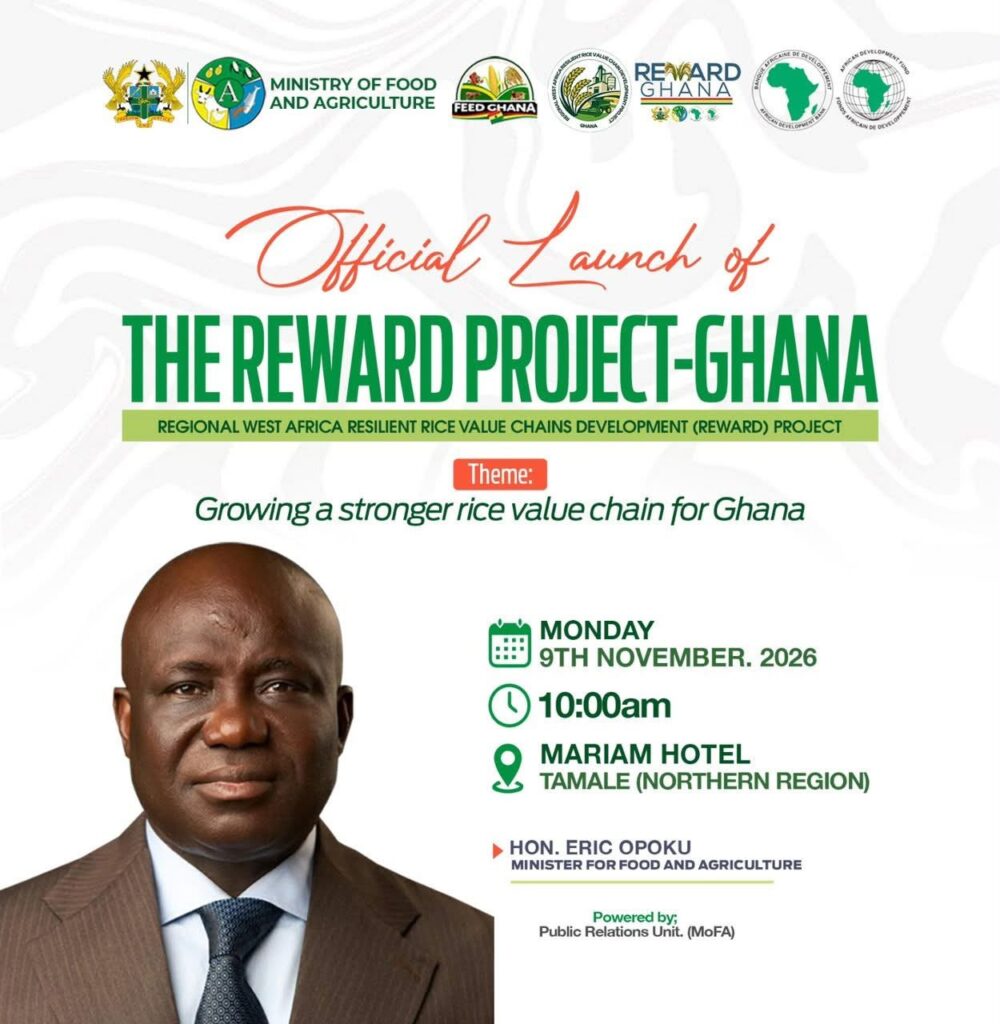
The Ministry of Food and Agriculture (MoFA) is set to officially launch the Regional West Africa Resilient Rice Value Chains Development (REWARD) Project in Ghana.
The launch ,scheduled for 10: 00 am at the Mariam Hotel on Monday, November 9, 2026, in Tamale, will be led by the Minister for Food and Agriculture, Hon. Eric Opoku, with a call for entrepreneurs and private sector actors to explore investment opportunities that could strengthen rice production and improve the livelihoods of rural farmers, particularly women.
The initiative forms part of Ghana’s broader efforts to increase domestic rice production, improve agricultural productivity, strengthen food security and reduce dependence on imported rice.
However, beyond the official launch, the project presents an opportunity for agribusinesses, entrepreneurs and investors to identify practical ways of supporting farmers and connecting rural agricultural communities to profitable markets.
“Growing a Stronger Rice Value Chain for Ghana,” Ministry of Food and Agriculture.
The engagement is particularly important for entrepreneurs who can serve as intermediaries between agricultural programmes and rural women farmers who may not have the opportunity, resources or technical understanding to participate directly in national level discussions.
Their involvement could help translate information about available agricultural interventions into practical opportunities for women who form an important part of Ghana’s agricultural workforce.
Closing Ghana’s Rice Production Gap
Ghana’s rice sector continues to face significant challenges despite improvements in domestic production.
According to the Ministry of Food and Agriculture, local milled rice production increased from approximately 650,000 metric tonnes to 900,000 metric tonnes in 2024 and 960,000 metric tonnes in 2025.
Nevertheless, domestic production currently satisfies only about 56 per cent of national rice demand, leaving the country dependent on imports to bridge the supply deficit.
The country spends an estimated US$320 million to US$500 million annually on rice imports, exposing the domestic market to international price fluctuations and supply disruptions.
To address these challenges, the African Development Bank (AfDB) has approved a US$18.8 million grant to support Ghana’s implementation of the REWARD Project.
The project is expected to contribute to the government’s target of achieving rice self-sufficiency by 2028, with national paddy production projected to reach 3.31 million metric tonnes.
Its interventions include developing 3,200 hectares of land for rice cultivation, improving access to quality seeds, strengthening mechanisation services and supporting processing and storage infrastructure.
The project also seeks to increase average rice yields from approximately 3.5 metric tonnes to 4.5 metric tonnes per hectare, improving productivity and the competitiveness of locally produced rice.
“Domestic production currently meets only about 56 per cent of national rice demand, leaving a significant deficit that is met through imports.”
Ministry for Food and Agriculture
Entrepreneurs Have a Role in Women’s Agricultural Development
Women contribute significantly to agricultural production and post-harvest activities, but many continue to experience challenges accessing finance, modern farming equipment, improved inputs, market information and business development support.
The REWARD Project specifically identifies increased incomes for women and young people as part of its objectives. Its implementation framework also recognises the importance of addressing gender-related barriers and improving women’s access to agricultural services and markets.
According to the Ministry’s project documentation, the initiative will cover seven districts across four administrative regions: Northern, Upper West, North-East and Savannah.
These include Mion, Tamale Metropolitan, Savelugu, Mamprugu Moagduri, Nandom, Wa Municipal and West Gonja.
For entrepreneurs, agricultural cooperatives, women-led businesses, processors, input suppliers and development organisations, the launch offers an opportunity to understand the project’s direction and identify areas where their businesses and expertise can complement its objectives.
Rather than viewing the programme solely as a government intervention, private-sector actors can explore partnerships that improve access to agricultural inputs, mechanisation, processing facilities, storage, transportation and markets.
“Increase rice productivity and production, thus increasing incomes for farmers, particularly women and young people.”
Ministry for Food and Agriculture
Turning National Opportunities Into Rural Impact
The success of REWARD-Ghana will require more than financial resources, infrastructure and agricultural technology.
Effective communication, community participation and private-sector collaboration will also be essential to ensuring that the programme delivers meaningful results.
Not every rural woman farmer will have the opportunity to attend the launch, understand the technical discussions or access information about the interventions. Some may lack transportation, digital access or the necessary business networks to connect with relevant institutions.
This creates an important responsibility for entrepreneurs, development practitioners, community leaders and women’s organisations attending the programme.
The African Development Bank’s financing and the government’s rice self sufficiency ambition provide an important foundation.
However, translating these commitments into higher incomes, stronger businesses and improved rural livelihoods will require deliberate efforts to ensure that women are not left behind.
“Not every rural woman can attend or even understand what is said in the programme, so you are their hope.”
Ministry for Food and Agriculture
The official launch should therefore be seen not only as an institutional milestone but also as an opportunity for entrepreneurs to identify how they can contribute to inclusive agricultural development.
READ ALSO:Asiama Reveals Bold Reforms Transforming Ghana’s Banking Sector