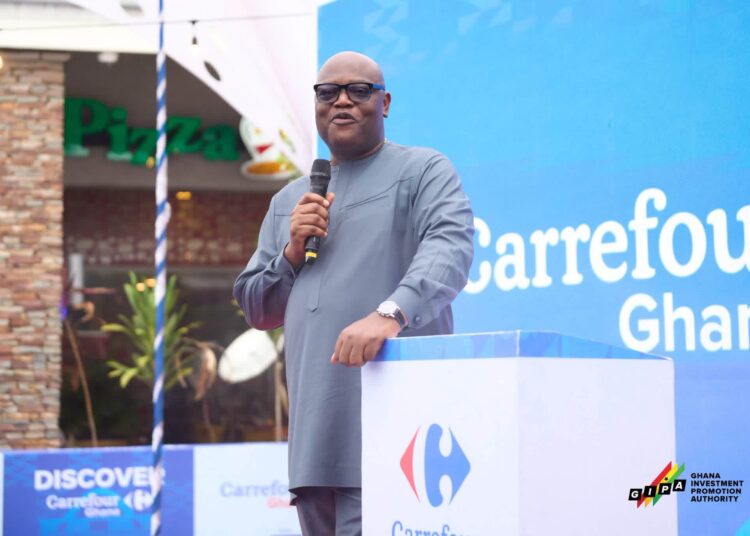
The entry of global retail operator Carrefour into Ghana marks a new development in the country’s formal retail sector, as the government intensifies efforts to attract international investment while strengthening opportunities for domestic enterprises.
The Ghana Investment Promotion Authority (GIPA) has welcomed the retailer following the official opening of its first Ghanaian store at Accra Mall describing the development as an opportunity to deepen investment participation and expand the country’s retail landscape.
Speaking at the launch, Chief Executive Officer of GIPA, Simon Madjie, congratulated the company on its entry into the Ghanaian market and urged it to build stronger commercial relationships with local businesses.
He emphasised the importance of ensuring that foreign investment generates economic benefits beyond the establishment of new retail outlets.
“Deepen its local content by creating opportunities for Ghanaian businesses and strengthening local participation across its operations.”
Ghana Investment Promotion Authority
Local Businesses at the Centre of Investment
Mr. Madjie’s appeal reflects a broader policy direction in Ghana’s investment promotion strategy, which seeks to ensure that foreign capital contributes to domestic enterprise development, employment creation and the expansion of local supply chains.
Local sourcing is particularly important in the agricultural and manufacturing sectors, where access to reliable and structured markets remains a significant consideration for producers.
Ghana has a substantial agricultural production base, with commercial opportunities across horticulture, poultry, fisheries, processed foods and other consumer goods. Connecting these producers to large retail distribution networks could improve market access, encourage consistency in production and create incentives for businesses to meet established quality and packaging standards.
Carrefour’s entry therefore presents an opportunity for structured engagement between the retailer and Ghanaian businesses, particularly in identifying local products that can be incorporated into its merchandise and distribution networks.
The development also comes amid ongoing discussions about the relationship between foreign investment and the protection of Ghanaian-owned businesses.
In August 2026, GIPA and the Ghana Union of Traders’ Associations (GUTA) agreed on measures to strengthen compliance with investment laws and protect Ghanaian participation in informal retail activities.
The Authority clarified that foreign investment is permitted in the formal retail sector, including supermarkets and shopping malls, subject to applicable legal requirements, while informal retail activities such as open markets, small shops and kiosks remain reserved for Ghanaian citizens.
“Foreign investment must operate within Ghana’s legal framework while contributing to the country’s economic development.”
Ghana Investment Promotion Authority
Ghana’s Changing Investment Environment
GIPA’s support and assistance, reinforcing the Authority’s responsibility to facilitate investment and help businesses navigate the country’s regulatory and institutional environment.
The engagement comes at a time when Ghana is implementing changes to its investment framework to improve the country’s competitiveness and attract a broader range of domestic and international investors.
The Ghana Investment Promotion Authority Act, 2026, represents a significant part of this reform agenda. The legislation transforms the former Ghana Investment Promotion Centre into an authority with an expanded mandate covering investment promotion, facilitation, technology transfer regulation and investor grievance resolution.
Among the changes is the removal of minimum capital requirements for most categories of foreign investors, while the minimum capital requirement for foreign-owned trading enterprises has been reduced from US$1 million to US$500,000.
The country is also positioning itself as a gateway to the wider African market through the African Continental Free Trade Area (AfCFTA), which offers opportunities for businesses to reach consumers and develop regional distribution networks.
GIPA has identified manufacturing, agribusiness, commercial farming, the digital economy, telecommunications and other productive sectors as priority areas for investment promotion.
The Authority’s maiden Invest Ghana Summit, scheduled for November 2026, is also intended to connect investors with opportunities across the country’s 16 regions, with particular emphasis on industrialisation, value addition and private-sector-led economic growth.
Retail Expansion and Economic Opportunities
Carrefour’s establishment in Ghana adds an international retail brand to the country’s organised supermarket and shopping mall landscape, potentially creating additional competition and opportunities for consumers, suppliers and businesses operating within the distribution sector.
The retail industry plays an important role in connecting manufacturers and agricultural producers to consumers. Its expansion can support activities across transportation, warehousing, packaging, logistics, marketing and other supporting services.
The potential economic contribution of Carrefour will therefore extend beyond its physical store, depending on the scale of its operations, its procurement strategy and the number of local businesses incorporated into its commercial network.
The development also places renewed attention on the need for stronger domestic production systems. Increased supermarket demand for locally manufactured and agricultural products could support investment in processing, cold-chain infrastructure, storage facilities and quality assurance.
For GIPA, the priority will be to ensure that the arrival of international businesses translates into sustainable economic participation rather than isolated commercial expansion. “Strengthening Local Participation Across Its Operations.”
The Authority’s welcome to Carrefour consequently reflects Ghana’s broader ambition to attract international capital while building stronger connections between foreign investors and domestic enterprises.
READ ALSO:Ghana-Nigeria Relations: Mahama Proposes 2028 Joint Commission Session