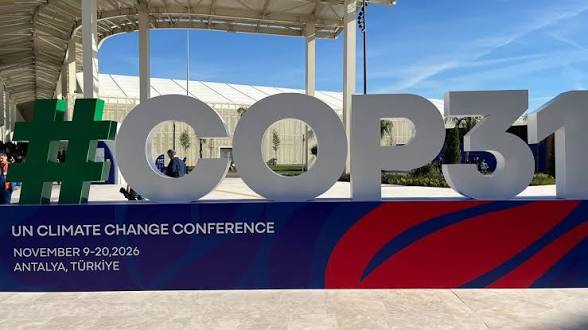
Ghana’s efforts to reduce methane emissions from landfills and expand its waste-to-resource industry could receive a new international opportunity following the launch of a fresh investment-focused programme at COP31 in Antalya, Türkiye.
The Climate and Clean Air Coalition (CCAC) on Monday, November 16, launched its 2026 Challenge Programme, titled Unlocking Value from Organic Waste, inviting proposals for commercially viable solutions that can turn organic waste into economic resources while reducing greenhouse gas emissions.
The initiative is designed to move beyond isolated waste-management projects towards commercially sustainable models that can attract investment, build markets and create opportunities for local enterprises, cooperatives and communities.
Its launch comes at a relevant time for Ghana, where the country’s climate commitments include expanding composting capacity, improving methane recovery at engineered landfills and scaling up institutional biogas facilities.
The CCAC said the new call for proposals opened on November 16 and will close on December 31, 2026.
The programme’s emphasis on commercial viability is significant because waste management in many developing economies continues to face challenges around financing, collection infrastructure, sorting and the availability of reliable markets for recovered materials.
For Ghana, the opportunity is not simply to divert more waste from disposal sites, but to develop projects capable of generating revenue from compost, biogas and other recovered resources.
Methane Reduction Presents An Economic Opportunity
Organic waste releases methane when it decomposes under conditions with little or no oxygen, particularly in dumpsites and landfills. Methane is a powerful greenhouse gas and a major contributor to near-term global warming.
Addressing emissions from waste has therefore become an important part of the climate agenda at COP31, particularly as governments look for interventions that can produce measurable results within shorter periods.

Speaking at the Leaders-Level Non-CO₂ Greenhouse Gases Summit at COP31 on November 12, UN Climate Change Executive Secretary Simon Stiell argued that methane reduction could deliver economic and environmental benefits simultaneously.
“It is one of the fastest, cheapest and most effective ways to check global heating in the near-term. While boosting economies, harvests, and health.”
Stiell also pointed to the financial potential of capturing methane from waste rather than allowing it to escape into the atmosphere.
“Seventy-five percent of methane reductions in the solid waste sector can even save money: that means the value of captured methane can outweigh investment.”
He further cited findings by the United Nations Environment Programme (UNEP) and the CCAC, stating that:
“Every dollar invested in key super-pollutant solutions delivers $15 in economic gains alone.”
The argument strengthens the case for treating organic waste as an economic resource rather than solely a sanitation problem.
Composting can produce soil-improving materials, while anaerobic digestion can convert biodegradable waste into biogas for energy use. Better collection and separation systems can also reduce the volume of organic material reaching landfills.
Ghana’s 2030 Waste Commitments
Ghana already has specific waste-sector interventions under its Nationally Determined Contribution (NDC), which sets out the country’s climate mitigation and adaptation commitments.
The Ghana Carbon Registry identifies three major actions under the sanitation and waste-management programme: building and operating three engineered landfills with 50 per cent methane recovery in Kumasi, Nsawam and Kpone, doubling existing waste-to-compost capacity from 200 tonnes per day to 400 tonnes per day by 2030 and Scaling up 200 institutional biogas facilities.

These commitments provide a framework for connecting Ghana’s waste-management priorities with the commercial opportunities highlighted by the CCAC programme.
However, achieving them requires more than identifying suitable technologies. Projects must have reliable waste supplies, effective separation systems, appropriate infrastructure, technical expertise and markets for the products generated.
The proposed international programme could therefore be relevant to Ghanaian enterprises and local authorities seeking to develop commercially viable waste-processing projects, subject to the call’s eligibility and application requirements.
From Waste Collection To Commercial Projects
The CCAC’s approach reflects a broader shift in international climate discussions towards solutions that can attract investment and sustain themselves beyond initial project support.
At COP31, the coalition also emphasised the importance of moving from individual waste-management interventions towards coordinated systems that connect waste reduction, collection, processing, markets and local economic activity.
Stiell said the task was now to ensure that national commitments were translated into practical action.
“The task now is to turn those plans into action.”
He urged governments to prioritise methane reduction in their national climate plans and support implementation through policies, financing and stronger institutions.
“Third, invest in institutions, technical capacity and project pipelines.”
That emphasis on project pipelines is particularly relevant to Ghana, where the existence of national waste targets does not automatically translate into investment-ready facilities or adequate funding for local authorities.
The country will need to strengthen the link between waste collection, source separation, composting, biogas production and the commercial use of recovered materials.

The CCAC programme could provide a platform for advancing such approaches, although the coalition has not announced a specific allocation for Ghana or guaranteed funding for any Ghanaian applicant.
For Ghana, the significance of the November 16 announcement lies in the opportunity to connect its existing methane-reduction commitments with commercially sustainable waste projects.
The challenge will be to develop proposals that can demonstrate measurable emissions reductions while creating viable businesses, improving sanitation and expanding the economic value of resources currently discarded as waste.
READ ALSO: Minority Accuses NDC of Hypocrisy Over Presidential Jet Acquisition