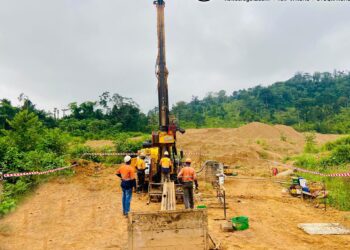
The Petroleum Commission’s engagement with PEGIS Global Services Limited as the Nigerian oilfield services company considers establishing a presence in Ghana is bringing renewed attention to how foreign investment can strengthen the country’s upstream petroleum industry without undermining opportunities for indigenous businesses.
The discussions provided PEGIS with an opportunity to understand Ghana’s regulatory requirements, local content framework and potential business opportunities, while exploring possible partnerships within the upstream petroleum sector.
Although the engagement does not amount to a confirmed investment or contract award, it represents an early step in the company’s assessment of Ghana as a potential market for its services.
PEGIS operates in several areas of the oil and gas services industry, including wellhead maintenance, well intervention, operations and maintenance, procurement, marine services, instrumentation and control, consultancy and technical training.
Its interest in Ghana could therefore create opportunities in specialised upstream services, depending on the company’s eventual investment decisions, regulatory approvals and ability to meet the requirements of operators and contractors.
However, the significance of the engagement extends beyond attracting another service provider. Ghana’s ability to secure lasting benefits from prospective entrants will depend on whether their participation strengthens domestic capabilities, creates business opportunities for local firms and facilitates the transfer of technical expertise.
Local Content Must Shape Market Entry
Ghana’s local content framework is designed to ensure that participation by foreign companies contributes to the development of domestic businesses and technical capacity.
The Petroleum (Local Content and Local Participation) Regulations, 2013 (L.I. 2204) establish this objective clearly, requiring the industry to prioritise local expertise, goods, services, businesses and financing.

Regulation 1 states that the purpose of the framework is to:
“Promote the maximisation of value-addition and job creation through the use of local expertise, goods and services, businesses and financing in the petroleum industry value chain and their retention in the country.”
The regulations also seek to develop local capacity through education, skills transfer, technology transfer and research and development, while improving the international competitiveness of Ghanaian businesses.
For PEGIS, understanding these requirements will be important in determining how it can participate in the market.
A prospective entrant must consider not only the services it can offer but also how its operations can align with the country’s local participation objectives.
This is particularly relevant in specialised areas such as well intervention and wellhead maintenance, where technical expertise, equipment availability, safety standards and operational experience can influence the competitiveness of service providers.
Partnerships with established Ghanaian companies could provide one route for combining international experience with local knowledge, personnel and business capacity.
Such arrangements, however, would need to deliver substantive participation rather than serve merely as formal relationships designed to satisfy regulatory requirements.
Regulatory Requirements Remain Central
The Petroleum Commission, established under the Petroleum Commission Act, 2011 (Act 821), regulates and manages the utilisation of petroleum resources and coordinates policies in Ghana’s upstream petroleum sector.
Companies seeking to provide goods or services to the industry are required to register with the Commission and obtain the appropriate permit before commencing operations.

The registration process involves meeting corporate, financial, tax, health, safety and environmental documentation requirements, alongside the applicable conditions for the specific category of services being offered.
These requirements are intended to ensure that companies entering the upstream industry have the necessary capacity and compliance systems to operate within Ghana’s regulatory environment.
The Commission has also been pursuing measures to make the regulatory process more efficient for prospective investors and existing operators.
At the November 2026 Local Content Conference and Exhibition in Takoradi, Acting Chief Executive Officer Victoria Emeafa Hardcastle announced the introduction of a digital permit application platform to replace the previous hard-copy process.
She emphasised the importance of an adequately resourced regulator in attracting and retaining investment.
“Given the increasing complexity of the global energy landscape and the need to attract and retain investments in Ghana’s upstream sector, a well-resourced regulator is indispensable,” she said.
The platform is expected to reduce administrative bottlenecks and improve service delivery, potentially making regulatory interactions more efficient for companies considering entry into the sector.
Ghanaian Service Providers Must Also Benefit
The prospective entry of another international service company raises an important question about how Ghanaian businesses can benefit from increased competition and investment in the upstream services market.
Foreign companies can bring specialised equipment, technical expertise and operational experience that may not be readily available locally.
However, these advantages will have greater long-term value if they also help strengthen the capabilities of Ghanaian businesses.

In October 2026, The Vaultz News examined this issue in its reports, Ghana’s Upstream Industry Faces Local Capacity Test and Petroleum Commission Wraps Up Western Region Company Visits.
Those reports highlighted the importance of ensuring that engagement between the regulator and indigenous service providers translates into stronger technical capabilities, access to contracts and greater participation in higher-value petroleum activities.
The PEGIS engagement presents a related but different dimension: how the entry of an external service provider could complement the development of the domestic oilfield services industry.
For Ghanaian companies, potential benefits could include subcontracting opportunities, technical collaboration, specialist training and access to knowledge that strengthens their ability to compete for more demanding upstream assignments.
For these outcomes to materialise, partnerships would need to be supported by clear arrangements on local participation, workforce development and the sharing of technical expertise.
The Petroleum Commission’s recently launched Local Content Fund, which is intended to support indigenous small and medium-sized enterprises in the petroleum industry, also reflects the importance of strengthening the domestic businesses expected to participate in this expanding market.
From Initial Engagement To Measurable Participation
The Commission’s engagement with PEGIS comes at a time when Ghana is seeking to attract investment and improve the competitiveness of its upstream petroleum industry.
The potential entry of service companies with experience in specialised oilfield operations could widen the range of technical capabilities available to operators and contractors.

However, the engagement announcement does not identify any signed partnership, investment commitment, contract award or confirmed timeline for PEGIS to commence operations in Ghana.
It also does not specify which Ghanaian companies the prospective entrant may partner with or the number of jobs and training opportunities that could emerge.
These are important details that will determine the practical value of the company’s interest in the market.
Ultimately, the success of the engagement should not be measured solely by whether PEGIS establishes a presence in Ghana.
It should also be assessed by whether its participation strengthens local suppliers, develops Ghanaian technical expertise and retains a greater share of petroleum-sector value within the country.
For the Petroleum Commission, the challenge is to make Ghana attractive to capable investors while ensuring that the local content framework remains central to the development of the upstream industry.
READ ALSO: GNPC Deepens Gambia Partnership Through Upstream Training