
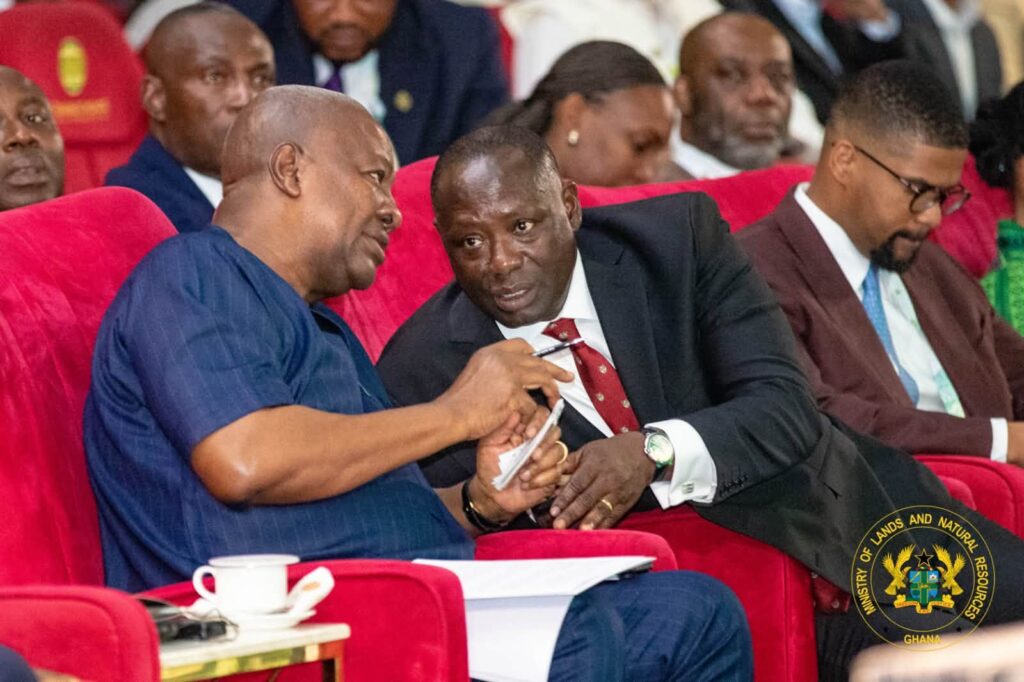
Minister for Lands and Natural Resources, Hon. Emmanuel Armah-Kofi Buah, has challenged Newmont Corporation to spearhead Ghana’s next phase of industrial mineral transformation by championing local value addition, technology transfer, and domestic supplier development across its operations.
Speaking on behalf of President John Dramani Mahama during Newmont’s 20th-anniversary celebration of commercial gold production in Kenyasi, Ahafo Region, the Minister signalled that the state expects multinational mining giants to transition beyond primary extraction toward building self-sustaining local industrial ecosystems.
While commending the American mining powerhouse for two decades of operational stability, economic contributions, and collaborative land reclamation efforts in areas scarred by illegal mining, Mr. Armah-Kofi Buah stressed that future licensing and partnership benchmarks will increasingly hinge on measurable in-country economic retention.
Representing the presidency before traditional authorities (Nananom), mine workers, contractors, and host community leaders, he linked Newmont’s technical capacity directly to the administration’s broader policy drive to anchor downstream processing, indigenous engineering, and youth skills training within Ghana’s borders before raw bullion leaves the country.
“As we look ahead, I invited Newmont to become a trailblazer in local value addition, technology transfer, supplier development and the training of Ghanaian professionals to also support our Responsible Cooperative Mining and Skills Development Programme (rCOMSDEP).”
Hon. Emmanuel Armah-Kofi Buah
Dismantling the Raw Extraction Paradigm
For decades, Ghana’s status as Africa’s premier gold producer has stood in sharp contrast to the limited domestic retention of capital across its mineral value chain.
Historically, the export of doré bars and unrefined bullion has transferred the most lucrative downstream segments refining, assaying, jewelry fabrication, and specialized equipment manufacturing to offshore jurisdictions.
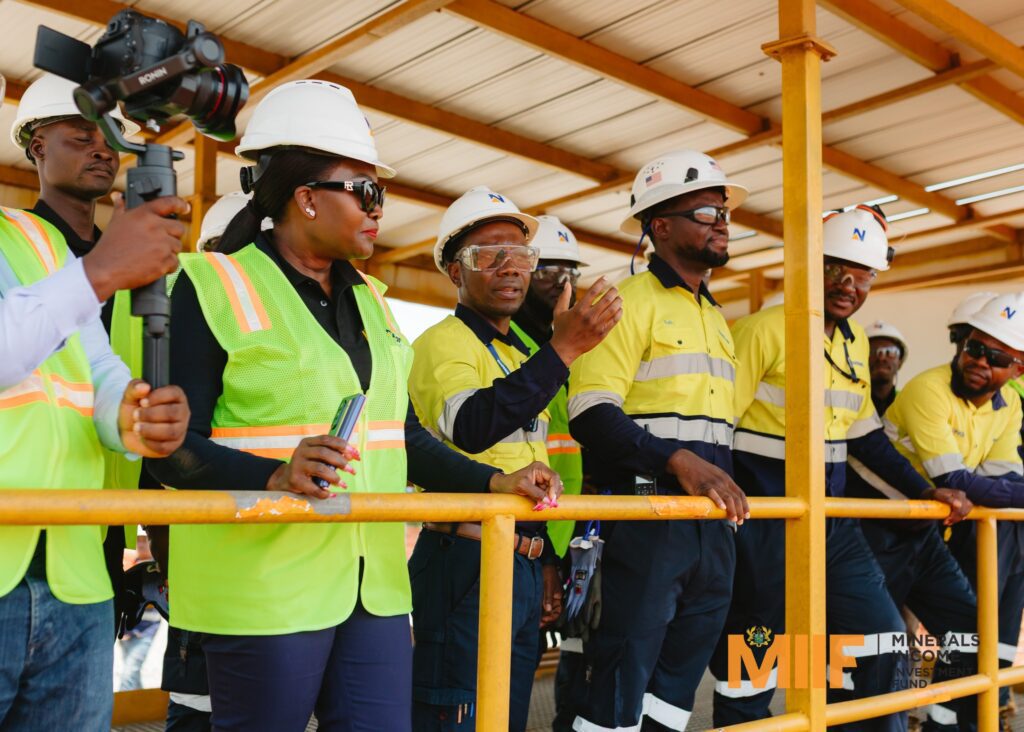
According to policy frameworks under the Minerals and Mining (Local Content and Local Participation) Regulations, 2020 (L.I. 2431), closing this structural leakage requires multinational operators to actively incubate domestic enterprises capable of meeting international procurement standards.
The government’s renewed push aligns with its overarching target to achieve full local processing of key strategic minerals by 2030.
“When gold leaves the ground, more skill, more enterprise, and more opportunity should remain in Ghana,” Mr. Armah-Kofi Buah noted in his address, emphasizing that mineral wealth is finite and must be converted into enduring human and industrial capital.
By urging Newmont to deepen collaborations with Ghanaian firms in precision engineering, fabrication, maintenance, and specialist technical services, Accra aims to transform local contractors from peripheral service providers into internationally competitive tier-one suppliers.
Integrating Tier-One Expertise into Cooperative Artisanal Reforms
A central pillar of the Minister’s charge involves bridging the persistent operational divide between large-scale corporate miners and the artisanal and small-scale mining (ASM) sub-sector.
Illegal mining, widely known as galamsey, has inflicted severe ecological damage on Ghana’s forest reserves and water bodies, prompting the administration to roll out the Responsible Cooperative Mining and Skills Development Programme (rCOMSDEP) as a structured formalization vehicle.
Under rCOMSDEP, small-scale operators are organized into regulated, locally owned cooperatives granted access to vetted concessions, shared mercury-free processing plants, and modern water treatment systems.
However, technical skill deficits and poor geological recovery rates remain significant hurdles for emerging cooperatives.
By inviting Newmont to lend its world-class geological, metallurgical, and environmental management expertise to rCOMSDEP trainees, the Ministry seeks to institutionalize knowledge transfer.
Replicating Newmont’s documented track record in reclaiming degraded lands within cooperative frameworks could accelerate environmental restoration while providing viable, legal livelihoods for youth across mining districts.
The Imperative for Domestic Supply Chain Sovereignty
The economic rationale behind compelling established multinationals to localize technology and procurement is reinforced by global commodity shifts and domestic fiscal pressures.
Although recent fiscal reforms including Ghana’s sliding-scale mineral royalty regime have bolstered direct state revenue collections from large-scale operators, royalties and corporate taxes alone cannot insulate the economy from external price shocks or resource depletion.

True economic resilience depends on backward and forward linkages that keep procurement expenditure circulating within the domestic financial system.
Industry analysts point out that while Ghanaian nationals occupy a growing share of operational roles in large mines, high-value service contracts and advanced technological applications remain heavily reliant on expatriate vendors.
“We cannot measure the value of our gold only by what it leaves our shores; we must also measure the skills, industries and enterprises it helps build,” the Minister underscored, framing technology transfer not merely as corporate social responsibility, but as a strategic economic imperative.
READ ALSO: GH¢14.35bn Revenue Gap Puts Customs Brokers Under Pressure