
Elliot Twum, Senior Vice President and Managing Director of Gold Fields Ghana Limited, has highlighted a massive operational turnaround at the Tarkwa Mine, revealing that average annual gold output has surged to 500,000 ounces from roughly 12,000 ounces when the company assumed control of the asset.
This more than forty-fold expansion reflects over three decades of sustained capital allocation, shaft rehabilitation, and the strategic pivot from depleted underground workings to high-volume surface mining.
Beyond sheer production numbers, the transformation underscores how modernizing legacy extractive infrastructure can rescue distressed state assets and anchor national fiscal stability.
When Gold Fields entered Tarkwa in 1992, the operation was trapped in severe economic decline, requiring continuous government subsidies merely to cover worker salaries, contractor bills, and essential chemical reagents for ore processing.
By replacing aging mechanical systems and aggressively pursuing surface exploration, the company converted a cash-draining liability into one of Ghana’s premier industrial contributors.
“Today, we produce an average of 500,000 ounces of gold a year, compared to about 12,000 ounces when Gold Fields took over Tarkwa.”
Elliot Twum
Turnaround from Underground Decline to Surface Scale
The structural crisis facing Tarkwa in the early 1990s stemmed directly from the geological and economic constraints of underground extraction.
Unlike open-pit operations, underground mining restricts access to massive rock volumes, meaning profitability depends entirely on extracting high-grade ore concentrations. As those rich underground veins depleted over decades of prior exploitation, falling ore grades rendered the mine commercially unviable.
Reflecting on the precarious state of the business prior to the takeover, Mr. Twum explained that “when you are depleting your grades, the grades are declining underground in underground operation. It doesn’t make it anymore economic. And that’s the stage we were at when Gold Fields took over in Tarkwa.”
Without high-grade material to offset fixed hoisting and ventilation costs, the state-run entity could no longer sustain basic operational liquidity.
To arrest the collapse, Gold Fields initiated a two-pronged recovery strategy that kept the legacy mine running while preparing a completely new operational model.
Engineers refurbished dilapidated shaft infrastructure and winding machinery critical systems responsible for transporting personnel underground and hauling ore to the surface while simultaneously launching an aggressive surface prospecting campaign.
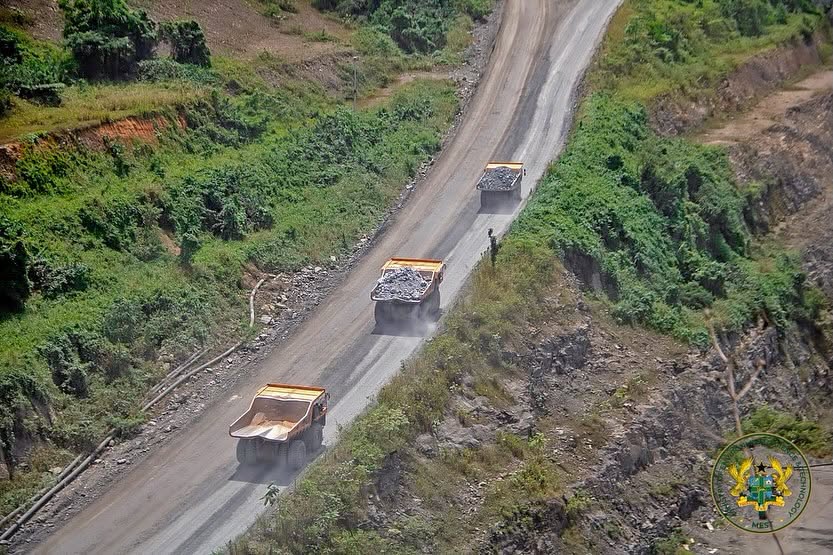
Over a five-year transition period, the company committed more than US$50 million to establish a dedicated surface mining operation by 1998, unlocking consistent, lower-grade deposits through large-scale earthmoving.
Capital Injection and Technological Modernization Drive Unit Cost Efficiency
Sustaining a 500,000-ounce annual run rate at Tarkwa requires mastering industrial scale and rigorous cost discipline.
Because Tarkwa’s surface ore body is characterized by relatively low gold grades within high-strength rock formations, economic success hinges on moving enormous tonnages efficiently.
Each year, the operation excavates roughly 100 million tonnes of material, of which only about 10 million tonnes represent gold-bearing ore, while 90 million tonnes are moved as waste.
Mr. Twum emphasized that deploying modern mining technology was essential to stretch the lifespan of existing assets and compress expenses, noting that “mining is about effectiveness and efficiencies. And if you’re able to mine a lot more efficient, you are able to reduce your unit cost of production. And that allows you to run longer than you would have.”

Over the past 30 years, cumulative capital expenditure at Tarkwa has surpassed US$5 billion, transforming the site into a flagship contributor to Ghana’s extractive economy.
Through taxes, royalties, salaries, and domestic supply chains, seventy-four cents of every dollar generated by the operation remains within the Ghanaian economy.
Over the past five years alone, the company channeled US$4.6 billion into local and host-community procurement contracts, while supporting roughly 5,640 direct employees and business-partner contractors, with Ghanaians accounting for 99 percent of the workforce and host-community residents representing 70 percent.
Strategic Imperative Ahead of April 2027 Mining Lease Renewal
The push to detail Tarkwa’s thirty-year industrial evolution comes at a pivotal regulatory juncture for Ghana’s extractive sector.
Following a request from the government, Gold Fields submitted an early formal application in November 2025 to renew its five Tarkwa mining leases ahead of their scheduled expiration in April 2027.

In an environment marked by heightened public scrutiny and competing local calls over mineral resource governance and fiscal returns, demonstrating tangible historical value creation has become vital for securing long-term policy certainty.
Maintaining operational continuity through a renewed lease agreement is not merely about preserving historical gains; it is the prerequisite for unlocking the next wave of multi-billion-dollar capital deployment.
Management has outlined an estimated US$7.5 billion investment pipeline designed to sustain and develop the Tarkwa operation over the coming two decades.
By proving that disciplined engineering and capital risk-taking turned an insolvent underground mine into a 500,000-ounce powerhouse, Gold Fields is making the commercial case that stable tenure remains essential for maximizing sovereign mineral wealth.
READ ALSO: Ghana’s Trade Surplus Hits US$13.02bn as Exports Surge