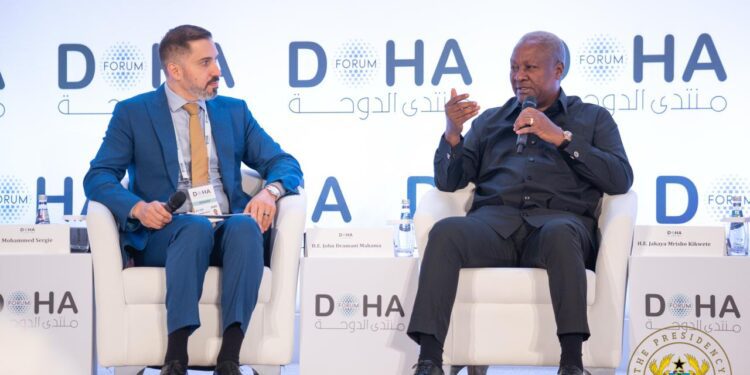
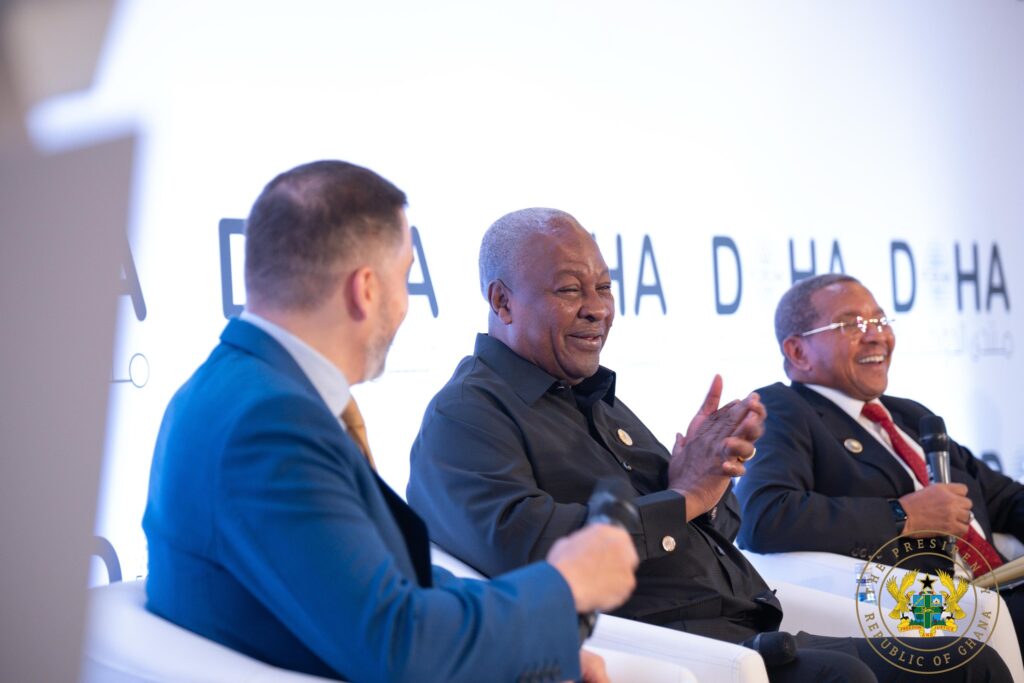
President John Dramani Mahama has delivered a compelling call for global commitment to educational justice at the 23rd Doha Forum in Qatar, urging world leaders, policymakers, and humanitarian actors to elevate education as a lifesaving priority in an era defined by overlapping crises.
Addressing an audience of global stakeholders, President Mahama framed education not merely as a social service but as a moral imperative embedded in Ghana’s constitutional values and essential to global stability, justice, and peace.
President Mahama began by extending warm greetings from Ghana and expressing deep appreciation to the Qatari government for its sustained leadership in global dialogue. He anchored his message on Article 25 of Ghana’s 1992 Constitution, which guarantees every citizen the right to equal educational opportunities and mandates free and compulsory basic education.
“This foundational article captures the soul of our national commitment that education is not a privilege, nor is it an afterthought of government policy, but an inherent right, a necessary condition for the dignity, empowerment, and full realisation of every citizen.”
President John Dramani Mahama
President Mahama argued that the world’s current challenges—ranging from conflict and climate instability to pandemics and economic shocks—do not merely destabilize nations but disrupt childhoods and dreams.



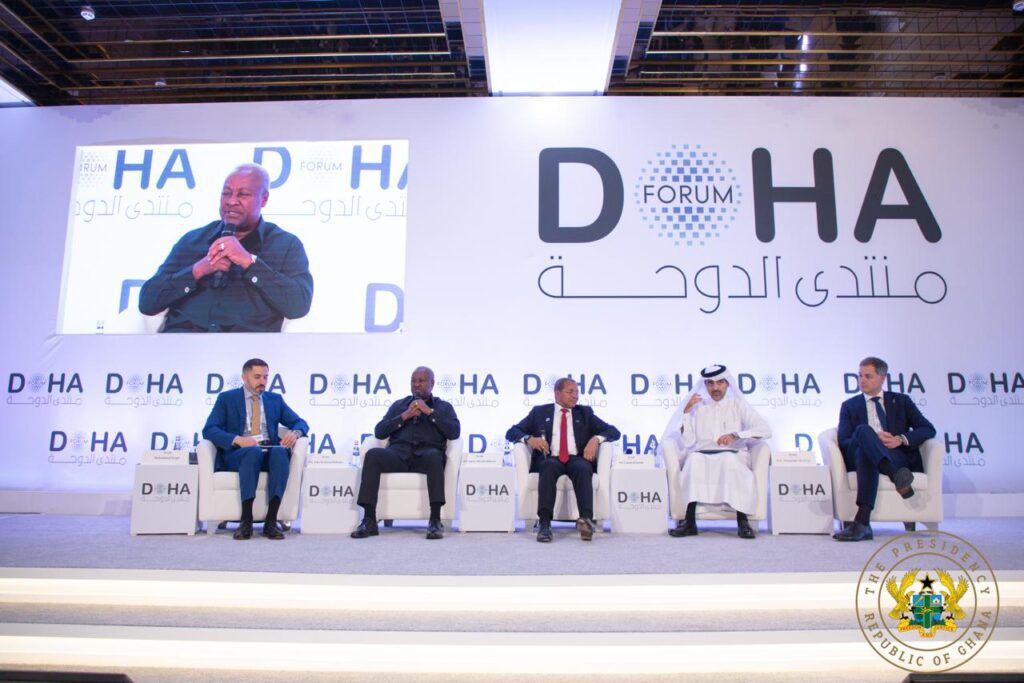
In this context, he insisted, education becomes “the battleground for justice.” He elaborated that education is justice when children displaced by war retain a pathway to their future; when children with disabilities receive targeted support; and when learning continues in spite of pandemics or disasters. Ultimately, education equips young people to rebuild communities and lead transformation.
Education as Lifesaving Response
The President stressed that education must be treated as a lifesaving response, not an optional service, during emergencies. He commended awardees Alex Theer and Saad Moseni for their work in closing learning gaps in crisis-affected societies, praising the Doha Forum for spotlighting educational resilience amid conflict.
Turning to global hotspots such as Gaza, Afghanistan, and Sudan, President Mahama described the mass disruption of education in these places as “an unfolding humanitarian tragedy that will play out for decades to come.”
He contrasted this with Ghana’s own experience, noting that resilient nations are those that prioritize education even under duress. He highlighted Ghana’s investments in free basic and secondary education, TVET expansion, and digital literacy as proof of sustained national commitment.
Reflecting on the global response to COVID-19, he said the pandemic demonstrated how innovative solutions—such as radio and TV learning programmes, remote learning platforms, and community-based teaching—kept education alive.
These adaptations, he noted, were acts of justice, ensuring no child was abandoned. For President Mahama, the lesson from COVID-19 is clear: “Education systems can be built with resilience at their core.”
President Mahama urged leaders to ensure classrooms are not the first institutions to close during crises nor the last to reopen. He stressed the urgency of this message for Africa, where over 30 million children remain out of school, and millions more attend school without learning.
Climate-related disasters, digital divides, and socio-economic inequalities, President Mahama bemoaned, continue to worsen educational disparities across the continent.
Education Central to Fulfilling SDGs
Underscoring education’s central role in fulfilling the Sustainable Development Goals, President Mahama explained that progress on poverty reduction, gender equality, health, climate action, economic growth, and peaceful institutions is impossible without quality education.
“Education illuminates the path to every other goal. It empowers individuals. It strengthens institutions. It transforms nations,” he said. President Mahama outlined a set of global commitments necessary to advance education as justice. He called for protecting education budgets during national crises, warning that “economic austerity should not begin in the classroom.”
He also urged governments to integrate education into humanitarian response plans, ensure school safety, accelerate digital inclusion, invest in digital infrastructure and teacher training, and strengthen global partnerships for equitable learning.
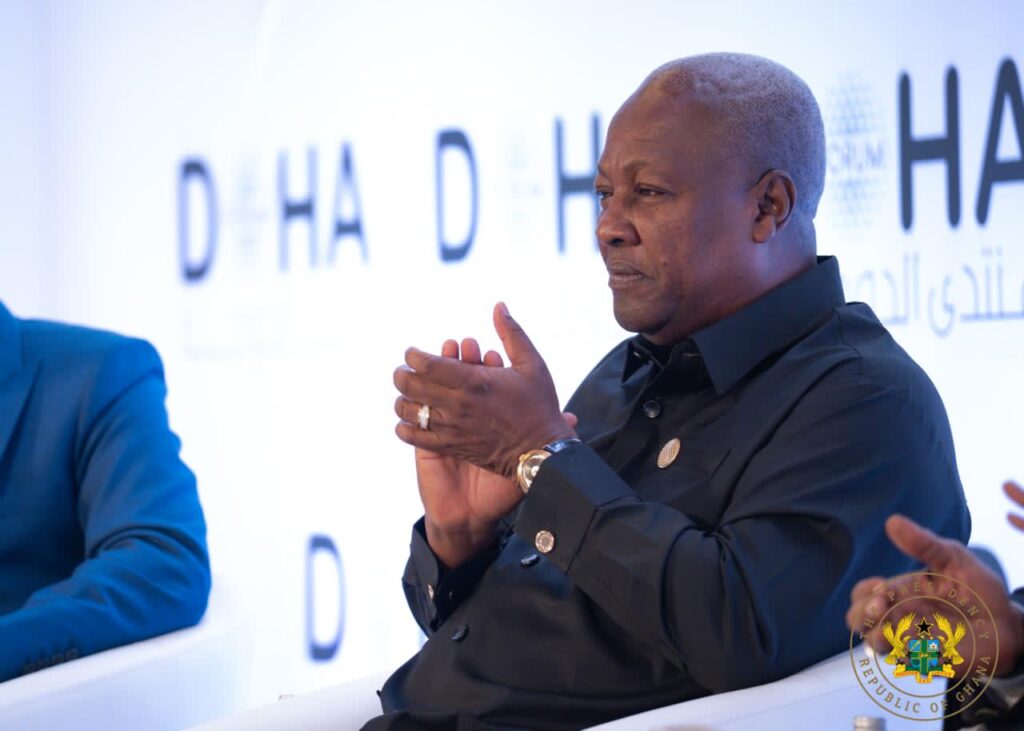
With rapid technological and environmental shifts reshaping the world, President Mahama said education must evolve accordingly. It must prepare young people to adapt to climate shocks, navigate digital disruption, participate in democratic governance, contribute to peaceful societies, and succeed in an innovation-driven global economy.
In his words, “Education must be transformational, not transactional. It must be equitable, not exclusive. It must be forward-looking, not outdated.”
President Mahama closed his address with a powerful reflection on the everyday moments in which justice reveals itself: a child learning to read, a young woman discovering her love for science, a displaced child finding hope in a classroom, or a teacher inspiring the next generation. “Justice is not only delivered in the courtrooms,” he reminded the audience. “Justice lives in the classrooms.”
Ending with a call for collective responsibility, he invoked an African proverb: “Knowledge is like a garden. If it is not cultivated, it cannot be harvested.” He urged the global community to cultivate the seeds of justice through education so the world may reap a harvest of peace, prosperity, and shared humanity.
READ ALSO: Time for Mineral Revenue Management Law – Michael Akafia