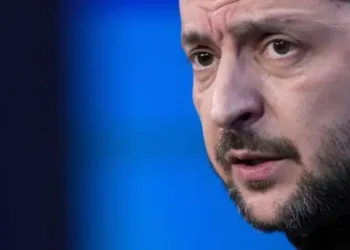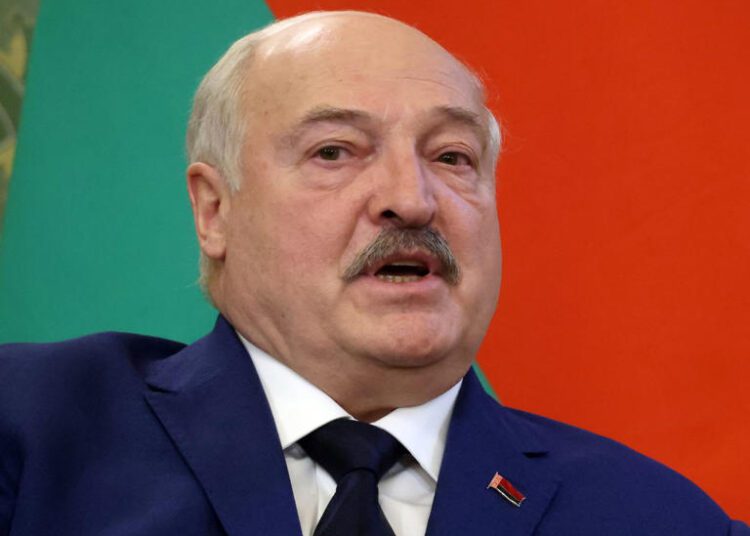
Ukraine’s President, Volodymyr Zelenskyy has announced new sanctions against Belarusian President Alexander Lukashenko, accusing him of enabling Russia’s war effort.
In a statement, Zelenskyy said that Ukraine “will significantly intensify countermeasures against all forms of his assistance in the killing of Ukrainians,” referring to Lukashenko.
The sanctions mark a further deterioration in relations between Kyiv and Minsk, as Ukraine continues to confront Russia’s full-scale invasion.
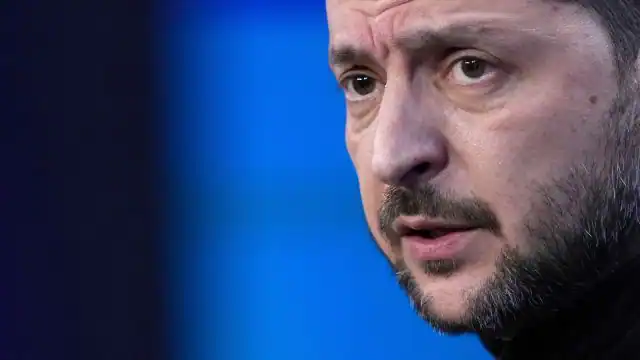
Zelenskyy accused Belarus of playing a direct supporting role in Russian military operations. He said that Belarus has enabled Russia to carry out a number of its attacks, particularly those targeting energy facilities and railways across Ukraine.
By stating that Belarus has enabled “a number” of these attacks, Zelenskyy suggested that Minsk’s cooperation extends beyond symbolic political support.
However, Belarus has previously maintained that it is not a direct participant in the fighting, even as it has deepened ties with Russia.
Since the start of the war, Ukraine’s energy infrastructure and transport networks have been frequent targets, with officials in Kyiv describing them as critical to both civilian life and military logistics.
According to Zelenskyy, Belarusian enterprises have been drawn into supporting Moscow’s war machine.
“More than 3,000 Belarusian enterprises have been put at the service of Russia’s war and supply machinery, equipment, and components categorised as ‘critically important’, including components for the production of missiles that terrorise our cities and villages.”
Volodymyr Zelenskyy
Kyiv’s decision to impose sanctions on Lukashenko personally is a political step as well as an economic one. Sanctions can include restrictions on assets, financial transactions and travel, depending on their scope.

While Zelenskyy did not detail the specific measures involved, his language emphasized determination to respond forcefully to what he views as Belarus’s role in the war.
Zelenskyy’s reference to missile production components highlights concerns about the sustained capacity of Russia’s military-industrial complex.
According to his statement, some of these components are used in missiles that “terrorise our cities and villages,” underscoring the human impact of the weapons systems involved.
Concern Raised About Infrastructure Development To Deploy Oreshnik

In addition to industrial support, Zelenskyy raised concerns about new military infrastructure developments in Belarus. He said that infrastructure is being developed to deploy the Oreshnik missile system on Belarusian territory.
The Oreshnik is an intermediate-range ballistic missile that can travel at speeds of at least Mach 5, five times the speed of sound, and can manoeuvre mid-flight, making it harder to track and intercept.
The potential deployment of such a system in Belarus would mark a significant development in the regional security landscape.
By highlighting the Oreshnik, Zelenskyy signaled concern not only about current cooperation between Minsk and Moscow but also about possible future military capabilities stationed closer to Ukraine’s borders.
Zelenskyy’s announcement reflects Ukraine’s broader strategy of applying diplomatic and economic pressure on states it accuses of supporting Russia’s invasion.
Since the start of the war, Kyiv has sought to isolate Moscow and discourage third-party assistance through sanctions and international advocacy.
The new measures against Lukashenko signal that Ukraine considers Belarus’s actions sufficiently consequential to warrant direct penalties.
By coupling sanctions with a pledge to “significantly intensify countermeasures,” Zelenskyy indicated that Kyiv may pursue additional steps in response to what it sees as escalating cooperation between Minsk and Moscow.
Zelenskyy’s statement highlights Kyiv’s position that Belarus’ involvement, whether through territory, industry or potential missile deployment, constitutes a direct threat to Ukrainian security.
The sanctions represent both a political message and a concrete measure aimed at addressing that perceived threat.
As the conflict continues, the relationship between Ukraine and Belarus remains strained.
READ ALSO: Philippine Vice President Announces Bid For Presidency