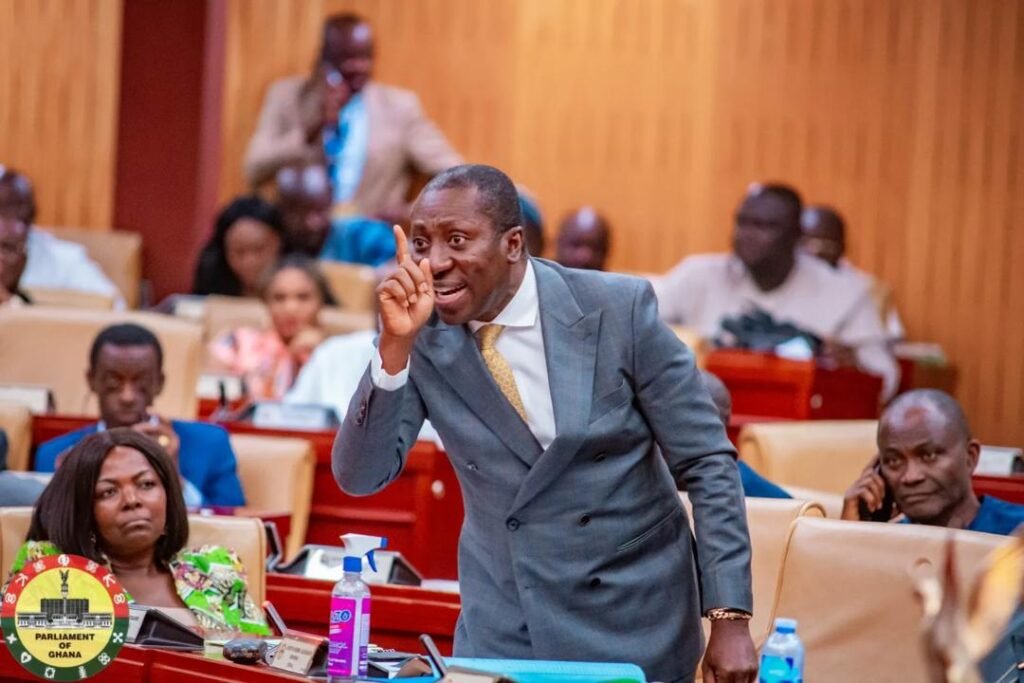
Minority Leader in Parliament, Hon. Alexander Afenyo-Markin, has sparked a fresh debate over the origins of Ghana’s strategic economic interventions, asserting that the “Gold for Reserve” policy is the intellectual product of former Vice President Dr. Mahamudu Bawumia.
Speaking after the State of the Nation Address (SONA) delivered by the president of Ghana, John Dramani Mahama, the lawmaker argued that the current administration must acknowledge the foundational work laid by the previous government, particularly regarding the accumulation of gold to shore up the national currency.
“The Bawumia they attack is the brainchild of this policy. Mr. Speaker, I would want to urge the government give to Bawumia what belongs to Bawumia. Our elders say give credit where credit is due.”
Hon. Alexander Afenyo-Markin
Afenyo-Markin’s remarks come at a time when the government is touting significant macroeconomic gains, including a stabilized Cedi and improved international reserves.
He maintained that these achievements are not accidental but are the direct result of the “innovative thinking” introduced by Dr. Bawumia during his tenure.
The Minority Leader’s stance challenges the narrative of the current administration, urging them to “give credit where credit is due” as they navigate the complexities of the extractive sector and national reserve management.
The Minority Leader was emphatic about the lineage of the policy during his address to the House. He noted that the very strategy now being used to buffer the economy against external shocks was once a point of ridicule by those now implementing it.
Strengthening the National Buffer: The Gold for Reserve Strategy

The significance of the Gold for Reserve policy, originally conceptualized as part of a broader “Gold for Oil” and “Domestic Gold Purchase” framework, has become a cornerstone of Ghana’s recent economic resilience.
Historically, Ghana’s gold reserves remained stagnant at approximately 8.7 tonnes for over six decades. However, following the implementation of this strategic shift, the Bank of Ghana’s reserves surged to over 30 tonnes by early 2025, providing a much-needed hedge against currency volatility.
Under the “Ghana Accelerated National Reserve Accumulation Policy” (GANRAP) presented to Parliament this week by Finance Minister Dr. Cassiel Ato Forson, the state aims to further increase international reserves to 15 months of import cover by 2028.
This evolution of the original brainchild aims to reduce Ghana’s reliance on expensive Eurobonds and commercial borrowing.
By leveraging the extractive sector specifically through the mandatory purchase of 20% of gold from large-scale miners and mopping up artisanal gold, the policy has successfully stabilized the Cedi from a “free fall” and contributed to the current surplus in the primary balance.
Extractive Governance and Future Economic Stability

Many experts and analysts argued that, the policy represents a paradigm shift in how Ghana manages its mineral wealth.
Instead of merely exporting raw gold for foreign currency, the state is now increasingly “internalizing” its gold output to build a physical reserve.
This has not only improved market sentiment but has also supported the Bank of Ghana’s ability to intervene in the forex market without depleting liquid cash reserves.
The implementation of the Ghana Gold Board Act, 2025, further solidifies this framework, ensuring that the, “brainchild” of the previous administration remains a permanent fixture in Ghana’s fiscal toolkit.
While political debates continue over who deserves the most praise, the extractive industry’s role in providing the “strategic anchor” for the nation’s 6.1% GDP growth in 2025 remains indisputable.
READ ALSO: Big Push Sees 73 Roads, 1,717Km Construction Nationwide – President Mahama