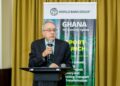
Ing. Wisdom Gomashie, a Mining Consultant and a Fellow at Africa Policy Lens (APL), has cast serious doubt on the government’s ambitious plan to source 127 metric tonnes of gold annually from the Artisanal and Small-scale Mining (ASM) sector under its newly introduced Ghana Accelerated National Reserves Accumulation Policy (GANRAP).
Speaking in an exclusive interview with The Vaultz News, Ing. Gomashie argued that the current production capacity of licensed small-scale mining companies is fundamentally incapable of meeting such a high-volume target.
He noted that the existing operational strength of licensed entities “cannot produce even 40%” of the state’s projected 127-ton goal, suggesting a significant disconnect between official policy and the reality of the country’s mineral output.
“The licensed small-scale mining companies in the country as we speak today cannot produce 40% of that 127 tons. I am saying this on authority and confirming to the point that majority of gold that is being bought by Gold Board even in the past in the previous administration came from illegal mining sources.”
Ing. Wisdom Gomashie

The mining policy expert further alleged that a substantial portion of the gold historically purchased by state agencies, including the Precious Minerals Marketing Company (PMMC) and the newly established Ghana Gold Board, is sourced from unregulated and illegal operations.
Mr. Gomashie contended that the government’s public emphasis on the National Anti-IllegalMining Secretariat (NAIMOS) serves a “psychological” purpose to manage public scrutiny rather than to genuinely halt illicit mining.
According to the mining consultant, while NAIMOS will be visible on the ground, the government is likely to prioritize achieving its procurement targets over strictly enforcing mining regulations, effectively absorbing “illegal mining gold” into the state’s formal reserves.
Traceability Crisis and Environmental Sustainability

For the 127-ton target to be met sustainably, the government must move beyond mere quantity and address the “traceability gap“.
To ensure that the Gold Board does not become an inadvertent “customer for galamsey,” the state must implement a rigorous digital tracking system that maps every gram of gold back to a verified, environmentally compliant concession.
Without such measures, the pursuit of these targets could lead to “compromising the environment” further, as the pressure to meet quotas might encourage the state to turn a blind eye to the destruction of water bodies and forest reserves as warned by experts including Mr. Gomashie.
Bridging the 40% Capacity Gap

The revelation that licensed miners cannot currently meet even half of the 127-ton target suggests that the government’s focus should shift toward “aggressive formalization” rather than just enforcement.
By providing licensed cooperatives with the “modern recovery technologies” mentioned in the Responsible Cooperative Mining and Skills Development Programme, the state could legally increase the yield of existing operations.
Strengthening the capacity of legal miners is the only way to meet the 127-ton threshold without relying on “illegal mining sources” to bridge the production deficit.
Reforming Market Incentives to Curb Smuggling

To truly “disincentivize smuggling” and ensure the target is met through legal channels, the Gold Board must consistently offer competitive pricing that mirrors the spot world market.
Ing. Gomashie’s critique signifies that as long as the state’s procurement strategy is viewed as a “psychological” exercise, illegal actors will continue to dominate the supply chain.
A sustainable solution requires the government to treat the 127-ton target as a “developmental milestone” rather than just a fiscal one, ensuring that the economic benefits of gold reach licensed miners while strictly excluding gold from devastated “galamsey” sites.