The industrial landscape of Ghana’s garment sector has reached a critical juncture with the Ministry of Trade, Agribusiness and Industry (MoTAI) hosting a high-level technical team from the United Nations Industrial Development Organization (UNIDO).
The strategic engagement, held at the Ministry’s headquarters in Accra, was designed to finalize the operational roadmap for a “Circular Textile Sector” – a move that signals Ghana’s intent to lead Africa in sustainable, closed-loop industrial manufacturing.
“For the Garment and Textiles Unit of the Ministry, this partnership is more than an environmental initiative; it is a structural ‘reset’ for a sector currently grappling with the dual challenges of global competition and the environmental burden of textile waste.
“By embedding circular economy principles into the national industrial agenda, the government aims to transform the 15 million pieces of secondhand clothing that enter Ghana weekly from a ‘waste liability,’ into a high-value industrial input”
MoTAI
A central pillar of the discussion was the feasibility of establishing Ghana’s first local closed-loop textile recycling facility. Unlike traditional waste management, which often results in downcycling, this facility is intended to process post-consumer textile waste back into virgin-quality fibers for new garment production.
This “cradle-to-cradle” approach is designed to reduce the sector’s dependence on imported raw materials, thereby stabilizing the Ghanaian Cedi by lowering the demand for foreign exchange in the textile supply chain.



“The UNIDO team presented key project outputs that emphasize the promotion of best practices in circular production. This involves a shift in factory floor operations, moving away from the linear ‘take-make-waste’ model toward a system where every scrap of fabric is captured, sorted, and re-integrated into the production line”
MoTAI
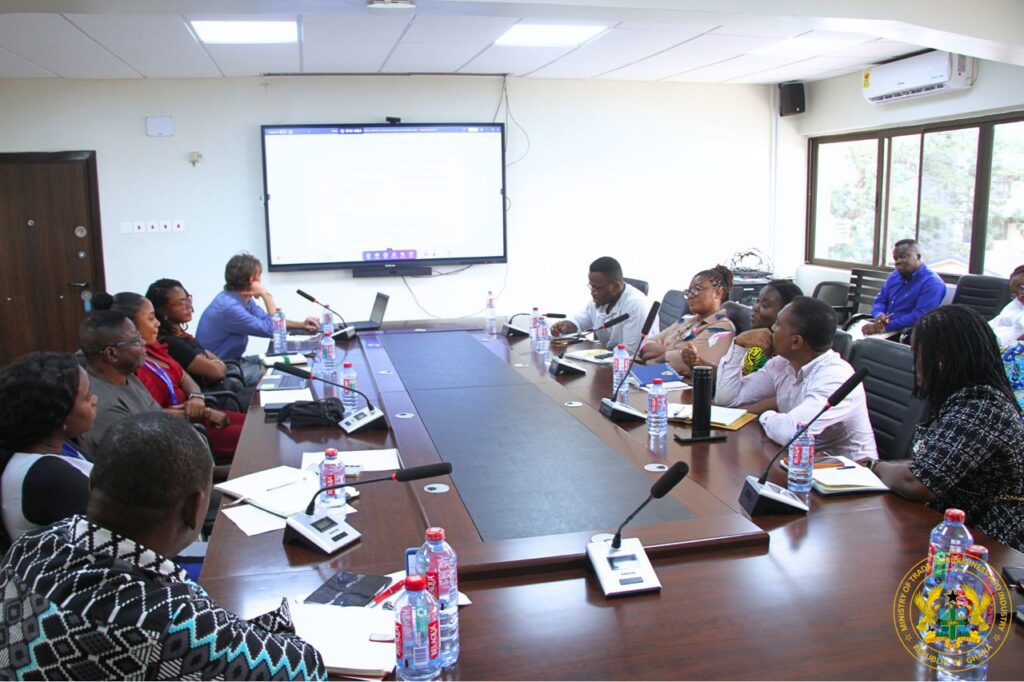
According to the team, this transition is backed by rigorous feasibility studies to ensure that the recycling infrastructure is not only environmentally sound but commercially profitable for private sector investors.
Among other priorities discussed were the promotion of best practices in circular production models, targeted support for small and medium-sized enterprises (SMEs) through access to technical equipment and specialized training.
Empowering SMEs
Recognizing that the backbone of Ghana’s textile industry is comprised of Small and Medium-Sized Enterprises (SMEs), the partnership designated specific interventions for local manufacturers.
The UNIDO-MOTAI framework will provide these businesses with access to specialized technical equipment – such as digital waste-tracking sensors and high-efficiency sorting machinery – that was previously out of reach for smaller players.
Beyond equipment, the initiative includes a robust training component. Local artisans and factory managers will receive specialized instruction on how to implement circularity at the design stage.
By designing garments for easier disassembly and recycling, Ghanaian manufacturers can meet the increasingly stringent “green” regulations of the European and North American markets, thereby boosting export competitiveness under the African Continental Free Trade Area (AfCFTA).
“Participants also explored measures to strengthen Ghana’s research institutions and deepen collaboration with relevant Italian and European partners to drive innovation and attract investment into the sector. The partnership is expected to enhance technical capacity while positioning Ghana to leverage global expertise in sustainable textile manufacturing”
MoTAI

Italy, a global leader in high-end textile machinery and circularity, was identified as a strategic partner to bridge Ghana’s technical gap. The UNIDO Italian Investment and Technology Promotion Office (ITPO Italy) will facilitate business missions and investment roadshows to bring Italian “circular tech” directly to the doorsteps of Ghanaian industrialists.
According to MoTAI, these technologies are capable of “detecting toxic components in discarded clothing and converting them into high-performance inputs,” for other industries, such as furniture, automotive components, and even construction insulation.
This cross-sectoral utility ensures that the “Textile Reset” creates a ripple effect across the broader industrial economy, generating thousands of new jobs in the “Green Economy,” investment promotion initiatives, business missions, and structured technology transfer arrangements.
Building Resilience
As the Ministry of Trade, Agribusiness and Industry accelerates its industrialization drive, the collaboration with UNIDO serves as a template for inclusive economic growth.
“The initiative marks a significant step in Ghana’s broader industrial transformation agenda, reinforcing efforts to build a resilient, environmentally sustainable textile industry that empowers local enterprises and promotes inclusive economic growth”
MoTAI
By transforming textile waste into valuable industrial inputs, Ghana is not only cleaning up its coastal lagoons and drainage systems but is also creating a self-sustaining manufacturing sector.
The initiative, alongside recent efforts by the Ghana Free Zones Authority, reinforces the government’s broader agenda to build an environmentally sustainable textile industry that empowers local enterprises.

As the technical teams move from consultation to implementation, the success of the circular textile sector will be measured by its ability to turn the “Dead White Man’s Clothes” (Obroni Wawu) into a vibrant, “Made in Ghana” industrial success story.
READ ALSO: Africa’s Energy Sovereignty Tested by Strait of Hormuz Crisis