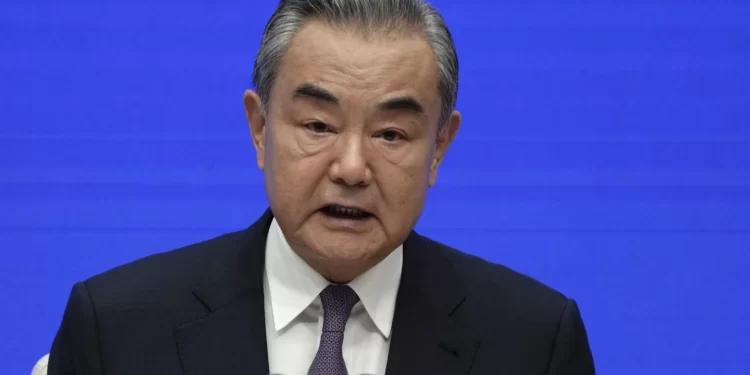
China’s Foreign Minister, Wang Yi has said that a “glimmer of hope” for peace has emerged due to moves to stop the war in the Middle East, despite Tehran vowing to keep fighting.
Wang Yi urged dialogue in separate calls with his Turkish and Egyptian counterparts, suggesting that both Tehran and Washington had shown signals they were willing to return to the negotiating table.
According to a Beijing readout published late on Wednesday and reported by Agence France-Presse, Wang told Egyptian foreign minister Badr Abdelatty, “With both the United States and Iran signalling a willingness to negotiate, a glimmer of hope for peace has emerged.”

He said, according to a statement from the Foreign Ministry, that continuing the war will only lead to more casualties, unnecessary losses and broader spillover.



“The international community should actively promote dialogue among the conflicting parties; as long as talks continue, there is hope for peace. China supports Egypt in continuing its mediation efforts in promoting the resumption of peace talks and a halt to the war.”
Wang Yi
He added that Beijing is willing to continue making constructive efforts in this regard.
Abdelatty expressed Egypt’s concern about the situation, particularly the risk of attacks on energy and power infrastructure that could trigger wider regional instability. He added that Egypt is working to de-escalate tensions.
The statement came hours before Iranian Foreign Minister, Abbas Araghchi said that “so far, no negotiations have taken place, and I believe our position is completely principled.” He asserted that speaking of negotiations “now is an admission of defeat.”

However, President Donald Trump insisted that Iran was taking part in peace talks. Trump insisted Iran is still interested in a deal, after Tehran dismissed a US ceasefire proposal, countered with a plan of its own and claimed it had no intention to negotiate.
Iranian state TV quoted an anonymous official as saying Tehran had rejected the plan it had received via Pakistan, saying it would “end the war when it decides to do so and when its own conditions are met.”
It was reported that Tehran had rejected the “excessive” demands in the proposal. Among the demands were a complete termination of Iran’s nuclear program and strict limitations on its missile arsenal. Foreign Minister Abbas Araghchi later said the proposals had been “passed on to the country’s senior authorities” but Iran had “no intention of negotiating for now.”
The US President later suggested that Tehran’s denials were because Iranian negotiators feared being killed by their own side.
“They are negotiating, by the way, and they want to make a deal so badly, but they’re afraid to say it because they figure they’ll be killed by their own people.”
Donald Trump
He added, “They’re also afraid they’ll be killed by us,” before quipping that no one wanted to lead Iran for fear of being assassinated by the US.
Wang Iterates Sentiments In Call With Turkish Counterpart

Wang reiterated the sentiments in his call with Turkiye’s Hakan Fidan and told both diplomats that China supports Cairo and Ankara’s efforts at mediating between the warring parties and halting the war.
The White House, meanwhile, warned that Trump was prepared to “unleash hell” if Iran did not accept defeat, and continued to insist that negotiations were ongoing.
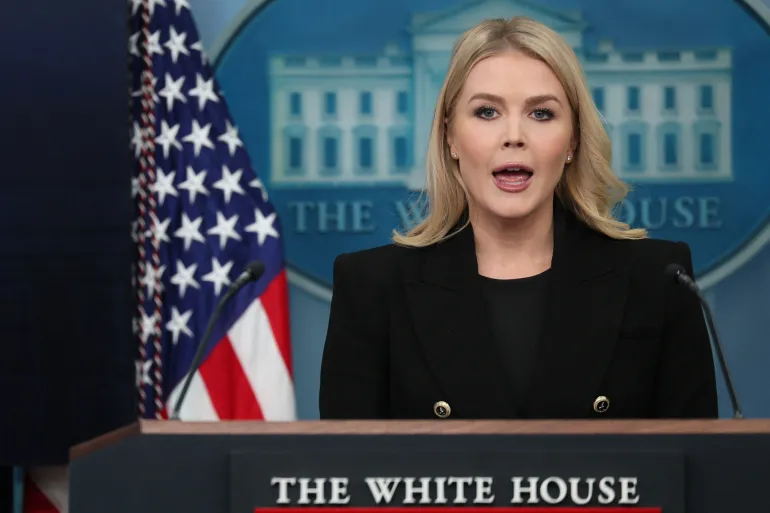
Press Secretary Karoline Leavitt Leavitt said that the US President preferred a peaceful path but was prepared to “hit [Iran] harder than they have ever been hit before” if necessary.
The US military said that its forces had hit more than 10,000 targets so far in the Iran war, including destroying 92% of the Iranian navy’s largest vessels.
Thousands more targets had been hit by Israeli forces, claimed US Navy Admiral Brad Cooper from US Central Command. “We have damaged or destroyed over two-thirds of Iran’s missile, drone and naval production facilities and shipyards, and we’re not done yet,” Cooper disclosed.
READ ALSO: House Committee Holds Hearing On Partial DHS Shutdown