
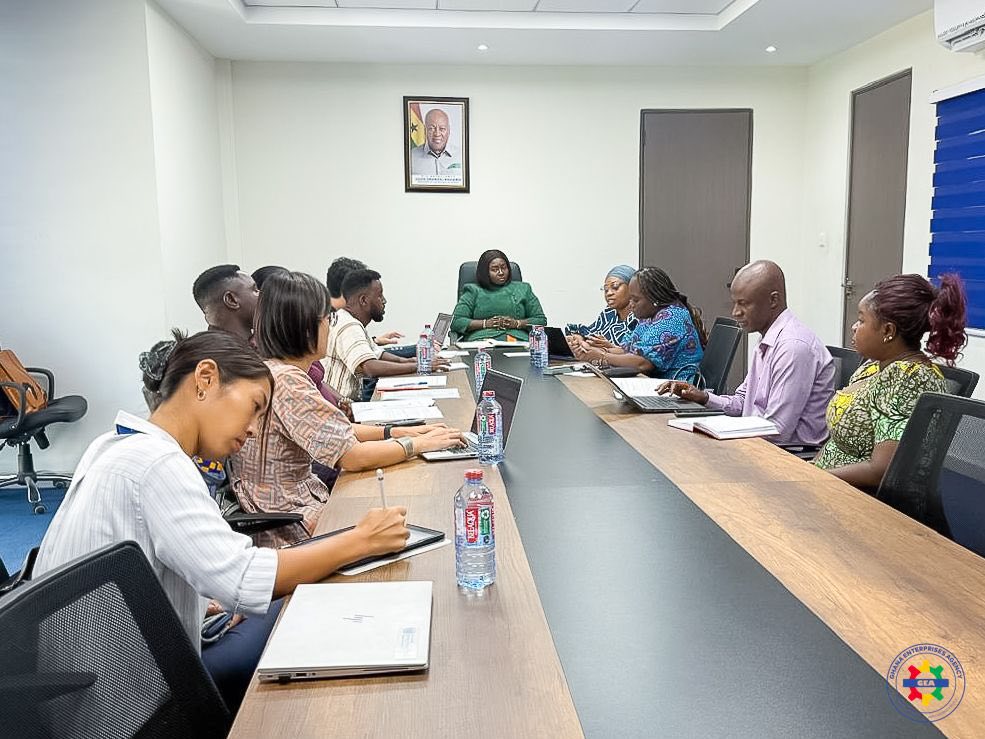
The Ghana Enterprises Agency (GEA) has entered into institutional deliberations with representatives from the United Nations Industrial Development Organization (UNIDO) and the Kaizen Regional Expansion Project. The project falls under the Technical Cooperation Programme of the Japan International Cooperation Agency (JICA).
The strategic engagement, led by GEA Chief Executive Officer Madam Margaret Ansei Magoo, forms part of state-directed efforts to standardize enterprise development and enhance operational frameworks within Ghana’s Micro, Small, and Medium Enterprise (MSME) sector.
According to the GEA, the meeting was an operational review of state-sponsored business support systems, focusing on how international lean management methodologies can be adapted to boost local manufacturing and agribusiness output.
“The meeting provided an opportunity to exchange knowledge and experiences on the implementation of Kaizen initiatives across Africa, particularly through the work of the Kaizen Excellence Center (KEC) of Ethiopia, one of the continent’s leading national Kaizen institutions”
Ghana Enterprises Agency
The tripartite partners utilized the session to evaluate field data and align their respective organizational roadmaps for technical assistance that translates directly into measurable productivity gains for domestic small businesses.
The bilateral session provided an institutional mechanism for the three organizations to analyze the successes and structural challenges of implementing Kaizen initiatives across different economic jurisdictions on the African continent.
Kaizen, a Japanese business philosophy centered on continuous improvement and waste reduction, has been progressively integrated into Ghana’s state-led business development programs over the past decade.
The KEC of Ethiopia is currently recognized by international development agencies as a premier model for national Kaizen deployment, offering centralized training, certification, and standard operating procedures that have successfully elevated the competitiveness of East African industries.
Through studying its centralized deployment model, the Ghana Enterprises Agency aims to identify institutional bottlenecks within its own regional distribution networks.
The comparative analysis focused on how Ethiopia scaled its lean management programs from localized pilot factories to a fully integrated national strategy, providing a structural blueprint that the GEA intends to utilize to optimize its operations across Ghana’s 16 regions.
Ghana’s Existing Kaizen Infrastructure
A significant portion of the technical consultation was dedicated to an exhaustive audit of the GEA’s internal capacity and its current methodologies for delivering field-level training.
The agency presented data regarding its existing delivery structures, long-term financial sustainability models, and the specialized metrics used within its Monitoring and Evaluation (M&E) systems to track post-training factory efficiency.
The delegates also reviewed the historical performance and behavioral impact of the Ghana National Kaizen Awards. This state-backed awards program functions as an economic incentive, publicly recognizing and rewarding domestic MSMEs that demonstrate verifiable reductions in manufacturing waste, optimized floor plans, and improved labor productivity.
The evaluation of these systems allowed UNIDO and JICA to assess the deployment of technical assets previously supplied to the GEA, including IT infrastructure and logistics equipment, checking that small businesses do not revert to inefficient operational habits after the initial training cycles are completed by state consultants.

To address identified capacity gaps within the state apparatus, the GEA, UNIDO, and JICA finalized a prospective roadmap for multi-country professional development. The planned initiatives are to elevate the proficiencies of GEA management executives, field officers, and local business development consultants who interact directly with factory owners.
The upcoming cooperative framework includes structured arrangements for Ghanaian personnel to participate in multi-country professional workshops and specialized third-country Kaizen training programs. These technical programs will operate through dual institutional bases, utilizing facilities and field sites located in both Addis Ababa and Accra.
This cross-border educational exchange aims to create a standardized cohort of certified Kaizen practitioners across the sub-region, exposing state consultants to the operational environments of advanced Ethiopian factories, to accelerate the domestic adoption of sophisticated diagnostic tools used for identifying hidden structural waste in corporate supply chains.
As part of the GEA’s updated operational strategy, Madam Margaret Ansei Magoo detailed a specific course of action focused on modernizing traditional business practices to remove growth barriers for local smallholders. The core of this new approach is a shift toward electronic tracking and automated process optimization.
The primary intervention proposed by the GEA leadership consists of establishing a specialized Kaizen Center of Excellence that is structurally anchored on digital technologies.
The Agency intends for this proposed facility to serve as a permanent hub for the continuous technical capacity building of local MSMEs and the advanced professional development of corporate consultants.
To transition this infrastructure project from design to execution, the GEA CEO issued a formal appeal to both JICA and UNIDO to explore specific collaborative funding and technical co-execution arrangements, including automated inventory trackers, resource planning software, and cloud-based waste diagnostics to modernize the delivery of Kaizen training beyond manual reporting systems.

The high-level meeting concluded with a reaffirmation of the GEA’s long-term reliance on structured international assistance to meet national industrial targets, noting that formal partnerships with specialized United Nations bodies and bilateral development agencies are key to maintaining institutional alignment with international best practices.
The management of the GEA emphasized that the successful execution of the digital Kaizen initiative will play a critical role in positioning Ghanaian small businesses to take full advantage of regional trade frameworks, such as the African Continental Free Trade Area (AfCFTA), by systematically lowering production costs and improving product quality.
The state agency plans to continue its technical consultations with UNIDO and JICA over the coming quarters to finalize the structural designs, budgetary allocations, and deployment timelines required to establish the digital Kaizen center within the capital.
READ ALSO: Prof Akosa Says Probe Reveals Emergency System Gaps