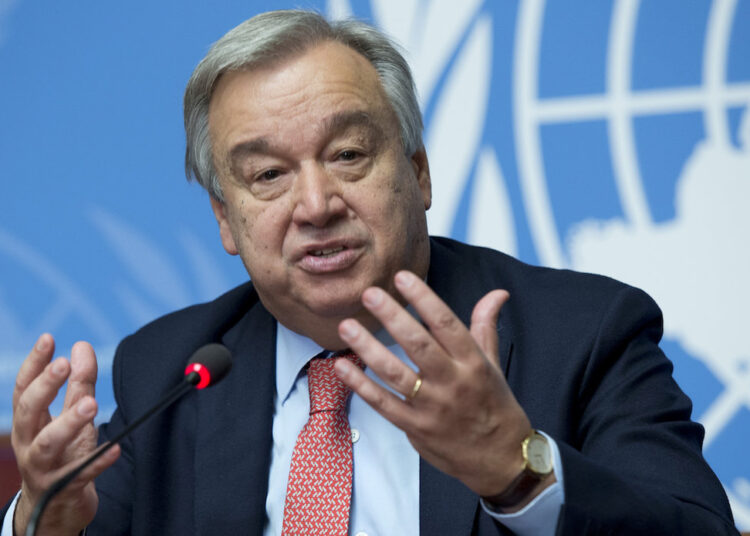
United Nations Secretary-General António Guterres has called on world leaders to make greater investments in peace as armed conflicts, political divisions and violence continue to deepen suffering across communities around the world.
Guterres made the appeal during the annual ceremony at the Japanese Peace Bell at the United Nations Headquarters in New York, using the symbolic occasion to warn that peace cannot be treated as an automatic outcome of diplomacy or the absence of open conflict.
“Each year, the toll of the Peace Bell reminds us of the most important and consequential job we have: building peace.”
António Guterres
The Secretary-General’s warning comes at a time when various conflicts throughout the world continue to cause humanitarian crises, displacement, destruction, and political instability, while efforts to address them through diplomacy and negotiation face significant challenges.
According to Antonio Guterres, the international community’s concern is not merely the quantity of conflicts, but also the seeming lack of political commitment and multilateral collaboration required to keep them from growing.
He stressed that “peace is never a passive achievement,” arguing that sustaining peace requires deliberate action, political commitment, and continued investment in the institutions and systems capable of addressing grievances before they develop into violence.
He added that action is increasingly faltering.
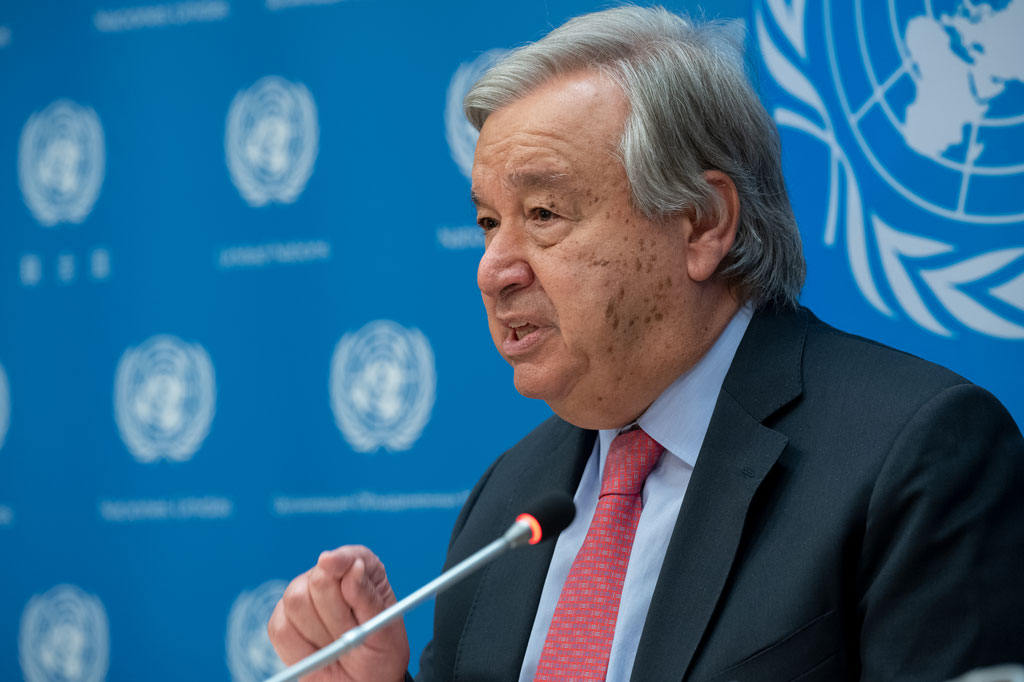
“Violence and division are tearing apart communities. Conflicts are widening and deepening. People are suffering. And the dialogue and solidarity that solutions require are missing in action.”
António Guterres
The call comes ahead of the International Day of Peace on September 21, which this year is themed “Investing in Peace: For Everyone, Everywhere, Every Day.”
The theme emphasises investment as the cornerstone of the international community’s understanding of peace, implying that long-term stability is dependent not only on ending wars but also on strengthening the social, economic, and political foundations that allow societies to withstand divisions and resolve disputes peacefully.
Guterres urged leaders to recommit to “the proven tools of peace, diplomacy, dialogue, negotiation and peacekeeping” and to take concrete steps towards ending wars and conflicts.
“Today, I call on world leaders to stand with us: take action; invest in solutions; and do the hard work of building lasting, sustainable peace.”
António Guterres
Peace Bell: A Symbol of Peace
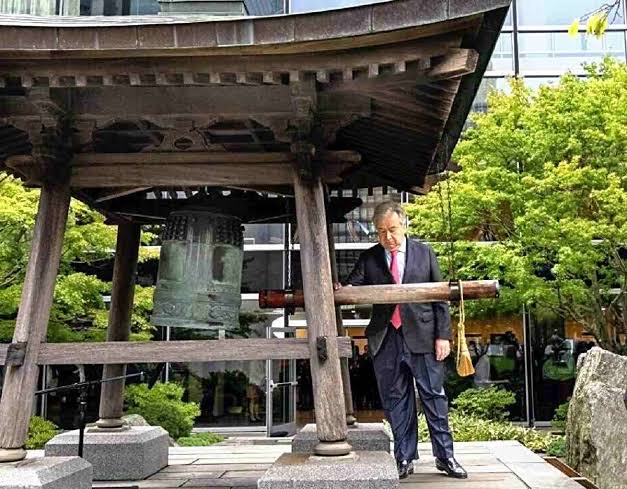
The Japanese Peace Bell served as the backdrop for Guterres’ warning, but its significance stretches far further than the ceremony itself.
Presented to the United Nations by the United Nations Association of Japan on 8 June 1954, the bell was created as a symbol of the universal aspiration for peace following the devastation associated with the Second World War.
The bell was cast from coins donated by delegates from 60 nations as well as individual contributions of different forms of metal. It is housed in a wooden structure resembling a traditional Shinto shrine.
At the time of its presentation, Renzo Sawada, the Japanese observer to the United Nations, described the bell as a symbol of the aspirations of people across the world.
The bell is rung twice each year on the first day of spring at the vernal equinox and to commemorate the International Day of Peace.
Its symbolism has acquired renewed significance as the UN faces questions about the effectiveness of multilateral institutions in preventing and resolving conflicts.
For decades, the organisation has served as one of the principal platforms for international diplomacy, peacekeeping and humanitarian coordination.
Yet the persistence and expansion of conflicts continue to expose the limits of international cooperation when political interests prevent collective action.
That challenge makes Guterres’ emphasis on investment particularly important.
Peace requires resources, but it also requires institutions capable of using those resources effectively. Investments in education, healthcare, nutrition and social protection can help address some of the structural pressures that contribute to instability, while credible institutions can provide peaceful channels through which citizens can express grievances and demand accountability.
The UN Secretary-General noted that, “this is the last time I will ring the Peace Bell.”
However, he added, “I will always stand with the champions of peace around the world.”
READ ALSO: Hon. Ahmed Shaib Calls for Standard Reserve Reporting On GoldBod Holdings