
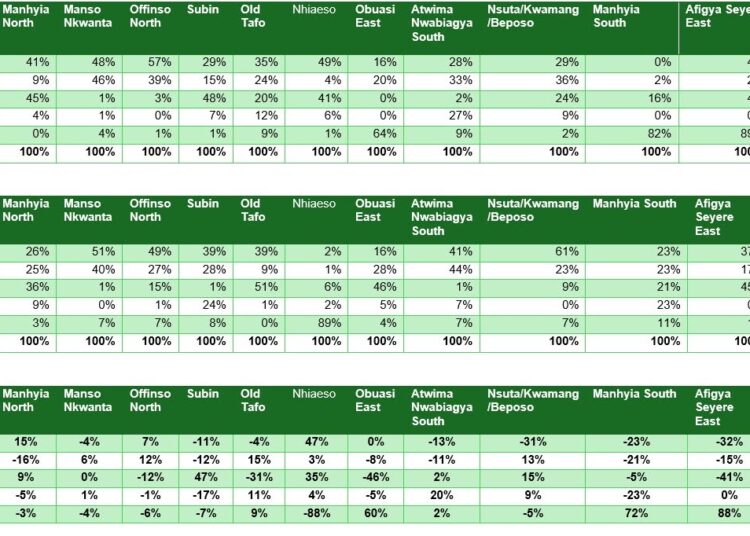
Fresh polling data from Global InfoAnalytics suggests that while the New Patriotic Party (NPP) has marginally strengthened its support base in the Ashanti Region, the broader electoral picture points to growing voter volatility and increasing uncertainty ahead of future elections.
According to insights shared by Executive Director of Global InfoAnalytics, Mussa Dankwah, the firm’s yet to be published June 2026 survey found that the NPP improved its support by 3 percentage points in the region compared to March 2026.
The National Democratic Congress (NDC), however, experienced a 9 percentage point decline over the same period. Despite the headline figures, Mr Dankwah cautioned against interpreting the NDC’s losses as an outright victory for the NPP.
“Overall, the data shows that NPP numbers improved by 3 percent compared to March 2026. While NDC declined by 12 percent, 9 percent of the decline went to other parties and not disclose, therefore should not be a cause for celebration for NPP, yet.”
Executive Director of Global InfoAnalytics, Mussa Dankwah
The findings emerged from a deliberate effort by the research firm to revisit the same constituencies randomly selected in March 2026 to track changes in voter preferences over time.

Constituency Trends Tell Different Stories
The survey revealed dramatic shifts across several constituencies in the Ashanti Region, highlighting the complexity of voter behaviour in what has traditionally been regarded as the NPP’s political stronghold.
In Kwabre East, the NPP gained 7 percentage points while the NDC lost 16 percentage points. However, only 7 percent of the NDC’s losses translated into gains for the NPP, with the remainder moving towards floating voters and smaller political parties.
Manhyia North recorded one of the most significant transfers of support directly between the two major parties. The NDC declined by 16 percentage points, while the NPP gained 15 percentage points.
In Offinso North, both major parties made gains. The NPP increased its support by 7 percentage points while the NDC improved by 12 percentage points, largely at the expense of floating voters.
One of the most striking developments occurred in Subin, where voter allegiances appeared increasingly fluid. Floating voters surged by 47 percentage points, while support for both the NPP and NDC declined by 11 and 12 percentage points respectively.
Mixed Fortunes Across Ashanti Constituencies
The survey also highlighted constituencies where the NPP’s support weakened considerably. In Old Tafo, the NPP’s support dropped by 4 percentage points, while the NDC improved by 15 percentage points. Support for other political parties, including The Base and the United Progressive Party, also increased.

Nhiaeso recorded substantial gains for the NPP after a sharp decline in respondents who had previously declined to disclose their political affiliation. The NPP gained 47 percentage points, while floating voters increased by 35 percentage points.
Atwima Nwabiagya South presented a different pattern. Both the NPP and NDC lost support, declining by 13 and 11 percentage points respectively. Meanwhile, smaller political parties experienced a combined increase of 20 percentage points.
The NPP suffered one of its steepest declines in Nsuta Kwamang Beposo, where its support fell by 31 percentage points. During the same period, the NDC gained 13 percentage points and floating voters increased by 15 percentage points.
Rise in Undecided Voters Raises Questions
Another notable finding was the significant increase in respondents unwilling to disclose their political preferences in certain constituencies. In Manhyia South, support for the NPP, NDC and other parties all declined substantially.
The NPP fell by 23 percentage points, the NDC by 21 percentage points, while other parties dropped by 23 percentage points. At the same time, the proportion of respondents who chose not to disclose their political affiliation rose by an extraordinary 72 percentage points.
Mr Dankwah described this trend as a potential source of concern for the NPP in the region. A similar pattern emerged in Afigya Sekyere East. The NPP declined by 32 percentage points and the NDC by 15 percentage points.

Floating voters dropped by 41 percentage points, while the category of respondents unwilling to disclose their preferences surged by 88 percentage points.
These developments suggest that beneath the relatively stable regional figures lies a rapidly evolving political landscape characterised by uncertainty and shifting loyalties.
Beyond the Headline Numbers
The Ashanti Region has historically served as the electoral backbone of the NPP. Consequently, even modest changes in voter sentiment within the region carry significant national implications.
While the New Patriotic Party’s overall 3 percentage point improvement may appear encouraging, the survey findings indicate that the party cannot afford complacency.
Equally, the NDC’s decline does not necessarily signal a strengthening of its main opponent, as much of the lost support appears to have moved towards undecided voters and smaller parties.
The data points to an electorate that is increasingly willing to reassess traditional political allegiances. Floating voters, non disclosing respondents and emerging political alternatives are becoming more prominent factors in shaping electoral outcomes.

As Ghana moves closer to future electoral contests, political parties may need to focus not only on consolidating their traditional support bases but also on addressing the concerns of a growing segment of voters who remain unconvinced by the country’s dominant political actors.
For now, the latest Global InfoAnalytics survey offers an important reminder that headline figures often conceal more nuanced political realities. In the Ashanti Region, the real story may not be who gained or lost support, but rather the growing unpredictability of the electorate itself.
READ ALSO: The Politics of Counting: Presidential Staffing Across Three Administrations