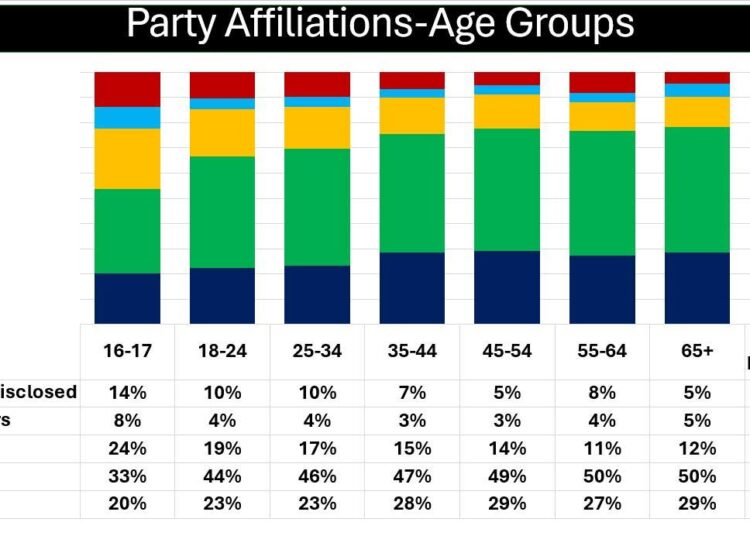
The ruling National Democratic Congress (NDC) continues to maintain a strong advantage across all age categories of Ghanaian voters, while the New Patriotic Party (NPP) remains unable to reverse its declining support among highly educated voters, according to insights from Global InfoAnalytics’ June 2026 national tracking poll.
Executive Director of Global InfoAnalytics, Mussa Dankwa, said the latest findings point to evolving political preferences that could have significant implications for future electoral contests.
The poll suggests that the NDC has succeeded in broadening its appeal beyond its traditional support base, while the NPP continues to grapple with retaining key segments of the electorate that have historically leaned in its favour.
According to the survey, the NDC now dominates across all age groups, including among older voters who have traditionally been associated with the NPP.
NDC Gains Ground Among Older Voters
One of the most notable outcomes of the June tracking poll is the NDC’s performance among older voters. Historically, older demographics have been viewed as a stronghold for the NPP. However, the latest data indicate that the ruling party has managed to make considerable inroads within this category.
Mr. Dankwa noted that the NDC’s ability to perform strongly among older voters reflects changing political attitudes and suggests that age based voting patterns may no longer be as predictable as they once were.
The development could prove significant in future elections, particularly given the influence older voters often wield through their relatively high turnout rates.
The findings suggest that the NDC’s message is resonating across generations, positioning the party favourably within Ghana’s evolving electoral landscape.
NPP’s Elite Voter Challenge Persists
Perhaps the most striking aspect of the survey is the continued erosion of the opposition New Patriotic Party’s support among voters with higher educational attainment.
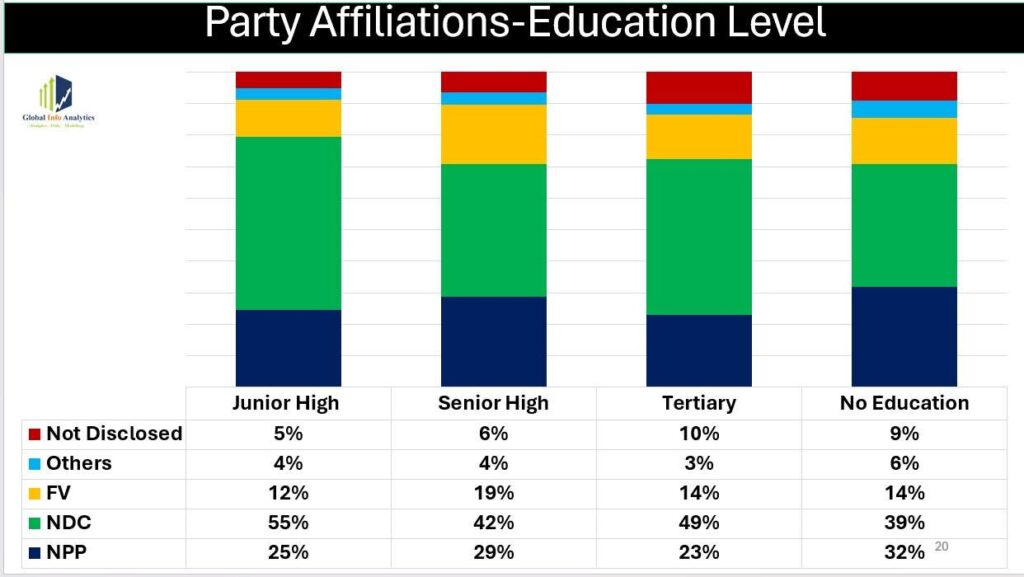
According to the poll, the NDC now commands 49 percent support among tertiary educated voters, while the NPP trails considerably with 23 percent support within the same demographic group.
The figures indicate that the NPP has yet to find an effective strategy to reconnect with voters who are often regarded as opinion leaders and influential voices within society.
The trend extends beyond tertiary-educated voters. Among respondents with senior high school education, the NDC secured 42 percent support compared to 29 percent for the NPP.
Among voters with junior high school education, the NDC recorded an even wider lead, attracting 55 percent support against the NPP’s 25 percent. Even among respondents without formal educational qualifications, the NDC maintained an advantage, polling 39 percent compared to the NPP’s 32 percent.
The data suggest that the NDC’s appeal currently spans educational backgrounds, while the NPP faces mounting pressure to rebuild confidence among highly educated constituents.
Search for Political Realignment
Political analysts have long viewed educated voters as an important constituency due to their influence on public discourse and policy debates. The continued decline in NPP support within this group raises questions about whether broader political realignments are underway.

Mr. Dankwa observed that the NPP has not yet identified the solution required to win back elite voters. The findings may prompt renewed introspection within the party as it seeks to understand the factors driving changing voter preferences.
For the NDC, the poll results could be interpreted as evidence that its messaging and policy positioning are attracting support from a wider cross section of society. However, analysts caution that public opinion remains fluid, and political fortunes can change significantly over time.
Regional Dynamics Continue to Shape Competition
The June tracking poll also highlighted broader shifts in party affiliation across different parts of the country. According to the findings, the NPP’s overall support appears to have stabilised after previous declines, supported largely by voter sentiment in the Ashanti and Northern regions.
At the same time, the NDC has managed to improve its standing after experiencing a steep decline in support within the Ashanti Region. The party also recorded substantial gains in the Greater Accra Region, further strengthening its national appeal.
These regional movements underscore the competitive nature of Ghanaian politics, where parties must continually adapt to changing voter priorities and local realities.
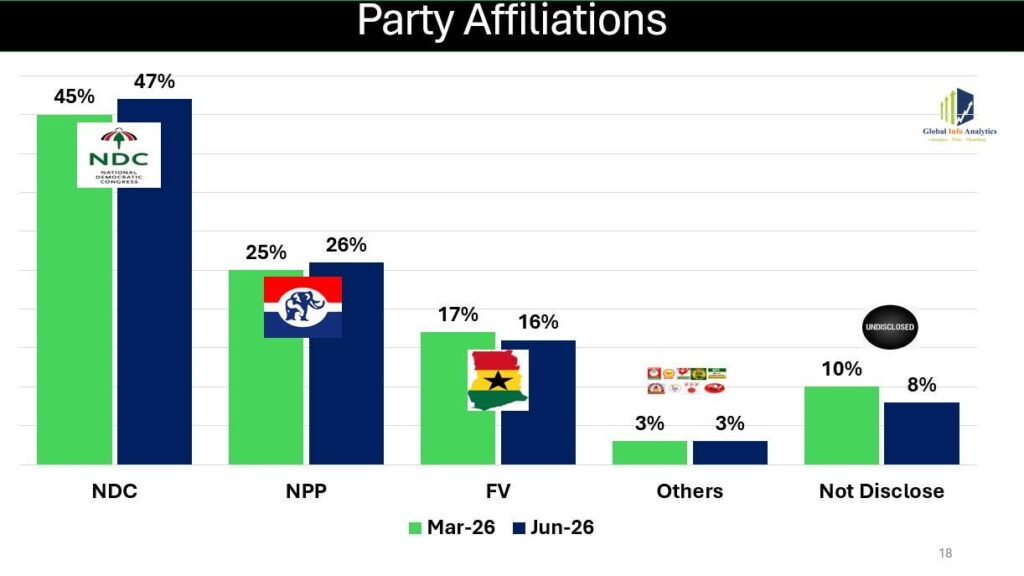
The June 2026 Global InfoAnalytics tracking poll provides a snapshot of the country’s current political mood, revealing both opportunities and challenges for Ghana’s two major political parties.
For the NDC, its dominance across age groups and strong performance among educated voters may reinforce confidence in its electoral strategy. For the NPP, the findings highlight the urgent need to address concerns among elite voters while consolidating support within its traditional strongholds.
As political parties prepare for future electoral contests, the demographic trends identified in the latest survey are likely to shape campaign strategies, policy priorities, and efforts to broaden voter appeal.
While polls do not determine election outcomes, they offer valuable insights into the sentiments of the electorate. In this case, the June tracking poll suggests that the NDC currently holds a demographic advantage, while the NPP continues its search for a pathway back to stronger support among Ghana’s educated voters.
READ ALSO: GSE Composite Index Soars Past 14,600 Points