UK Prime Minister Andy Burnham faces the daunting challenge of leading Britain through one of its toughest economic periods in decades, with his ability to foster growth, uphold fiscal discipline and raise living standards expected to define the success of his premiership, according to a leading UK political scientist.
Speaking exclusively to the Vaultz News, Dr Thom Oliver, Senior Lecturer in Politics at the University of the West of England, explained that the success of Burnham’s government will depend on whether it can craft a coherent economic strategy capable of rebuilding public trust and addressing the deep-rooted structural challenges facing the UK economy.
“Burnham should reject the idea that economic growth, fiscal responsibility and improving living standards are entirely separate objectives.
“His central challenge is to devise policies that advance all three. In the context of today’s politics, that’s not an aspiration, it is a requirement if this Labour government is going to survive.”
Dr Thom Oliver
According to Dr Oliver, Britain’s strained public finances leave the government with limited room to manoeuvre, meaning any economic strategy pursued by Burnham’s administration will face intense scrutiny from financial markets.
Dr Oliver explained that the new administration cannot ignore Britain’s challenging financial circumstances, with rising borrowing costs and pressures from debt, healthcare, pensions and an ageing population placing limits on government spending.
However, he added that “a loss of confidence in the government’s fiscal strategy would also raise borrowing costs and make every other objective harder to achieve.”
He also cautioned against relying solely on fiscal restraint, arguing that such an approach would undermine investment and economic recovery.
“At the same time, a policy of permanent restraint is unlikely to generate the investment, productivity or public confidence required for recovery.
“The key distinction could be between poorly targeted current spending and investment that expands the economy’s productive capacity.”
Dr Thom Oliver
Dr Oliver indicated that Burnham’s government could prioritise investment in housing, transport, skills, energy and industry to create jobs in the short term and strengthen the economy over time.
Reflecting on Burnham’s record as Mayor of Greater Manchester, Dr Oliver suggested that the Prime Minister will look to scale up the place-based investment model that shaped his mayoralty and apply it across UK.
“His approach has generally been to use public authority to coordinate private, local and national investment around particular places.
“Applied nationally, this would mean giving city regions, devolved governments and local authorities greater control over long-term investment rather than requiring them constantly to compete for short-term grants.”
Dr Thom Oliver
However, Dr Oliver cautioned that decentralisation should not be viewed as a standalone solution to Britain’s fiscal difficulties. He argued that shifting powers to local areas without providing reliable funding would merely transfer financial pressures rather than resolve them.
Addressing the cost-of-living crisis, Dr Oliver noted that Burnham’s government should move beyond temporary financial assistance and instead tackle the structural factors driving household costs.
“The cost-of-living crisis will require more than temporary subsidies. Britain needs to address the structural factors that make essential goods and services expensive: insufficient housing supply, high energy costs, insecure work, weak public transport and the limited bargaining power of many workers.”
Dr Thom Oliver
According to Dr Oliver, the government’s ambitions for increased investment could require difficult decisions on taxation. He stated that any revision of Labour’s tax plans would need to be clearly justified, transparent and guided by fairness rather than broad-based increases.
Dr. Oliver argues that the Prime Minister has a chance to present voters with a more understandable and sympathetic political story.
“Starmer suffered from a lack of a clear ‘Labour’ story. His mandate may have delivered electoral numbers, but it didn’t deliver a narrative that voters could understand. Burnham is often candid, and like his predecessors he will lean upon a need to be honest that there are no painless options.”
Dr Thom Oliver
Burnham’s First 100 Days Will Test Labour’s Ability to Deliver
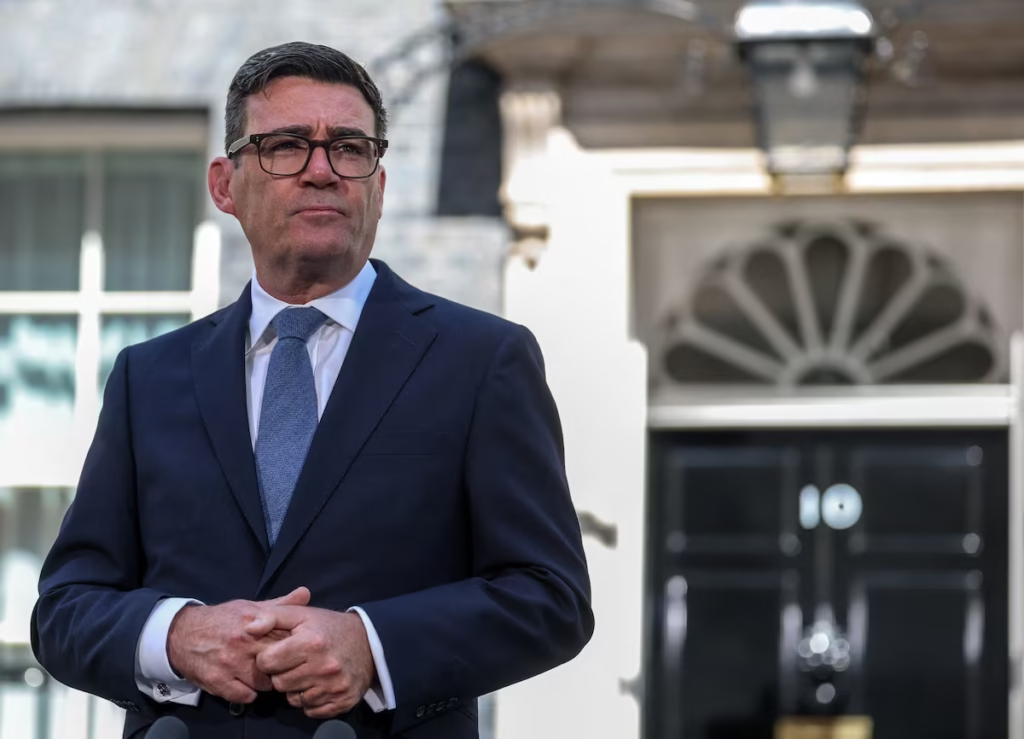
Assessing the early test of leadership facing Burnham, Dr Oliver highlighted that the Prime Minister’s priority should be to create a sense of competence and strategic clarity, laying the foundations for long-term reform rather than pursuing immediate solutions to every issue.
“The first 100 days should establish direction, competence and political priorities rather than attempt to solve every national problem.”
Dr Thom Oliver
Furthermore, he stated that an early fiscal statement will be necessary to clarify how the administration plans to strike a balance between ambitious changes and constrained public funds.
Beyond the economics, Dr. Oliver contends that Burnham’s administration will be characterised by decentralisation. Nevertheless, he cautioned that decentralisation must benefit every region of the country.
“He must ensure that devolution benefits the whole country, including the South West, the Midlands, eastern England and rural areas, rather than appearing to transfer power primarily from London to Manchester.”
Dr Thom Oliver
Dr Oliver also anticipates a series of early measures designed to ease pressure on households.
“These may include reviewing tax thresholds, accelerating housing construction, addressing household energy costs or introducing measures intended to improve access to healthcare and social care. These will aim to be tangible changes which are felt in wage packets, energy bills, and the cost of weekly shopping.”
Dr Thom Oliver
While Burnham has sought to distinguish himself through a more direct and empathetic style of leadership, Dr Oliver stressed that communication alone will not determine the government’s success.
He also warned against creating unrealistic public expectations.
“His greatest danger is overpromising. He has inherited the same economic constraints, administrative machinery and international pressures that confronted his predecessor. A change of leader does not produce a new state overnight; changing the driver of the car does not remove the potholes from the road.”
Dr Thom Oliver
Looking beyond the opening months of the new administration, Dr Oliver believes Burnham has an opportunity to redefine how Britain is governed, provided his government can translate political ambition into practical reform.
READ ALSO: Chelsea Complete The Signing of Morgan Rogers From Villa