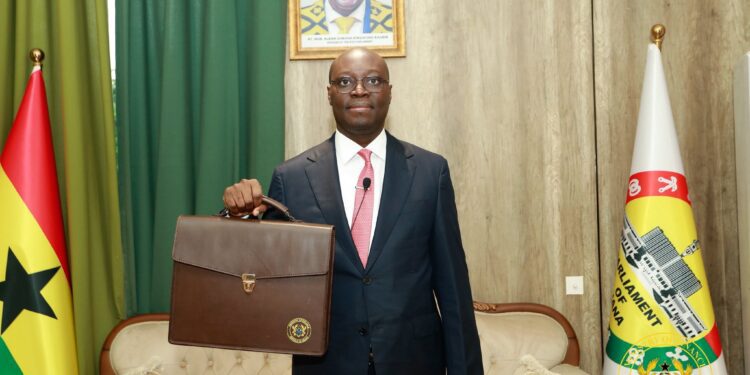
Finance Minister Dr Cassiel Ato Forson has rejected claims that Ghana’s recent economic improvements are the result of coincidence, insisting that the country’s recovery is being driven by deliberate policy choices, fiscal discipline and stronger economic management.
Presenting the Mid-Year Budget Review to Parliament on Thursday, July 24, Dr Forson argued that Ghana’s progress under the current administration was achieved through a carefully planned reform programme aimed at restoring stability, rebuilding investor confidence and strengthening public finances.
According to the Finance Minister, the economic gains recorded in recent months were not simply inherited benefits from external programmes but the outcome of tough decisions taken by government since assuming office.
“Ghana’s recovery is as a result of superior economic management,” Dr Forson told Parliament, stressing that the improvements in key economic indicators reflected the impact of government interventions.
Recovery Built Through Difficult Decisions
Dr Forson said when the administration took office, it immediately recognised that Ghana required more than temporary measures to address its economic difficulties.
He explained that government concluded that the previous approach to managing the economy was insufficient and that structural reforms were necessary to restore confidence.
“When this administration assumed office, it moved swiftly and decisively to stabilise the economy and begin the work of national reconstruction. It was immediately clear that the old model of managing the economy had failed and Ghana did not need incremental adjustment, but it needed structural reforms.”
Dr Cassiel Ato Forson
The Finance Minister acknowledged that the reforms introduced were challenging and required sacrifices from citizens, but argued that they were necessary to place the economy on a stronger foundation.
“These decisions demanded our collective sacrifice, but they were necessary to restore stability and rebuild confidence,” he stated.
IMF Programme Not Sole Reason for Progress
Dr Forson pushed back against suggestions that Ghana’s economic recovery was mainly due to the International Monetary Fund programme or the country’s debt restructuring process.
While recognising the importance of those interventions, he maintained that they only provided support and could not replace sound domestic economic management.
“Debt restructuring may create fiscal space, but it does not create fiscal discipline,” Dr Forson said.
“An IMF programme may provide a framework, but it cannot substitute for sound policy, disciplined implementation and political will.”
Dr Cassiel Ato Forson
He argued that sustainable recovery depends on strong leadership, effective policies and consistent implementation.
“Sustainable economic recovery is built on good policy choices, competent economic management and disciplined execution, and most importantly, courageous leadership.”
Dr Cassiel Ato Forson
Three Major Reforms Behind Ghana’s Economic Revival
The Finance Minister identified three major policy reforms that he believes have driven Ghana’s turnaround.
The first reform was fiscal correction, aimed at controlling public finances, reducing unnecessary expenditure and placing public debt on a sustainable path.
The second was the modernisation of Ghana’s tax regime to improve domestic revenue mobilisation.
The third was the implementation of complementary fiscal policies designed to support inflation reduction and exchange rate stability.
“These key transformational reforms are as follows. The first is fiscal correction, the second is the modernisation of Ghana’s tax regime, and the third is a complementary fiscal policy for inflation targeting and exchange rate stability.”
Dr Cassiel Ato Forson
Spending Cuts Deliver Fiscal Improvement
According to the Finance Minister, one of the major achievements of government’s fiscal correction programme was a significant reduction in public expenditure.
He said the 2025 budget was reset to 2023 nominal levels, with government eliminating what it described as wasteful spending and improving efficiency across the public sector.
“As a result, primary expenditure declined sharply from 18.7% of GDP in 2024 to 13.2% of GDP in 2025,” Dr Forson explained.
He described the adjustment as a major fiscal achievement because it was achieved without damaging economic growth. “A 5.5% adjustment without hurting economic growth,” he emphasised.
The Finance Minister also highlighted improvements in Ghana’s primary balance, noting that the country moved from a deficit position into surplus.
“The primary balance also improved from a deficit of 2.9% of GDP in 2024 to a surplus of 2.5% of GDP in 2025, placing public debt firmly on a downward trajectory.”
Dr Cassiel Ato Forson
Ghana Sends Strong Signal to Investors
Dr Forson said the fiscal reforms had sent a clear message to domestic and international investors that Ghana was committed to responsible economic management.
He described the reduction in government expenditure as evidence that fiscal discipline had become central to economic governance.
“Mr. Speaker, this sent an unmistakable signal to Ghanaians, investors and other development partners that fiscal discipline is the new order.”
Dr Cassiel Ato Forson
The Finance Minister further argued that the progress recorded across inflation, debt management, fiscal performance and investor confidence reflected the impact of government’s reform agenda.
He maintained that Ghana’s recovery was the result of intentional decisions rather than luck.
“The evidence before us is overwhelming. Ghana’s recovery has been driven by a deliberate programme of economic reforms implemented since President Mahama assumed office in January 2025.”
Dr Cassiel Ato Forson
As the government continues implementing its economic programme, the Finance Minister believes the foundation has been laid for sustained growth, improved fiscal stability and renewed confidence in Ghana’s economy.