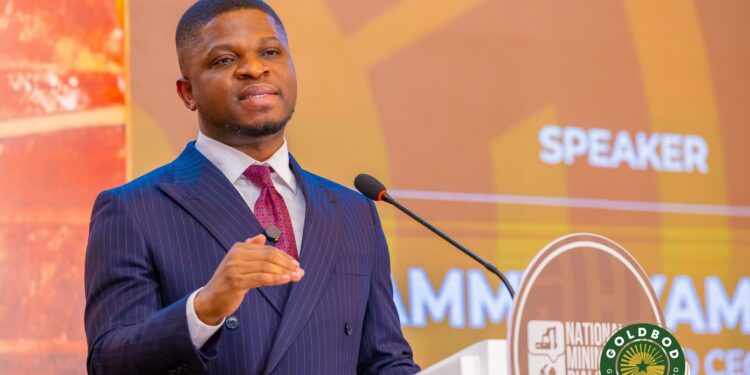
Sammy Gyamfi, Chief Executive Officer of the Ghana Gold Board (GoldBod), has clarified that the scaling up of the Bank of Ghana’s domestic gold purchase program, rather than institutional mismanagement or operational breaches, was the direct driver behind the central bank’s reported $1.7 billion financial loss in 2025.
Expanding on this statement, Sammy Gyamfi pointed out during a press briefing held under the Government Accountability Series that critics have conflated two separate institutions and balance sheets to mislead the public.
He emphasized that the Auditor General’s 2025 report on GoldBod returned zero adverse audit findings, clearing the board of any statutory, procurement, or financial management infractions under the Public Financial Management Act.
Consequently, political opponents such as Alexander Afenyo-Markin shifted their rhetoric toward the International Monetary Fund’s (IMF) report on Ghana’s Extended Credit Facility, erroneously assigning the Bank of Ghana’s macro-level program losses to GoldBod.
“In summary, ladies and gentlemen, what the IMF report states is that Bank of Ghana incurred losses through the sale of gold under its domestic gold purchase program of $400 million in the year 2024 and $1.7 billion in the year 2025. And that the 2025 loss of $1.7 billion was as a result of, I’m quoting the IMF verbatim, the scaling up of the domestic gold purchase program. Not incompetence or mismanagement.”
Sammy Gyamfi, Chief Executive Officer of the Ghana Gold Board (GoldBod)
Clearing Institutional Roles and Audit Integrity
The distinction between GoldBod’s operational mandate and the Bank of Ghana’s monetary policies forms the baseline of Gyamfi’s defense.

GoldBod operates as the primary regulatory and trading facilitator for the country’s precious minerals, ensuring transparent artisanal and small-scale gold supply chains. In contrast, the Bank of Ghana executes macro-hedging and sovereign reserve accumulation via its domestic gold purchase program to stabilize foreign exchange reserves.
Sammy Gyamfi issued a direct challenge to critics attempting to blur these lines, stating, “I challenge Afenyo-Markin to point to any page, paragraph, sentence, phrase, or punctuation mark in the said referenced reports of the IMF where the Gold Board was accused by the IMF as the entity responsible for losses incurred by the Bank of Ghana.”
He stressed that the Auditor General found “not on imaginary or hallucinatory losses, not on procurement breaches or breaches of the Public Financial Management Act” within GoldBod’s financial accounts.
Understanding the Mechanics of Central Bank Program Expansion
To evaluate why this clarification is vital for Ghana’s extractive and financial sectors, one must examine how sovereign gold purchase programs operate under rapid scaling. When a central bank aggressively expands local gold acquisition, it buys domestic bullion in local currency (Cedi) while absorbing international price volatility, currency fluctuations, and localized premiums.
During rapid volume scaling, financial losses on paper often represent carrying costs, price shifts, and valuation adjustments rather than physical or cash leakage.

By scaling up purchases from $400 million in 2024 to $1.7 billion in 2025, the central bank took on larger balance-sheet exposure to stabilize the national currency and build official reserves. Attributing these macro-level trade-offs to operational failure at GoldBod misrepresents public finance and creates unnecessary panic across the mining industry.
Public Accountability and Media Responsibility in Extractive Reporting
Gyamfi urged media practitioners to exercise diligence and resist political narratives that distort technical financial reports. Misinterpreting multilateral reports from institutions like the IMF threatens public confidence in national resource governance and damages investor trust in Ghana’s formalized gold supply chain.

“The media, I humbly submit, must not condone and entertain the deliberate propagation of lies in the face of glaring evidence to the contrary,” Sammy Gyamfi cautioned.
He reiterated that opposition claims evolved only after official audit figures disproved initial allegations against GoldBod. Maintaining clear boundaries between regulatory agencies and monetary authorities remains critical as Ghana continues to leverage its mineral wealth to back national economic stability.