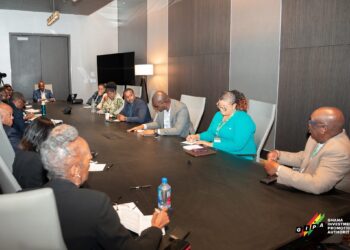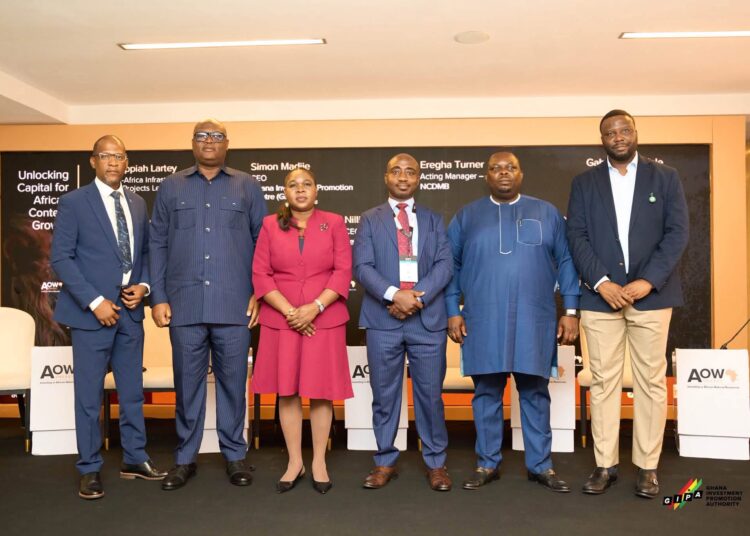
The Chief Executive Officer of the Ghana Investment Promotion Authority (GIPA), Mr Simon Madjie, has called for a deliberate and strategic shift in how Africa finances its oil and gas industry, urging the continent to look inward and mobilise its own long-term capital.
Speaking at the AOW Energy 2026 Conference in Accra, Mr. Madjie said Africa can no longer depend solely on external financing for its energy and industrial development at a time when global is becoming more competitive and selective.
He argued that two largely untapped but massive pools of African capital pension funds and diaspora remittances hold the key to sustainably financing Africa’s energy value chain and broader industrial transformation.
According to Mr. Madjie, African pension funds collectively control hundreds of billions of dollars in assets, but only a small fraction of those funds is invested in productive sectors like oil and gas, energy infrastructure and manufacturing.
He said with appropriate regulation, de-risking instruments and well-structured investment vehicles, pension funds could become a stable source of long-term local currency and dollar financing for energy projects across the continent.
The second pool, he noted, is remittances from Africans in the diaspora. Mr Madjie observed that Africans in the diaspora remit billions of dollars to the continent annually, making remittances one of Africa’s largest and most consistent foreign exchange inflows, often exceeding foreign direct investment and official development assistance.
Diaspora Funds Largely Goes to Consumption, not Investment
However, he lamented that much of these funds are not channelled into structured investments that can support industrial growth and economic development, but instead go into consumption, family support and informal real estate.
“There is a huge opportunity to convert remittances from consumption to capital,” he said, challenging policymakers, financial institutions and investment promotion agencies to design diaspora bonds, investment funds and co-investment platforms that can crowd diaspora money into energy, industrial parks, logistics and manufacturing.
Mr Madjie told delegates at AOW Energy, one of Africa’s longest running energy conferences bringing together governments, investors, operators and financiers – that financing Africa’s energy future requires African solutions and African capital at the centre.
He explained that while international oil companies and foreign investors remain important, the continent must build financial sovereignty by mobilising domestic capital first to attract foreign capital on better terms.
Beyond financing, Mr Madjie also made a strong case for greater regional specialisation in the oil and gas value chain. He said African countries should move away from the approach where every country tries to do everything in the oil and gas sector, and instead identify areas where they have comparative advantage and build competitive expertise.
For instance, he noted, one country can specialise in fabrication and engineering, another in refining and petrochemicals, another in logistics and maritime services, and another in technical training and local content development.
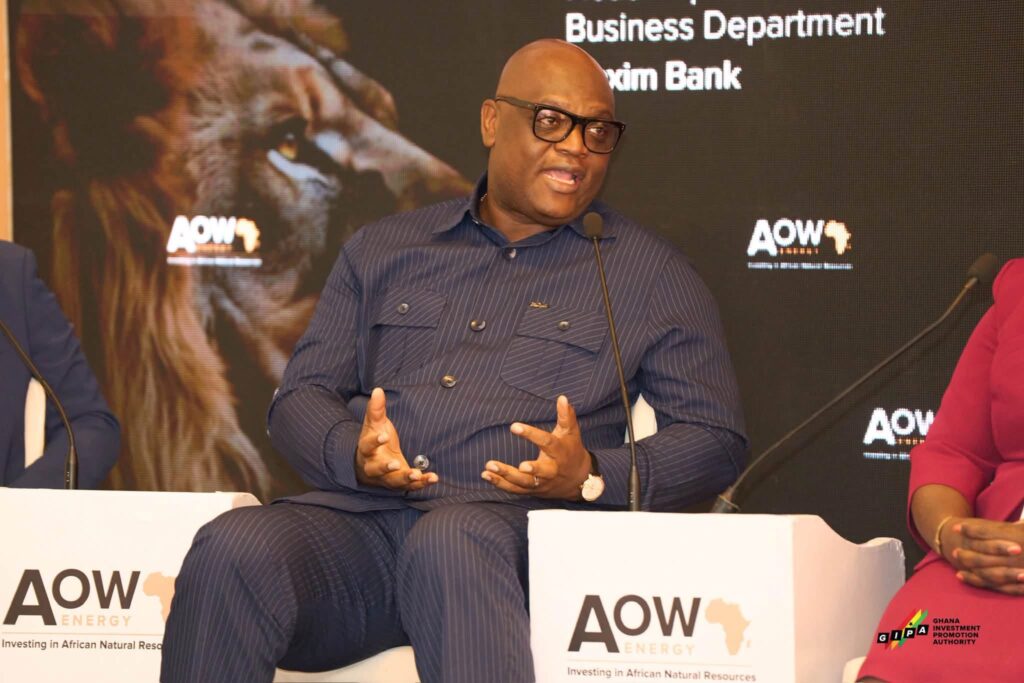
According to him, such specialisation would strengthen intra-African trade and collaboration, reduce duplication and cost, and create integrated regional value chains that make Africa more competitive globally. He said this approach aligns with the African Continental Free Trade Area (AfCFTA) vision, which seeks to boost intra-African trade and industrialisation.
Mr Madjie further used the platform to highlight key reforms under the GIPA Act, 2026 (Act 1173), which he said have significantly improved Ghana’s investment climate. He revealed that one of the most transformative reforms under the new law is the removal of the blanket minimum capital requirement for foreign investors.
A provision that for years had been cited by investors as a barrier to entry, particularly for SMEs, technology firms and service providers. He explained that the removal does not mean a lack of regulation, but rather a shift to a more targeted, sector-based and risk-sensitive approach that makes Ghana more competitive and investor-friendly while still protecting the national interest.
According to him, the reform will contribute to a more open and competitive environment, allowing more investors to enter, test the market and scale, while enabling Ghana to attract high-quality investments in technology, services, energy and manufacturing.
Mr Madjie said GIPA’s new mandate under Act 1173 positions the Authority not just as a facilitator of foreign investment, but as a champion of both domestic and foreign investment, with a stronger focus on linkages, joint ventures and retention.
He stressed that Ghana is ready to serve as a hub for energy investment and regional collaboration, given its stable political environment, improving infrastructure, local content framework and its location at the centre of the Gulf of Guinea.
He urged African governments to harmonise regulations, improve transparency in licensing and procurement, and create credible mechanisms for dispute resolution to build investor confidence.
Mr Madjie concluded that Africa’s oil and gas sector must be seen not as a sunset industry, but as a catalyst for industrialisation, job creation and energy security – provided its financing and value chain strategy is reimagined.
“If we can mobilise our pensions and our diaspora, and if we can specialise and trade among ourselves, we will finance our own industrial future.’’
Mr. Madjie
The AOW Energy 2026 Conference in Accra brought together energy ministers, regulators, national oil companies, private operators and financiers to discuss investment, energy transition and regional cooperation at a time when Africa is seeking to balance energy security, industrial growth and climate commitments.
READ ALSO:There Remains A Gap In Public Participation — Former Chief Justice