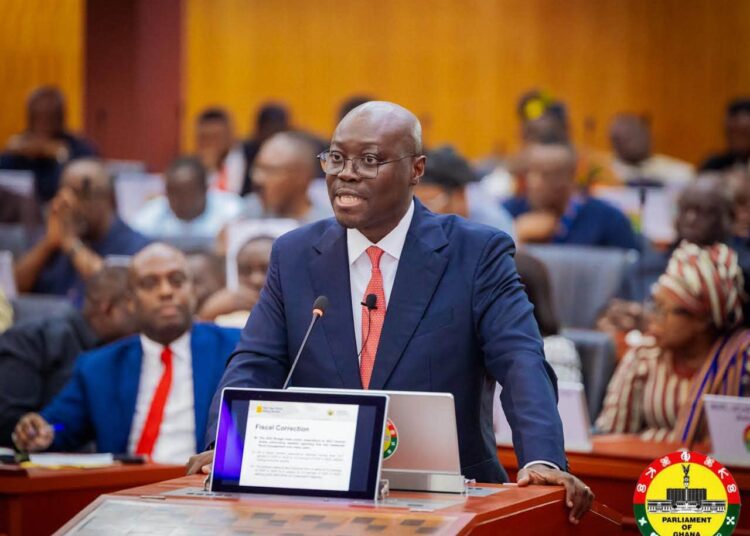
Finance Minister, Hon. Ato Forson, has stated that Ghana must establish a robust system to ensure the nation directly benefits from the economic rent generated by its extractive industry, particularly gold and petroleum.
Addressing the fundamental principles of national resource governance, the Minister explained that while institutional equity shareholders and corporate investors are legally entitled to commercial returns, the ultimate owners of the subterranean wealth the Ghanaian people must equally share in the financial proceeds.
He stressed that aligning sovereign rights with commercial interests is essential for long-term national development.
“I have always said that the time has come for Ghana to have a system to be able to benefit from economic rent of particularly extractive industry, oil or gold in the case of Ghana. It is a fact that shareholders must benefit, but it’s also a fact that the owners of the resource must also benefit. That was the reason why Government of Ghana decided to introduce the sliding scale royalties, recognizing that yes, there is an all-in cost, and there is also the level of profit that the company expects to make.”
Hon. Ato Forson
Expanding on the government’s fiscal framework, Dr. Forson indicated that the strategic introduction of sliding scale royalties was designed to achieve a fair equilibrium between investor earnings and state revenue.

He noted that this progressive taxation policy explicitly recognizes the operational realities of resource extraction, including all-in sustaining costs and the baseline profit margins expected by concessionaires.
By structuring royalty rates to adjust automatically with fluctuating international commodity prices, the state ensures that higher market valuations translate into increased public revenues without undermining the commercial viability of mining and oil companies.
Securing Ghana’s Resource Wealth Through Fiscal Reform
For decades, Ghana’s resource governance architecture relied heavily on static royalty rates and conventional corporate income taxes, which frequently failed to capture windfall gains during global commodity booms.
Extractives experts have long observed that fixed fiscal regimes allow multinational mining and petroleum corporations to accumulate massive super-profits when gold and crude oil prices surge, while the host nation receives only marginal increases in statutory royalty receipts.

As Dr. Forson observed, a modern fiscal framework must overcome these historical deficiencies by implementing dynamic tax instruments that secure a fair share of economic rent for the public purse.
The application of sliding scale royalties represents a transformative policy shift toward equitable value distribution in the extractive sector. Under this framework, royalty percentages increase incrementally as benchmark commodity prices breach specific thresholds, ensuring that the state captures a higher proportion of resource windfalls during market rallies.
“Dynamic royalty models prevent the transfer of economic rent away from host nations during commodity market surges,” stated a senior extractive policy analyst. This mechanism guarantees that the state’s financial returns directly reflect the true market value of the finite natural resources being depleted.
Balancing Corporate Returns and National Interests
Constructing an effective extractive fiscal policy requires a delicate balance between preserving investor confidence and protecting sovereign national interests.
Exploration and commercial production of gold and crude oil demand massive upfront capital investments, sophisticated technological infrastructure, and substantial operational risk management.

Consequently, host countries must maintain fiscal regimes that allow corporate entities to fully recover their all-in production costs and secure an attractive, risk-adjusted return on capital.
However, ensuring reasonable corporate profitability must not come at the expense of the state’s fundamental rights as the owner of the resource. As the Finance Minister highlighted, recognizing a company’s financial expectations does not require the government to yield its claim to economic rent.
When favorable global market conditions drive profit margins far above normal operational requirements, the host nation possesses an undisputed moral and legal right to participate in those surplus earnings through progressive royalty structures.
Maximizing Extractive Rent for Sustainable Development
Optimizing economic rent collection from gold and petroleum is essential for driving Ghana’s broad-based economic transformation and sustainable development agenda. Historically, raw resource extraction without significant rent capture left host communities exposed to severe environmental degradation while delivering minimal long-term financial reserves.
By enforcing progressive fiscal instruments like sliding scale royalties, the government can generate substantial non-tax revenues needed to finance major national infrastructure projects, expand social services, and fund climate-resilient economic initiatives.

Ultimately, securing maximum economic benefits from Ghana’s natural endowments requires continuous legislative oversight, transparent revenue management, and assertive fiscal policy implementation.
As Ghana continues to refine its minerals and extractives framework, the Finance Minister’s policy stance sends a clear message to international capital markets: commercial investment is welcome and protected, but the ultimate beneficiaries of Ghana’s finite natural riches must remain the sovereign owners of the land.
READ ALSO: Burnham Faces Test of Turning Political Vision Into Deliverable Policy – Analyst