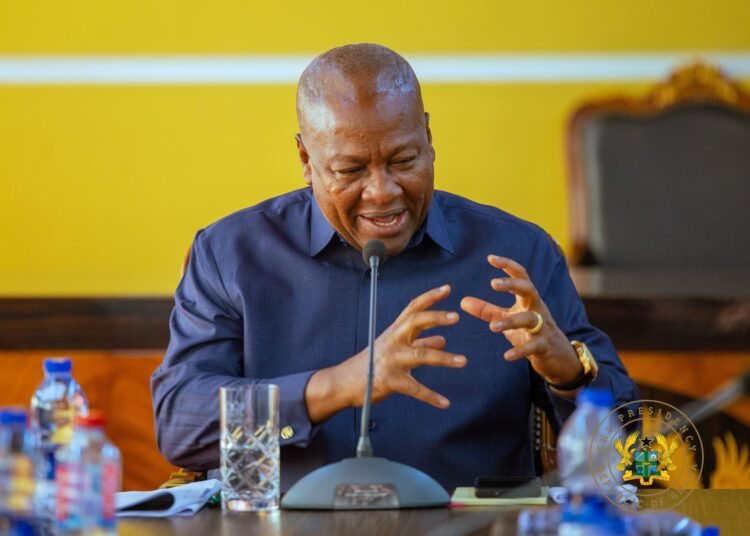
President John Dramani Mahama has dissolved the governing boards of nine state institutions with immediate effect, according to a Presidency Communications statement dated Wednesday, September 2, 2026, and signed by Spokesperson to the President and Minister for Government Communications Felix Kwakye Ofosu.
The affected institutions span the energy, financial, housing and sports sectors, and include Prestea Sankofa Gold Limited, Bulk Oil Storage and Transportation Company Limited, Volta Aluminium Company Limited, Consolidated Bank Ghana Limited, Ghana Post Company Limited, the Road Maintenance Trust Fund, TDC Ghana Limited, the Ghana National Petroleum Corporation and the National Sports Authority.
What the Statement Says
The Presidency’s release was brief and did not assign a reason for the dissolution. “Relevant sector Ministers have been directed to take all necessary steps, in accordance with the applicable laws and governing instruments, to give effect to the dissolution of these Boards,” the statement said. It added that the affected boards would be reconstituted in due course.

A separate letter from the Office of the President, signed by Secretary to the President Dr Callistus Mahama, provided operational detail beyond the public statement.
It directed relevant authorities to formally notify members of the dissolved boards and confirmed that management teams at the affected institutions would continue overseeing day-to-day operations under the supervision of their respective sector ministries pending reconstitution.
Crucially, the letter specified that management would not be permitted to take major policy, financial or contractual decisions requiring board approval without prior authorisation from the appropriate authority, a safeguard intended to prevent a governance vacuum while new boards are assembled.
Timing Against a Backdrop of SOE Scrutiny
The dissolution arrives days after the State Interests and Governance Authority released its 2025 State Ownership Report, which found that Ghana’s state-owned enterprises swung from a GH¢2.25 billion net loss in 2024 to a GH¢19.8 billion net profit in 2025, ending four consecutive years of losses.
That report also flagged persistent underperformers, including five SOEs that recorded losses in every year from 2021 through 2025, and noted that dividend payments to government had declined even as overall sector profitability improved.
None of the reporting on Wednesday’s dissolution has confirmed a direct causal link between the SIGA findings and the board changes, and the Presidency’s own statement offered no stated rationale.
The proximity of the two developments, however, places the decision within a period of heightened attention to how effectively Ghana’s state enterprises are governed and performing.
Part of a Broader Pattern
Wednesday’s action follows an earlier blanket directive President Mahama issued dissolving statutory boards, corporations, commissions and councils appointed by the previous administration, in accordance with the Presidential (Transition) Act, 2012.
Under that directive, individuals appointed to boards by former President Nana Addo Dankwa Akufo-Addo or a former Minister of State ceased to hold office on January 7, 2025, the date of President Mahama’s swearing-in, though the Presidency clarified at the time that the cessation did not affect independent constitutional creations.
The National Sports Authority’s now-dissolved board had been constituted for the 2025-2029 period and was chaired by Dr Fred Awaah, with representation from the security services, tertiary institutions, the National Paralympic Committee and the Ghana Olympic Committee alongside sporting personalities and development specialists, illustrating the scale of institutional turnover the latest directive triggers across just one of the nine affected entities.

What Happens Next
With management teams instructed to maintain only routine operations and defer major decisions until new boards are seated, the practical consequence of Wednesday’s directive is a pause in strategic decision-making at nine institutions spanning some of Ghana’s most consequential state assets, including its national oil corporation and its state-owned bank.
The Presidency has not indicated a timeline for reconstituting the boards, leaving the duration of that pause an open question.
READ ALSO: BoG’s Digital Credit Rules Could Reshape Borrowing Costs and Access