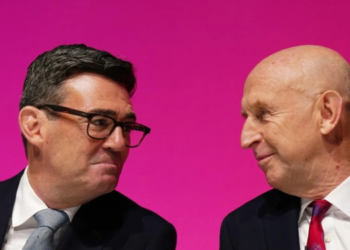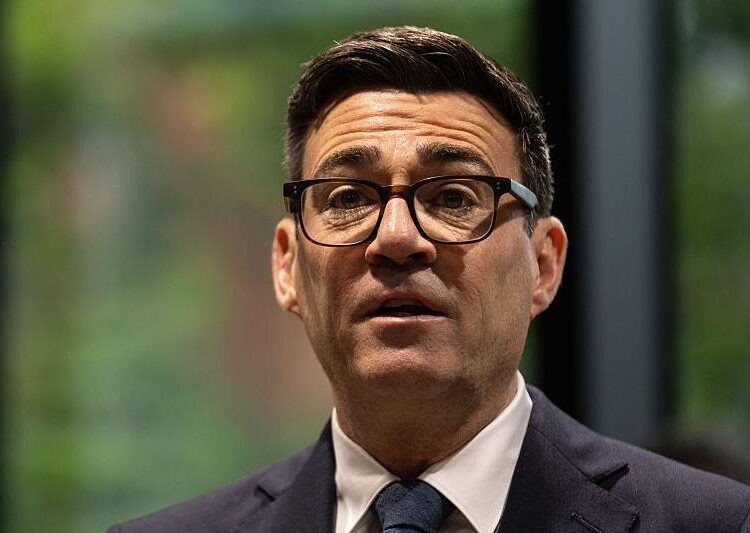
UK Prime Minister Andy Burnham has defended his government’s decision to impose sanctions on trade with illegal Israeli settlements in the occupied West Bank, insisting that Britain must demonstrate leadership by taking action against injustice.
Speaking during Prime Minister’s Questions (PMQs), Burnham rejected criticism from Conservative Party leader Kemi Badenoch, who accused him of being “continuity Keir” and questioned his government’s approach to national security, defence spending and foreign policy.
Burnham used the exchange to argue that Britain’s international role should be defined not only by its military strength but also by its willingness to act when people are subjected to intimidation, displacement and injustice.
Responding to Badenoch’s accusation, Burnham stated that, “Britain has to stand for something. Britain has to show leadership. Britain has to stand for fairness against injustice, where people are being bullied out of their homes, intimidated.”
His remarks come after UK government imposed sanctions aimed at economic activity linked to Israeli settlements in the West Bank.
The Israeli government has condemned the measures and responded with punitive diplomatic moves, including the closure of the British consulate in East Jerusalem and restrictions on the entry of British legislators and a campaigner.
Israeli Prime Minister Benjamin Netanyahu has also criticised the British position, urging Britain to reverse course and “stand beside us in the fight against evil.”
According to the Israeli Prime Minister, “it is not too late. Britain can still remember who it once was and choose to become that nation again.”
Burnham, however, argued that successive British governments had spent decades supporting the principle of a two-state solution without necessarily matching those declarations with meaningful action.
“There have been Conservative politicians at this despatch box, Labour politicians too, for decades, who’ve talked about the importance of the two-state solution between Israel and Palestine.
“Words from any politician about a two-state solution will be only words if it’s not backed with action. And leadership is about taking action.”
Andy Burnham
The Prime Minister also praised Conservative MP Sir Edward Leigh for supporting the sanctions, describing his backing as significant in a “difficult and dangerous world.”
Defence Spending Becomes Major PMQs Battleground
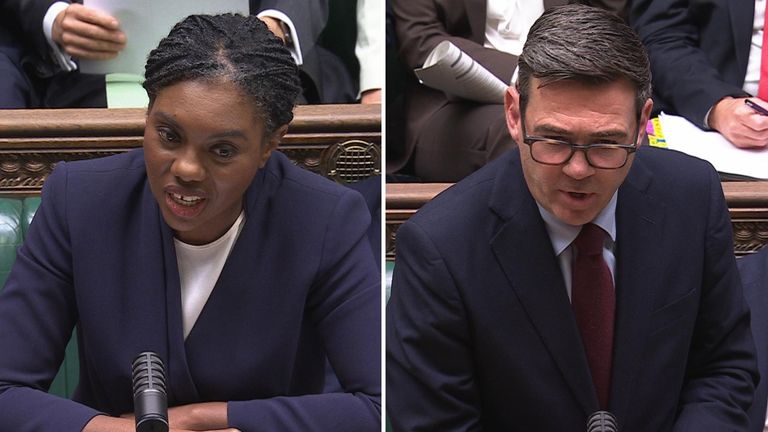
Meanwhile, Conservative Leader Kemi Badenoch raised concerns about Burnham’s government’s ability to achieve its defence promises, notably its ambitions to boost spending as a percentage of GDP.
She stated that major challenges to national security could not be postponed and questioned whether former Defence Secretary John Healey was correct to resign from his position under former Prime Minister Keir Starmer after failing to get the spending pledges he desired.
Burnham defended Healey’s record, stating that he appointed him because of his strong commitment to defence.
“We will honour our Nato commitments,” Burnham noted, pointing to the government’s commitment to spend 3.5% of GDP on defence by 2035.
He indicated that a target date for reaching 3% of GDP would be announced during the expenditure review.
Burnham also attacked Badenoch’s attempt to take the moral high ground on defence spending, citing the Conservative government’s record.
He stated that under the Conservatives, defence spending amounted to 2.3% of GDP, and urged lawmakers to focus on practical solutions rather than political points.
“On this issue, we should do more problem solving than points scoring,” he stated.
Badenoch rejected the argument and described Burnham’s position as “unbelievable,” shifting the discussion towards how the government intended to finance its defence commitments.
She cited the decision by Chris Rokos, described as the UK’s third-biggest taxpayer, to leave the country and argued that the departure could cost the Treasury an estimated £330 million in tax revenue.
Badenoch suggested that the lost revenue could instead have contributed towards increased defence spending.
She also pointed to the Rosebank oil field, which the government has not yet approved, as another potential source of funding.
However, Burnham countered that the government’s approach would seek to reduce welfare costs through structural reforms rather than through what he described as crude reductions in housing support.
He argued that expanding social housing would reduce the government’s long-term expenditure on housing benefits, while policies aimed at increasing employment among young people would further reduce welfare spending.
The Prime Minister further argued that Badenoch’s criticism of Labour’s defence record ignored the historical trajectory of UK military spending.
He stated that defence spending stood at 2.5% of GDP when Labour had last left office and had subsequently fallen to 2.3% under the Conservatives.
Burnham maintained that his government had a “fully funded plan” and called for cooperation across Parliament to establish a credible path towards 3.5% of GDP by 2035.
He invited Badenoch to work with the government rather than focusing solely on political attacks.
Badenoch nevertheless maintained that the government lacked clarity over how the additional defence spending would be financed, arguing that Britain faced growing challenges to its sovereignty and national security.
READ ALSO: Banking Giants Battle for Control of Société Générale Ghana