Development Bank Ghana (DBG) is pushing for a major rethink of how Ghana’s technology businesses are financed, warning that the financing gaps holding back the sector cannot be solved with a single formula.
The state-backed development finance institution believes that unlocking the full potential of Ghana’s Information and Communication Technology (ICT) sector will require financing instruments designed around the realities of individual businesses and value chains.
The call follows a nationwide feasibility study conducted by DBG, which identified financing, policy alignment, investor readiness and business development support as some of the major barriers confronting ICT businesses across the country.
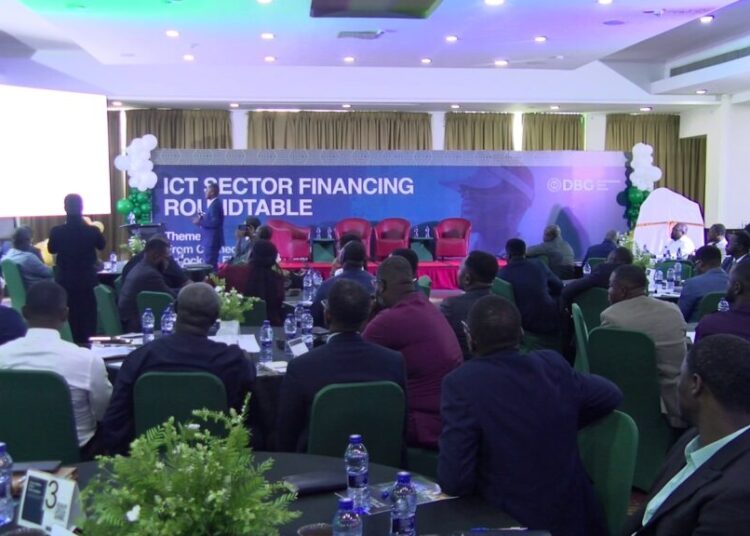
Speaking at an ICT roundtable discussion in Accra, DBG Chief Executive Officer, Prof. Randolph Nsor-Ambala, urged stakeholders to move beyond simply identifying challenges and focus on practical interventions that can deliver measurable results.
Financing Access Alone Is Not Enough
For many technology businesses, securing funding remains one of the biggest obstacles to growth. But according to Prof. Nsor-Ambala, the discussion must go beyond simply asking how much money businesses can access.
He stressed that the structure and suitability of financing are just as important as access to capital.
“Our view of things is that it goes beyond just financing. When it comes to financing, it also has to do with the structure of the financing. What is the appropriate financing instrument they need?”
The distinction could be crucial for Ghanaian businesses operating in a rapidly changing industry where companies have different revenue models, growth cycles and capital requirements.
A technology start-up developing software, for example, may have completely different financing needs from a telecommunications infrastructure company, a digital payments provider or an ICT firm serving farmers.
DBG therefore wants financing solutions to reflect these differences instead of forcing businesses into the same funding model.
ICT Sector Too Diverse for One Formula
Prof. Nsor-Ambala stressed that Ghana’s ICT sector is made up of several value chains, each with its own opportunities, risks and financing requirements.
“The ICT sector is not homogeneous. The value chain is complex, and the peculiarities associated with the various streams of value chains require different actions,” he explained.
This means that a financing package that works for one category of ICT business may not necessarily work for another.
DBG’s proposed approach is to break down the challenges across the different segments of the ICT value chain and identify interventions that directly respond to their specific needs.
The objective is not simply to inject money into the sector, but to ensure that available financing helps businesses survive, expand, create jobs and become more competitive.
Prof. Nsor-Ambala also cautioned against relying on a blanket solution.
“We need to essentially disabuse our mind, first of all, from the one-size-fits-all solution,” he said.
For Ghana’s growing technology ecosystem, that shift could determine whether promising businesses receive the right support at the right stage of their development.
DBG Wants Measurable Results
DBG is also calling for stakeholders to agree on what success should actually look like.
Rather than launching programmes without clear indicators of impact, the Bank wants financiers, investors, engineers, innovators and ICT companies to work together to establish practical targets and continuously monitor progress.
The roundtable brought together key players from across the ecosystem, creating an opportunity for businesses and financial institutions to discuss the challenges they face and identify possible solutions.
Prof. Nsor-Ambala said continued engagement would be necessary to ensure that agreed interventions do not remain on paper.
The approach reflects DBG’s broader focus on evidence-based interventions aimed at addressing barriers to private-sector competitiveness and economic growth.

Building a Private Sector That Includes More Businesses
Beyond financing individual companies, DBG says its broader goal is to create a competitive and inclusive private sector.
Prof. Nsor-Ambala said the Bank does not want development opportunities to be concentrated among a small number of businesses.
“Our mandate is to create a competitive private sector. Competitive private sector essentially means that we do not believe in creating opportunities for just a few,” he said.
For smaller ICT companies and emerging innovators, access to appropriate financing and business development support could be particularly important.
Many businesses may have innovative ideas but lack the financial strength, investor readiness or managerial support needed to turn those ideas into sustainable enterprises.
DBG’s approach seeks to address those gaps while creating room for more businesses to participate in Ghana’s digital economy.
ICT Could Also Transform Ghana’s Agribusiness
DBG’s technology push is not limited to companies operating directly within the ICT industry.
Prof. Nsor-Ambala revealed that the Bank is also applying technology to address information challenges in Ghana’s agribusiness sector.
One major problem identified in the sector is limited access to reliable and relevant technical information for farmers.
Without timely information and extension support, some farmers struggle to make their activities more commercially viable or competitive.
DBG sees ICT as a relatively low-cost way of changing that situation. “One of the challenges we found within the agribusiness space was access to quality information that is relevant to the course of business of the farmers,” he said.
Through technology, farmers can potentially gain easier access to information and technical support that can help them make better decisions, improve productivity and scale their businesses.
Prof. Nsor-Ambala described ICT as a convenient tool for delivering information and democratising access to knowledge.
A Bigger Opportunity for Ghana’s Digital Economy
Businesses need financing that matches their circumstances, policies that support growth, investors who understand their risks and business development assistance that helps entrepreneurs turn opportunities into sustainable companies.
If those pieces come together, Ghana’s technology ecosystem could become a stronger engine for private-sector growth, innovation and job creation.
DBG’s latest position signals a move away from broad interventions towards more targeted solutions based on evidence from businesses operating on the ground.
Meanwhile, the entrepreneurs who have long complained about the difficulty of finding suitable financing, the approach could offer a new opportunity.
But the real test will be implementation.
The Bank and its partners will now have to translate the findings of the feasibility study into practical financing instruments and support programmes that businesses can actually access.
READ ALSO: Ghana’s SOE CEOs Answer to Politicians Rather Than Boards, IMF Finds