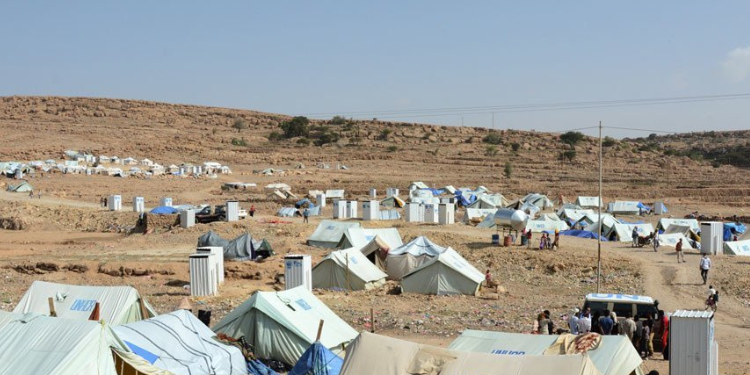
Yemen has recorded more than 104,796 internally displaced people, with violence along the West Coast continuing to drive families from their homes and intensify an already severe humanitarian crisis.
The latest figure, covering 17,461 households, was released by the International Organization for Migration (IOM) through its Displacement Tracking Matrix (DTM), highlighting the scale of population movement as violence continues to disrupt communities across several parts of the country.
The displacement is concentrated in several areas, with Taiz emerging as the main centre of population movement. More than 63,000 people have been displaced across districts in the governorate, with Jabal Habashi recording 21,018 displaced people, followed by Al Ma’afer with 12,642 and Ash Shamayatayn with 8,250.
Lahj has also recorded significant displacement, with nearly 26,400 people forced to leave their homes. The Al Madaribah Wa Al Aarah district accounts for much of the movement, with almost 19,000 people displaced.
Other governorates are also reporting rising displacement as fighting spreads. Aden has recorded more than 3,500 displaced people, while Al Abyan, Hadramawt and Ma’rib are also experiencing increasing population movements.
According to Amy Pope, IOM Director General, “Yemen is a country torn by war, displacement, poverty, and climate impacts. Overlooking the suffering of civilians is not acceptable as needs continue to rise.”
The displacement is not confined to Yemen. In neighbouring Djibouti, the number of people who have crossed from Yemen has reached 2,776, according to the latest data obtained.
As people arrive, IOM continues to provide immediate assistance, including 1,500 hot meals twice a day, while responding to the wider needs of displaced families and migrants.
Aid workers face growing difficulties in keeping pace with the movement of people. According to the situation outlined by IOM, the rate of displacement is outstripping the ability of humanitarian workers to track movements in real time.
IOM Expands Emergency Assistance
In response to the escalating needs, the International Organization for Migration (IOM) is assisting newly displaced families through its Rapid Response Mechanism (RRM), Shelter and Non-Food Item (NFI) assistance, and protection services.
The organisation is also using its Displacement Tracking Matrix to monitor population movements and generate real-time data intended to support the wider humanitarian response.
IOM currently operates in Aden, Ma’rib, Lahj and South Taiz, while maintaining the capacity to deploy teams to accessible areas as needs develop.
Since the start of the conflict, IOM’s RRM and Cash-Based Interventions team has registered and assisted 1,159 households with in-kind assistance. Emergency Multi-Purpose Cash Assistance distributions are also continuing despite increasingly constrained access.
IOM is also supporting 460 families with non-food item assistance and providing shelter support to 449 households.
At the same time, growing displacement is exposing vulnerable groups, including internally displaced people and migrants, to heightened protection risks. IOM has provided protection services to 758 people in Ma’rib, Aden and Lahj.
The organisation is also preparing for further emergency needs through its water, sanitation and hygiene response. As manager of the WASH Cluster emergency pipeline, IOM has approximately 8,000 pre-positioned WASH kits in Aden and Ma’rib, which are ready for deployment within 72 hours.
Beyond direct assistance, IOM maintains a broader coordination role within Yemen’s humanitarian response. It co-leads the Refugees and Migrants Multi-Sector response and the RRM at the national level.
The organisation also manages the Humanitarian Hub in Ma’rib, which hosts eight United Nations agencies, while co-leading the Shelter, Land and Site Management Cluster and the WASH Cluster.
IOM additionally serves as the Shelter, Land and Site Management Cluster Area of Responsibility lead in Aden and co-chairs the Yemen Cash and Markets Working Group.
These coordination responsibilities are increasingly important as humanitarian organisations attempt to respond to displacement across multiple locations while access remains constrained.
With over 104,000 persons internally displaced, the most recent numbers indicate that the problem is spreading beyond specific areas of conflict. Population movements in Taiz, Lahj, Aden, and other governorates show how fresh or ongoing violence affects communities across a larger geographical area.
The influx of thousands of refugees into neighbouring Djibouti highlights the crisis’s broader scope, as people seek refuge outside Yemen’s borders.
IOM is urging donors to contribute cash for the humanitarian response before additional families are forced to leave their homes without enough help.
The organization warned that the situation is still volatile, with more displacement predicted in the coming days.
READ ALSO: We Refuse to Repeat Last Season’s Survival Struggles – Young Apostles Captain