Ghana is aggressively leveraging the global diplomatic stage to rebuild fiscal resilience, expand industrial trade, and lead sub-Saharan Africa’s transition into high-tech automation.
President John Dramani Mahama is leading a high-powered Ghanaian delegation at the 81st United Nations General Assembly (UNGA) in New York, initiating critical bilateral talks aimed at attracting direct foreign investment and accelerating cross-border economic transformation.
Flanked by the newly appointed Minister for Trade, Agribusiness and Industry, Hon. Elizabeth Ofosu-Adjare, the President is holding targeted talks with global heads of state, development finance experts, and multilateral leaders.
The engagements, unfolding under the main assembly theme, “Restoring Trust, ManagingTransformation: A United Nations That Delivers for All,” focus heavily on digital technology deployment, alternative trade partnerships, agricultural industrialization, and continental financial sovereignty.
The Ghanaian executive team is aggressively promoting the country as West Africa’s primary commercial hub. On the sidelines of the assembly, President Mahama holds crucial bilateral discussions with Kenyan President William Ruto.
The high-level meeting between the two African leaders focuses on expanding intra-African trade under the framework of the African Continental Free Trade Area (AfCFTA), enhancing regional security apparatuses, and presenting a unified African voice on global climate finance and macroeconomic reforms.
Turning toward the Middle East and Europe, the President engages in strategic diplomatic talks with Jordan’s King Abdullah II ibn Al Hussein and Swiss President Guy Parmelin.
These sessions center on diversified investment, sustainable industrial production, and mutual technical cooperation.
By deepening diplomatic ties with Switzerland, a major destination for Ghanaian gold and cocoa exports. The delegation is seeking to secure fairer trade conditions and maximize value addition within the domestic production pipeline.
Advancing AI and Securing Africa’s Financial Sovereignty
Beyond traditional trade pacts, the delegation’s agenda features a profound focus on the emerging digital landscape and global financial restructuring.
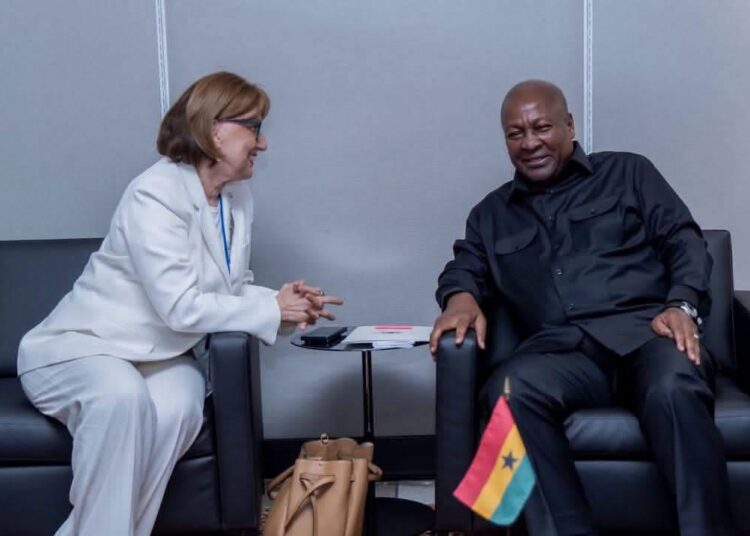
President Mahama meets with UN Secretary-General António Guterres and Rebeca Grynspan, the Secretary-General of UN Trade and Development (UNCTAD), to advocate for reforms in the global financial architecture.
The Ghanaian administration continuously emphasizes that the current international economic system disadvantages developing economies, calling for more flexible lending terms, debt relief mechanisms, and independent financial structures that allow African nations to grow without suffocating debt burdens.
Simultaneously, the administration is prioritizing advanced technology as a catalyst for leapfrogging development. The New York meetings delve deeply into the ethical integration of Artificial Intelligence (AI) within governance, healthcare, and state administration.
The administration views AI not as a distant luxury, but as an immediate tool to optimize port operations, improve industrial logistics, and scale up agricultural yields.
In discussions with Queen Máxima of the Netherlands, who serves as the UN Secretary-General’s Special Advocate for Inclusive Finance for Development, the Ghanaian team focuses heavily on digital financial inclusion.
The dialogue aims to secure international technical backing to expand digital banking services to rural populations, formalize micro-enterprises, and protect smallholder farmers against sudden climate disruptions.
Industrializing Agribusiness and Protecting Local Markets
A critical pillar of Ghana’s aggressive representation in New York is the promotion of its revised industrial and agricultural frameworks. Hon. Elizabeth Ofosu-Adjare, drawing upon her extensive legislative and legal expertise, is actively participating in high-level trade roundtables to champion Ghana’s new market landscape.
Her presence highlights a deliberate shift toward connecting raw agricultural yields with heavy industrial manufacturing.
The Ministry for Trade, Agribusiness and Industry is presenting global investors with concrete opportunities within the sub-region. Fresh off announcing a massive $200 million government commitment to expand Ghana’s tree crop sector.
‘’This Initiative is Specifically Aimed at Scaling up the Cashew, Oil Palm, and Coconut Value Chain,’’ Hon.Ofosu-Adjare is pitching Ghana as the premier destination for agro-processing plants.
The administration emphasizes that the country is actively moving away from exporting raw commodities, offering lucrative incentives to international firms ready to build factories within the Tema Free Zones Enclave and other designated industrial parks.
Elevating the “Accra Reset” and Global Justice
The economic push is tightly synchronized with Ghana’s broader foreign policy objectives. President Mahama is utilizing the global platform to host two landmark side events aimed at redefining international development paradigms and advancing continental pride.
The first, dubbed the “Accra Reset,” convenes global policymakers under the banner “Full Circle: Making Global Development Work Again,” challenging traditional aid models in favor of reciprocal trade agreements.
The second major forum addresses the pressing issue of Reparatory Justice, focusing on international cooperation for the return and restitution of African cultural properties and heritage stolen during the colonial era.
By linking economic independence with cultural and historical restoration, the Ghanaian delegation is projecting a comprehensive vision of national sovereignty.
As the UNGA general debate continues, the Ghanaian delegation remains locked in continuous negotiations. The targeted engagements signal a sophisticated diplomatic strategy: converting political goodwill into verifiable investments, ensuring technology transfers, and laying the groundwork for a structural economic turnaround that delivers sustainable, long-term wealth for the Ghanaian people.
READ ALSO:GHS Set to Vaccinate 440,000 Girls Aged 9–15 Against HPV