
The Africa Centre for Energy Policy (ACEP) is demanding greater transparency over the finances of Ghana’s Uniform Petroleum Pricing Fund (UPPF) after an Auditor-General’s performance audit identified a GH¢2.05 billion gap between receipts and expenditure during the period under review.
ACEP says the finding raises a broader policy question over how petroleum-pricing margins are determined, accumulated and accounted for, particularly as charges embedded in fuel prices have grown into significant revenue streams.
Figures cited by the organisation show that the UPPF received GH¢13.22 billion, against reported expenditure of GH¢11.17 billion, leaving a difference of GH¢2.05 billion.
ACEP has stopped short of describing the balance as evidence of misappropriation. Instead, it wants the financial position of the fund reconciled and the basis for retaining or applying any surplus clearly established.
UPPF Margin Has Expanded Sharply
The UPPF was created to support the equalisation of petroleum transportation costs across Ghana, allowing petroleum products to be distributed nationwide without transportation costs creating major differences in pump prices between regions.
The principle provides an important consumer-protection function. Fuel supplied to a remote market can cost more to transport than fuel delivered closer to a refinery, port or major storage facility. The equalisation mechanism spreads part of that cost across the national market.
ACEP, however, believes the size of the margin now warrants closer examination.
The organisation cited an increase in the UPPF margin from 22 pesewas per litre in 2018 to 90 pesewas in 2024, representing an increase of more than 300%.
That expansion changes the significance of the margin.
A charge that appears relatively small when applied to a single litre can generate substantial sums when multiplied across national petroleum consumption.
Once such collections reach billions of cedis, questions about their calculation, expenditure and oversight become matters of public financial governance rather than merely technical petroleum-pricing issues.
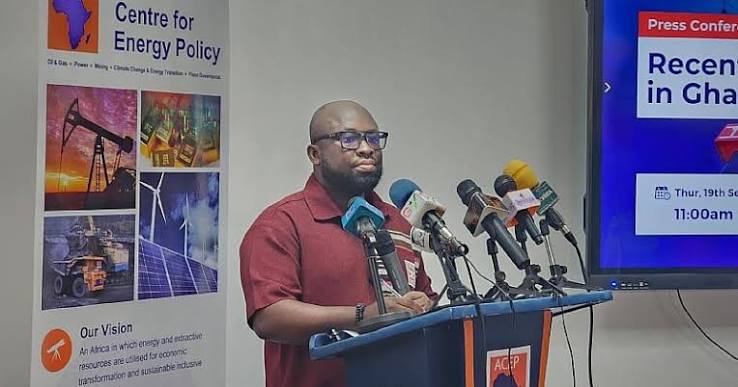
Kodzo Yaotse, Policy Lead for Petroleum and Conventional Energy at ACEP, said the organisation has repeatedly sought greater visibility into the fund’s operations.
“We have tried countless times to get a certain breakdown on how the fund is managed.”
For ACEP, the issue is therefore not simply whether the UPPF has a legitimate purpose. It is whether the financial arrangements supporting that purpose remain proportionate, transparent and sufficiently accountable.
Regulatory Margins Draw Fresh Scrutiny
ACEP estimates that regulatory margins incorporated into petroleum prices generate about GH¢7.6 billion annually, compared with approximately GH¢9.7 billion collected through petroleum levies.
The distinction between the two is central to the organisation’s concern.
Petroleum levies are established through legislation and subject to parliamentary processes, while regulatory margins are administered within the petroleum-pricing framework.
Both ultimately affect the cost of petroleum products, but they can operate through different accountability structures.
ACEP argues that the growing financial value of regulatory margins makes that distinction increasingly important.
The question is not necessarily whether regulators should be permitted to impose charges connected to their functions. Rather, it is whether consumers and Parliament have sufficient visibility over how significant collections generated through those charges are subsequently used.
This becomes particularly relevant when expenditure financed through petroleum margins could otherwise ordinarily be accommodated through the national budget.
Mr Yaotse questioned why certain public expenditures should be recovered through the petroleum-pricing mechanism rather than being subjected to normal budgetary processes.
“If government wants money to buy fuel for security agencies, there are appropriate mechanisms which is passed into the budget. But why do you ask your regulator to charge certain costs under the guise of transporting commodities?”
Kodzo Yaotse, ACEP
The argument points to a wider issue in Ghana’s energy-sector financing: the growing use of charges attached directly to energy consumption to finance activities beyond the immediate cost of supplying that energy.
GH¢2.05bn Difference Requires Explanation
The most immediate issue arising from the Auditor-General’s performance audit is the GH¢2.05 billion difference between UPPF receipts and expenditure.
The figures presented by ACEP show GH¢13.22 billion in receipts compared with GH¢11.17 billion in expenditure.
The difference should not automatically be treated as an unexplained loss.
A fund can legitimately carry a balance because expenditure may occur at a different time from collections, future obligations may not yet have fallen due, or financial buffers may be required for its operations.
What matters is whether the balance has been properly reconciled and whether there is a clear legal and financial basis for its treatment.
ACEP is therefore calling for greater clarity over the destination and status of the GH¢2.05 billion.
That distinction is important because an audit variance and financial misconduct are not the same thing. The former establishes a figure requiring explanation; the latter requires evidence beyond the existence of a difference between receipts and expenditure.
ACEP has also raised concerns about procurement and the beneficial ownership of companies involved in activities financed through the mechanism. Those concerns, however, do not by themselves establish wrongdoing.
They instead strengthen the case for detailed disclosure of how UPPF resources are collected, committed and disbursed.
Equalisation Policy Faces Efficiency Test
There is also a substantive economic question behind the debate.
The UPPF effectively operates as a cross-subsidy. Consumers contribute to a national mechanism that helps absorb the cost of moving petroleum products to areas where transportation distances and logistics costs are higher.
That arrangement can support national price uniformity and protect consumers in remote communities.
But equalisation also creates a need for accurate costing.

If the amount collected through the margin rises substantially faster than the underlying cost of transporting petroleum products, the mechanism could accumulate resources beyond what is required for its original purpose.
ACEP has therefore questioned whether the margin should be continuously assessed against actual transportation costs.
Mr Yaotse captured the distributional concern by asking:
“Why should my consumption subsidise their consumption?”
The question does not necessarily invalidate the equalisation principle. Instead, it raises the issue of how the subsidy should be calculated and who should ultimately bear its cost.
For policymakers, the challenge is to preserve nationwide access to reasonably uniform petroleum prices without allowing the mechanism to become a source of opaque or excessive collections.
Billions In Fuel Margins Raise Governance Stakes
The scale of petroleum-related collections means the UPPF debate cannot be isolated from Ghana’s wider downstream pricing system.
Fuel prices already incorporate several taxes, levies and regulated margins. These components accumulate through every litre sold and ultimately influence the cost of transportation, logistics, agriculture, manufacturing and household consumption.
When margins rise, the impact is distributed across the economy.
That makes transparency important not only for public finance but also for energy affordability.

If consumers are paying a higher margin to finance a particular function, policymakers should be able to demonstrate the cost of that function and explain how the associated revenue is being used.
The same principle applies to accumulated balances.
A surplus may be entirely legitimate, but its existence should be accompanied by information explaining why it exists, what obligations it is intended to cover and whether retaining it remains consistent with the fund’s mandate.
Audit Finding Creates Policy Opportunity
The Auditor-General’s finding provides an opportunity to examine whether Ghana’s petroleum-pricing architecture has kept pace with the changing scale of the downstream sector.
A stronger system would provide regular disclosure of UPPF collections and expenditure, the basis for calculating the margin, transportation costs used in determining the charge and the status of any accumulated balance.

It would also make clear which expenditures fall within the fund’s mandate and which require separate budgetary approval.
Such measures would not require abandoning the equalisation principle.
Instead, they could strengthen confidence in it.
The policy objective should be to ensure that consumers pay for a clearly defined service at a charge that reflects its actual cost, while maintaining adequate resources to meet legitimate future obligations.
Accountability Must Match Collection Size
For Ghana’s downstream petroleum sector, the central issue is increasingly the relationship between the size of consumer-funded charges and the strength of the governance systems surrounding them.
As petroleum margins have expanded, the amounts collected through pricing mechanisms have become too significant to be treated solely as technical components of fuel pricing.
ACEP’s concerns therefore point to a broader reform question: whether regulatory margins generating billions of cedis should face stronger reporting, reconciliation and oversight requirements proportionate to their financial importance.
The GH¢2.05 billion difference identified by the Auditor-General does not, on its own, establish that funds have been lost or misused.
It does, however, create a clear accountability requirement.
The UPPF was established to support an identifiable national purpose. Ghana now needs to demonstrate that the money collected for that purpose is being calculated transparently, spent efficiently and accounted for completely.
That would allow the equalisation mechanism to continue serving its consumer-protection role without leaving avoidable questions over the billions of cedis moving through it.