Ghana’s investment landscape is showing signs of increasing diversification as new projects, expanding industries and regional investment opportunities continue to emerge across the country, with the Ghana Investment Promotion Authority (GIPA) using its latest newsletter to spotlight developments in aquaculture, manufacturing and regional economic growth.
The September edition of the GIPA Newsletter highlights developments ranging from Flosell Farms’ expansion of aquaculture activities along the Volta River to the growth of Northshore Apparel Ghana Limited in Savelugu, while also drawing attention to the investment potential of Ghana’s northern regions.
The publication comes against the backdrop of renewed efforts to position Ghana as an attractive destination for both domestic and international investment. GIPA’s 2025 Annual Investment Report recorded US$2.62 billion in foreign direct investment in 2025, compared with US$651.7 million in 2024, with the investments spread across 245 new projects and existing companies.
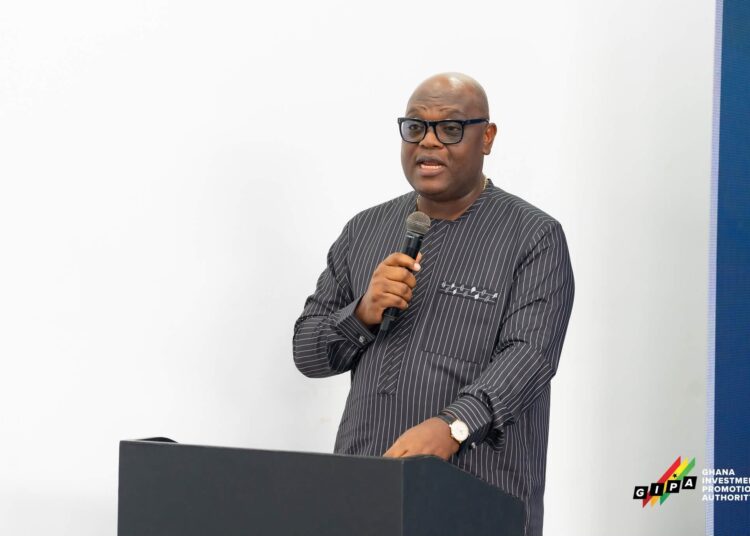
GIPA Chief Executive Officer, Mr Simon Madjie, has stressed that investment should be viewed beyond the immediate inflow of capital, noting that foreign direct investment also encompasses machinery, equipment, raw materials and other components that contribute to economic activity.
“Foreign Direct Investment goes beyond cash inflows; it also includes investments in machinery, equipment, raw materials and other components, and therefore, if we are to properly understand the scale and impact of investment activity in Ghana, we need stronger coordination among institutions so that we can develop a comprehensive picture of the investments taking place across the economy.”
CEO of GIPA, Mr. Simon Madjie
Flosell Expands Aquaculture Opportunities
Among the enterprises featured is Flosell Farms, an aquaculture company operating in the Volta Region, where fish production activities are linked to the resources of the Volta River.
The company, based in Sogakope, has developed expertise in fish farming, hatchery operations, fingerling production and fish pond management. Its operations include both land-based and lake-based production, with activities covering the production cycle from egg collection and fertilisation to fingerling development and harvesting.
The Volta Regional Coordinating Council has identified the company’s activities as part of the region’s wider potential in aquaculture and related value chains, particularly under efforts to develop the Volta Lake Economic Corridor.
During a working visit to Flosell Farms, the company’s Chief Executive Officer, Mr Evans Kwadzo Danso, took officials through its tilapia production processes, including its lake-based operations.
The farm has also previously hosted aquaculture training and internship activities, with its operations described as combining local resources with modern aquaculture practices.
An earlier programme at the farm involved practical training in fish hatchery operations and sustainable aquaculture, while the company has also explored the use of soy-based feed and opportunities to support other farmers through outgrower arrangements.
Mr Danso has previously emphasised the importance of developing Ghana’s aquaculture sector through practical knowledge, modern production systems and opportunities that can expand domestic fish production.
The focus on aquaculture is significant because investment in the sector can extend beyond fish production to areas such as feed manufacturing, hatcheries, cold storage, transportation, processing and distribution
Northshore Drives Industrialisation in Savelugu
The GIPA newsletter also highlights Northshore Apparel Ghana Limited, whose establishment in Savelugu has emerged as a major example of industrial investment outside Ghana’s traditional commercial centres.
President John Dramani Mahama inaugurated the facility in August 2026 as part of the government’s 24-hour economy initiative. The wholly Ghanaian-owned facility currently has 50 sewing lines across a 40,000-square-metre production facility on a 50-acre campus.
With supporting facilities including a cutting and design centre, warehouses and worker support infrastructure. The company has already trained and deployed more than 2,300 operators.
President Mahama described the project as evidence that large-scale manufacturing could be established successfully in Northern Ghana.
“This is an example of what our vision, the 24-Hour Economy in each city is meant to do. Northshore is going to run several shifts, and it means that several young people would get jobs to do.”
President of Ghana, John Dramani Mahama
The company is being developed in three phases. The second phase is expected to increase sewing capacity to 200 lines, while also incorporating a cotton facility and additional solar power generation with battery storage.
The third phase is expected to include a fabric mill and cotton out grower scheme.The development is also expected to stimulate supporting businesses in areas such as cotton production, packaging, transport, catering and other services.
Presidential Adviser on the 24-hour Economy and Accelerated Export Development, Mr Augustus Obuadum Tanoh, said the project could serve as an anchor for a broader industrial ecosystem in Savelugu.
“The next step after the Northshore factory is a cluster of garment producers around it. After the cluster, an industrial park, a veritable production corridor of light industry, anchored around Northshore Apparel.”
Presidential Advisor on 24-Hour Economy, Mr. Augustus Obuadum Tanoh
Northern Ghana’s Investment Potential
The developments featured in the newsletter point to growing interest in Northern Ghana as an investment destination, particularly in manufacturing, agribusiness and value-added production.
The Trade Minister, Mrs Elizabeth Ofosu-Adjare, has said the Northshore project demonstrates that the Northern Region can attract large-scale industrial investments, create employment and add value to locally available resources while contributing to Ghana’s export ambitions.
GIPA’s broader investment promotion agenda also includes identifying and communicating opportunities across different regions and sectors, with the Authority seeking to connect investors to projects capable of generating employment, expanding production and strengthening Ghana’s participation in regional and global markets.
GIPA Expands Investment Storytelling
Beyond individual projects, GIPA is also expanding how Ghana’s investment opportunities are presented to domestic and international audiences.
The Authority has partnered with media and research organisations to showcase opportunities across priority sectors through documentary and video content. In August, GIPA announced a collaboration with the Oxford Business Group (OBG) to produce a series of Global Platform videos examining investment opportunities in 12 priority sectors.
Mr Madjie said the initiative would help communicate Ghana’s investment proposition more clearly to international investors and business leaders.
“Through this series of Global Platform videos, we will highlight the country’s investment priorities, the work of its institutions and the sectors that can support future growth.”
CEO of GIPA, Mr. Simon Madjie
GIPA also maintains engagement with the media, on GIPAs business programmes to discuss investment developments, foreign direct investment and measures to ensure that investment contributes to job creation, technology transfer and broader regional development.
The latest newsletter therefore presents Ghana’s investment story through projects already creating economic activity while drawing attention to sectors and regions where further investment could expand production, employment and value addition.
As GIPA continues its investment promotion activities, the emphasis remains on identifying bankable opportunities, connecting investors with projects and institutions, and communicating Ghana’s economic potential to audiences within and beyond the country.
READ ALSO:Government Not Interested In Curtailing Freedoms — Government Communications Minister