Ghana’s trade with Africa swung from a GH¢12.3 billion surplus in the first quarter of 2026 to a GH¢4.4 billion deficit in the second, after a sharp increase in imports from South Africa changed the regional balance.
The Ghana Statistical Service’s Quarter Two Trade Newsletter shows Ghana exported GH¢19.2 billion of goods to African markets between April and June and imported GH¢23.6 billion. In the preceding quarter, exports to Africa were GH¢21.8 billion while imports were GH¢8.7 billion. In rounded figures, that represents a GH¢16.7 billion swing within three months.
The underlying merchandise series is compiled from Ghana Revenue Authority customs records and can be examined through the GSS trade database. The reversal matters because it occurred while Ghana’s overall merchandise account still recorded a GH¢13.8 billion surplus.
Machinery Shock Rewrites Balance
The largest change came from South Africa. Ghana imported GH¢11.8 billion of goods from the country in Q2, equivalent to about half of all imports from Africa. Pump parts alone were valued at roughly GH¢10 billion, representing 42.5 percent of Ghana’s total African import bill.
That concentration changes how the deficit should be interpreted. One machinery category accounted for a large share of the shift rather than an equally broad increase in purchases from every African market.
A simple arithmetic exercise illustrates the scale. Removing the GH¢10 billion pump parts line would reduce African imports to about GH¢13.6 billion, below exports of GH¢19.2 billion. This is not an estimate of what trade would otherwise have been, but it shows how strongly one import flow influenced the balance.
The GSS release does not identify the final use of those pump parts, so it would be premature to classify the entire increase as either consumption or productive investment.
Gold For Machinery
South Africa was simultaneously Ghana’s largest African export destination and supplier. It bought GH¢10.8 billion of Ghanaian goods, about 56.5 percent of exports to the continent, while supplying GH¢11.8 billion of imports.
The composition was highly asymmetric. Gold represented 99.8 percent of Ghana’s exports to South Africa, while machinery and electrical equipment accounted for 92.3 percent of imports from that market.
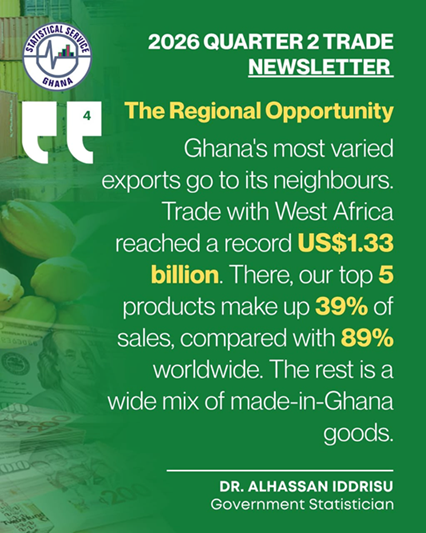
This pattern captures a structural feature of Ghana’s trade model. The country earns foreign exchange largely from primary commodities, then uses part of those earnings to purchase machinery, fuel and other imported inputs. Yesterday’s Q2 trade analysis showed gold alone generated GH¢78.4 billion, or 72.3 percent of total merchandise exports.
Machinery imports can weaken the trade balance and raise immediate foreign exchange demand, but they may support future output if tied to viable production or infrastructure. Without project level information, the prudent conclusion is that the composition deserves monitoring rather than an automatic negative interpretation.
West Africa Shows Broader Mix
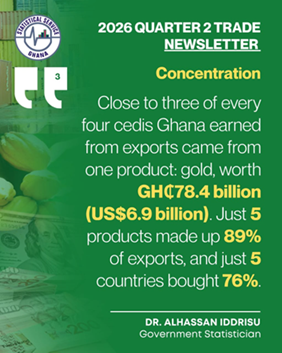
Ghana’s trade with West Africa reached a record US$1.33 billion in Q2. Exports to the subregion were GH¢6.18 billion against imports of GH¢8.86 billion, producing a GH¢2.68 billion deficit.
Yet Ghana sold a much wider range of products to its neighbours than to the world. The top five products accounted for only 39.4 percent of exports to West Africa, compared with 89 percent globally. The basket included manufactured products such as baby nappies, tiles, plastics and steel products.
That makes the regional market strategically important even when the quarterly balance is negative. Ghana’s AfCFTA export project reflects the policy effort to expand value added trade within Africa rather than relying overwhelmingly on gold and other commodities.
Deficit Needs Careful Reading
A trade deficit is an accounting outcome, not by itself evidence of economic deterioration. Its significance depends on what is imported, how the imports are financed and whether they raise future productive capacity.
For Ghana’s external sector, the immediate issue is foreign exchange demand. African imports rose by GH¢14.9 billion between Q1 and Q2, while exports to the continent were lower.
That reinforces the liquidity question highlighted in reserve paradox analysis: strong export earnings do not automatically translate into equally strong foreign exchange availability at every point in time.

The structural challenge is different. Ghana’s trade with South Africa remains concentrated in gold on the export side, while its more diversified manufactured exports are finding a market closer to home in West Africa.
GSS has consequently emphasised widening what Ghana sells and where it sells, increasing domestic value addition and making greater use of the African Continental Free Trade Area.
The Q2 African deficit should therefore be read carefully. It exposes sensitivity to large import flows and concentrated commodity exports, but it also highlights the potential to use imported equipment productively while scaling the broader made in Ghana export mix already visible across West Africa.
READ ALSO: Import Surge Shrinks Ghana Trade Surplus 70%