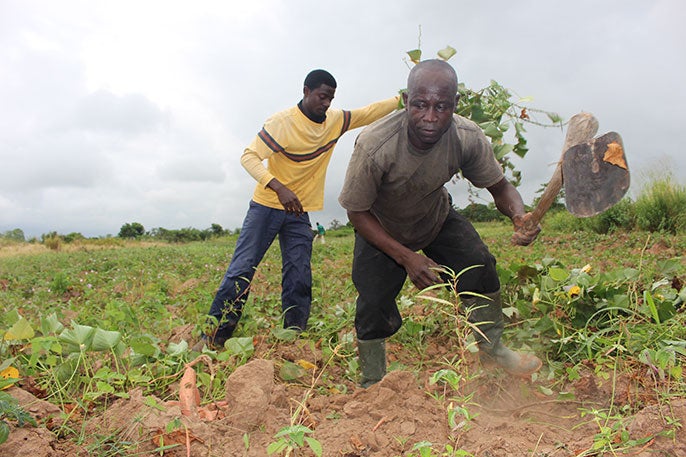
Agriculture’s share of Ghana’s total employment has fallen to 34.6 per cent in 2025 from 71.8 per cent in 1991, according to International Labour Organization modelled estimates published through the World Bank.
The 37.2-percentage-point decline means agriculture’s employment share has fallen by about 51.8 per cent relative to its 1991 level, marking one of the clearest long-run changes in the structure of Ghana’s labour market.
The decline does not mean the absolute number of people working in agriculture has necessarily halved. The indicator measures agriculture’s share of all employment, so population growth and expansion in other sectors can reduce the percentage even when agricultural headcounts remain sizeable.
What the series does show is that Ghanaian employment has become progressively less concentrated in farming, forestry and fishing. That shift is especially relevant in 2026 because the government has framed the current economic phase as a move ‘from stability to jobs’.
The policy challenge is no longer simply to move workers out of agriculture, but to ensure that workers entering services and industry find jobs with higher productivity, stronger earnings and greater security. The Vaultz’s earlier productivity test highlighted why that distinction matters for living standards.
Farm Share Halves
The long-run trend is persistent. The agriculture employment share stood at 64.0 per cent in 2000, fell below half to 48.8 per cent in 2010, declined to 43.4 per cent in 2015 and reached 37.4 per cent in 2020 before falling to 34.6 per cent in 2025. The ILO employment data therefore point to structural reallocation rather than a one-off labour-market movement.
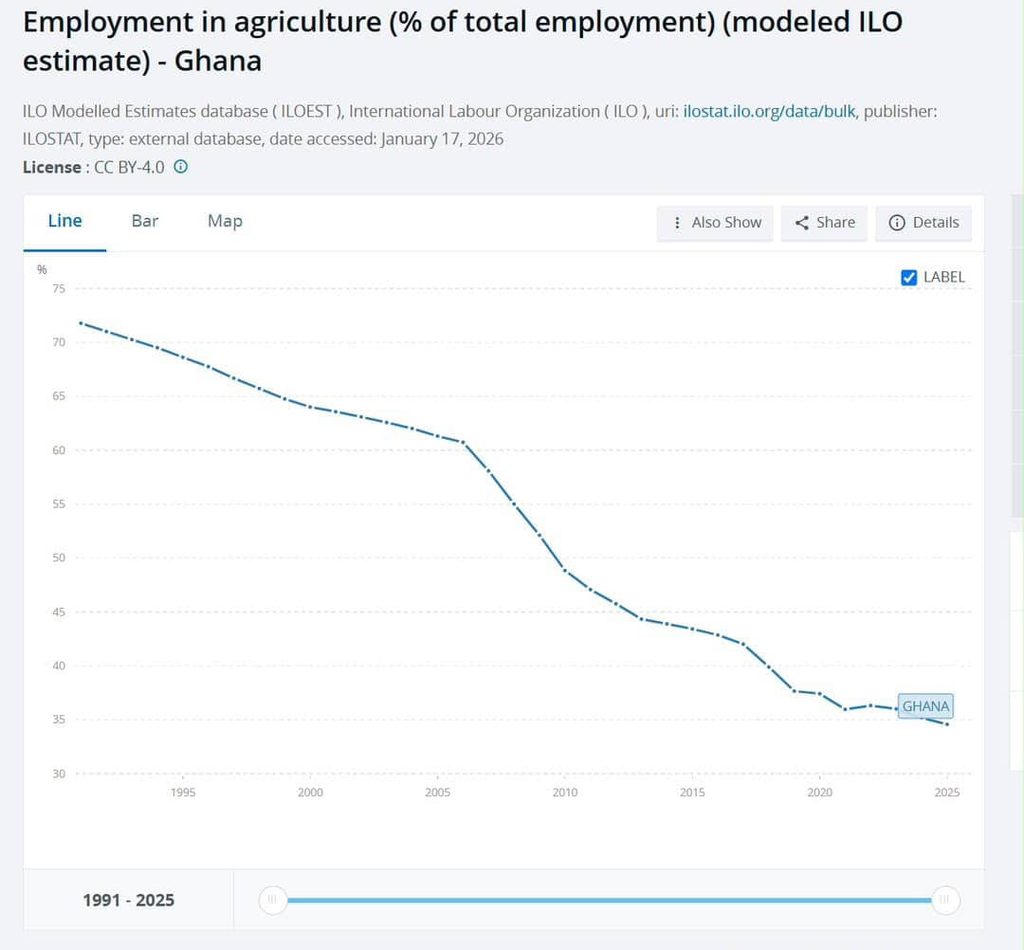
The pace has not been perfectly smooth. Agriculture’s share rose slightly in 2022 before resuming its downward path, but the longer trend is unmistakable. Compared with 1991, agriculture’s share of national employment has fallen by roughly half as other sectors have absorbed a larger proportion of Ghana’s workforce.
Services Take Lead
Ghana Statistical Service survey evidence points in the same direction, although the estimates are not directly interchangeable with the ILO modelled series. In the third quarter of 2025, GSS put services at 44.5 per cent of employment, agriculture at 37.2 per cent and industry at 18.3 per cent.
Across the first three quarters, services employed about 6.0 million people, agriculture 5.0 million and industry 2.5 million. The economic implication is more important than the ranking itself. A fall in agriculture’s employment share is normally associated with structural transformation only when labour moves towards activities that generate more output per worker.
If workers leave farms mainly for low-productivity informal services, the economy changes sectoral composition without capturing the full productivity gain usually associated with industrialisation and modern services.
Regions Diverge Sharply
The national average also conceals large regional differences. GSS data show agriculture accounted for 71.8 per cent of employment in the Savannah Region in the third quarter of 2025, while the share was only 3.6 per cent in Greater Accra. Services, by contrast, accounted for 74.0 per cent of Greater Accra employment.

That divergence means Ghana’s employment transition is occurring at different speeds. Policies that support high-value services, manufacturing and logistics in urban centres may have limited effect in regions where agriculture still employs most workers. In those areas, raising farm productivity, agro-processing and market access remains central to structural change rather than separate from it.
Productivity Becomes Test
The fall in agriculture’s employment share should therefore not be interpreted as evidence that farming is becoming economically unimportant. Ghana’s current strategy is simultaneously trying to raise agricultural output and reduce import dependence.
Recent food output gains show why fewer workers relative to the total labour force can coexist with a policy push for more domestic production if productivity rises.
That is the desirable transformation: agriculture producing more value with a smaller share of national labour, while industry and modern services absorb workers into activities with higher earnings and stronger productivity. The alternative is a numerical shift in employment shares without a corresponding improvement in job quality.
Jobs Define Next Phase
Ghana’s 2026 Budget makes that question current by placing job creation alongside commercial agriculture, agribusiness, infrastructure and economic transformation. The employment data provide a useful benchmark for judging that agenda.
The country has already moved a long way from the labour structure of the early 1990s; the harder task is determining what workers are moving into. If the next phase creates productive firms, stronger manufacturing, modern services and more efficient agriculture, the decline in farm employment share will represent deeper structural transformation.
If most new jobs remain informal and low-productivity, Ghana may continue to shift labour between sectors without securing the income gains that should accompany economic transformation.
READ ALSO: Gov’t Positions Economic Zones as Drivers of Jobs and Exports