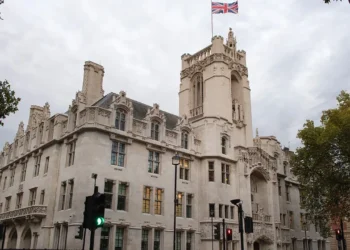
The Head of Britain’s Domestic Intelligence Service, MI5, Sir Ken McCallum, has warned that terrorists could exploit artificial intelligence (AI) to develop more sophisticated attacks involving drones and biological weapons, as United Kingdom confronts an increasingly complex national security environment.
Speaking after delivering his annual address at MI5 headquarters, the MI5 Chief stated that Britain had entered a “new era of national security.”
He warned that AI could expand the capabilities of terrorist groups, particularly by improving their reconnaissance and attack planning, while potentially lowering barriers to acquiring knowledge associated with chemical and biological weapons.
“We’ve caught terrorists seeking to exploit AI to improve their reconnaissance and attack methodologies.”
Sir Ken McCallum
The MI5 Director General also cautioned that hostile actors could target essential infrastructure, including banking systems, aviation and healthcare, through cyberattacks and other forms of disruption.
AI Raises Concerns Over Drones and Biological Weapons

MI5 Chief further identified the potential misuse of artificial intelligence as an emerging security challenge, warning that the technology could enable terrorists to improve existing methods of attack and potentially pursue more dangerous forms of weaponry.
He described the possibility of AI-enabled drones as adding “a new twist” to the threat posed by hostile actors, while identifying biological weapons as a particularly serious concern.
Sir McCallum explained that terrorist organisations had long sought access to chemical and biological capabilities, but acquiring the necessary knowledge and expertise had historically proved difficult.
He cautioned that advances in AI could change that calculation by making specialised information more accessible to individuals who might otherwise struggle to obtain it.
“One risk, and as I said in my speech, this is not yet manifest, but one risk is that AI could enable knowledge to get into the hands of people we would not want to have that knowledge.”
Sir Ken McCallum
MI5 Director General highlighted concerns that AI could potentially contribute to the development of novel pathogens that had not previously been identified, creating additional challenges for authorities responsible for preventing biological threats.
“In the case of bioweapons, one concern would be that comparatively low-sophistication actors may have a capability uplift in the AI era, if the guardrails don’t operate or do not function as intended.”
Sir Ken McCallum
However, he distinguished between emerging risks and confirmed threats, stressing that some of the most serious biological scenarios remained potential dangers rather than established developments.
To strengthen the country’s preparedness, MI5 has established an AI Threat Assessment Centre (AITAC), which will assess the security implications of the technology.
McCallum indicated that MI5, the Government Communications Headquarters (GCHQ) and the Secret Intelligence Service (MI6) were working with the UK’s AI Security Institute to address the risks and ensure that technological advances strengthened rather than undermined national security.
He called for continued investment in intelligence capabilities to ensure that security agencies could keep pace with hostile actors seeking to exploit AI.
Russia and Iran Intensify Britain’s State Security Concerns

Alongside the technological threat, McCallum warned that Britain was facing increasingly complex state-sponsored activities, particularly involving Russia and Iran.
He described Russia as “aggressor number one,” accusing its military and intelligence services of escalating hybrid warfare, including cyber operations and suspected sabotage attempts targeting infrastructure across Europe.
Among the incidents he cited were a cyberattack on Polish energy infrastructure and an attempt to use a drone to blow up a cargo plane in Germany.
McCallum also raised concerns about Iranian efforts to intimidate political opponents, Iranian media organisations and Israeli-linked sites through criminal intermediaries.
He referred to the suspected terrorist plot against RAF Fairford in Gloucestershire, which Prime Minister Andy Burnham stated was “almost certainly” directed by Iran’s Islamic Revolutionary Guard.
According to the MI5 Chief, the incident is not an isolated case, with Iranian-linked activity forming part of a broader campaign against British interests.
He disclosed that MI5 investigations had led to more than 50 arrests in Iran-linked operations in the UK over the preceding 12 months. The agency’s state threats caseload had also quadrupled over the past decade.
“You might be surprised to know that in 2026, MI5 is devoting more resources to countering state threats than during the Cold War,” he stated.
McCallum added that dozens of arrests had been made under the National Security Act since the legislation came into force three years earlier, involving cases linked to Russia, Iran and China.
He warned individuals against accepting payments from overseas actors to carry out suspicious activities on British soil.
The Intelligence Chief also cautioned that Iran could move towards more aggressive operations, noting that its activities in Britain had frequently involved recruiting criminals to carry out intimidation and other tasks.
MI5 Warns of Persistent Terrorism and Infrastructure Threats

Also, the MI5 Chief stated Britain continued to face threats from Islamist extremists seeking to carry out mass-casualty attacks, alongside an increase in extreme right-wing terrorism.
He highlighted cases in which anti-immigration and anti-Muslim grievances had developed into terrorist intent, warning that radicalisation among young people remained a serious concern.
The MI5 Director General cited an investigation involving a radicalised 13-year-old with extreme right-wing views in Britain. He noted that the investigation had generated intelligence that enabled an international partner to prevent a potentially lethal attack on its territory.
He also called for a “whole-of-society effort” to protect the country against threats to essential infrastructure, warning that cyberattacks could disrupt banking services, interfere with flights and compromise hospital operations.
McCallum revealed that the intelligence community is working to strengthen the country’s ability to identify and counter such threats. He also cautioned that the current environment should not be treated as a temporary departure from normal conditions.
READ ALSO: Fish and Feed Rewards Two BECE Stars