Reform UK and the Green Party are losing ground in public perceptions of their ability to form the next British government, with new YouGov polling suggesting that voters increasingly view Labour and the Conservatives as the country’s principal governing parties.
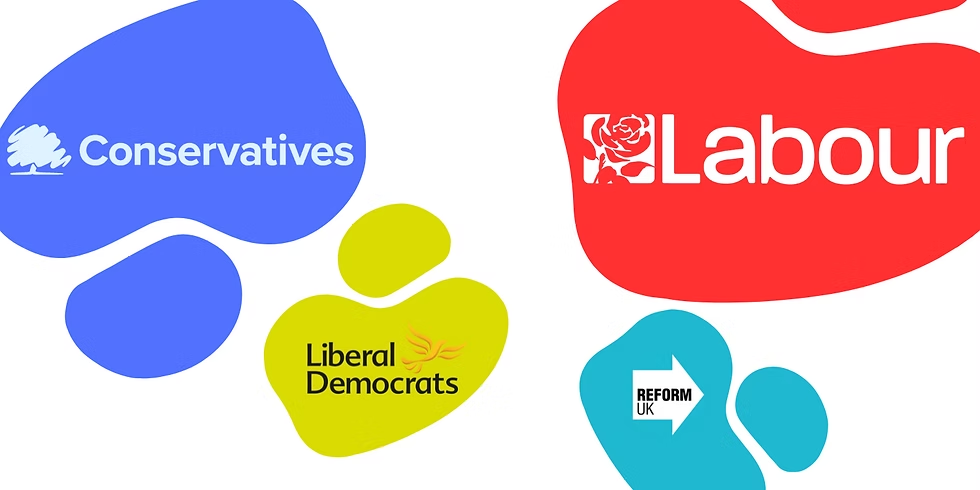
According to the latest YouGov figures, 90% of respondents consider Labour a main party, compared with 86% for the Conservatives.
Reform UK, led by Nigel Farage, has experienced the sharpest decline, with just 44% of voters viewing it as a main party capable of winning an election, down 17 percentage points from the previous month.
The Green Party, led by Zack Polanski, has also suffered a decline, with only 16% of respondents regarding it as a main party, an eight-point fall over the same period.
The Liberal Democrats, despite having more than 70 Members of Parliament, remain outside the group of parties widely perceived as capable of forming a government, with 34% of respondents holding that view, down four points in a month.
Reform UK Faces Declining Confidence Amid Party Controversies
The fall in confidence in Reform UK comes as the party struggles to maintain the electoral momentum it enjoyed after emerging as Britain’s most popular party in polling between March 2025 and August 2026.
A YouGov voting-intention poll placed Labour three percentage points ahead of the Conservatives and four points ahead of Reform, leaving Farage’s party in third place for a second consecutive week.
Reform’s declining support has coincided with a series of controversies surrounding the party’s finances and conduct. Nigel Farage has faced scrutiny over donations, with the standards commissioner investigating him, while police investigations have involved the party’s Treasury spokesman, Robert Jenrick, and deputy leader Richard Tice.
The party is also facing competition from Rupert Lowe’s Restore Britain, which has emerged as a potential challenger to its right.
Meanwhile, the Conservatives have experienced a gradual improvement in voting intention, rising from 19% to 21% in the polling aggregate.
Labour has also regained support among voters who had previously abandoned the party. The proportion of former Labour voters indicating that they would support it has risen from 49% following the departure of former Prime Minister Keir Starmer in June to 64% in the latest poll.
Among voters aged 18 to 24, Labour’s support has increased from 14% to 32% over the same period, while only seven per cent of respondents in that age group stated they would vote for Reform.
The Green Party has also struggled to translate its electoral challenge into broader national support. Although Polanski’s party contested the Holborn and St Pancras by-election earlier in October and challenged Labour’s majority, it finished more than 3,000 votes short of victory.
YouGov cautioned that the voting-intention trends did not yet establish a definitive return to a two-party system, although public perceptions of the party landscape appeared to be moving in that direction.
Coalition Options Divide Voters as Parties Rule Out Deals

The polling also examined public attitudes towards potential coalition governments, revealing that none of the combinations tested commands majority support or even the backing of a plurality of respondents.
The findings come amid political disagreements over possible post-election arrangements, including Conservative leader Kemi Badenoch’s declaration that she would prefer a second election to forming a coalition with Reform.
Labour has also faced questions about cooperation with the Greens, with Burnham ruling out an agreement unless the party abandons its conference motion titled “Zionism is racism,” which he has characterised as antisemitic.
According to YouGov, a potential coalition between Labour and the Liberal Democrats would divide public opinion equally. Under the scenario tested, Labour would be the largest party, and Burnham would serve as Prime Minister, with 42% of respondents supporting the arrangement and another 42% opposing it.
Conservative-led coalitions proved considerably less popular among the wider electorate.
YouGov found that only between 25 and 26% of Britons would support Badenoch leading a coalition with either the Liberal Democrats or Reform, while between 58 and 61% would oppose the respective arrangements.
The figures suggest that support for a party does not necessarily translate into public approval of its potential governing partnerships, particularly when those arrangements involve parties with competing political positions.
Among current Conservative supporters, however, both coalition options attracted majority backing. Some 68% supported a deal with the Liberal Democrats, compared with 60% who favoured an arrangement with Reform. At least 28% opposed either coalition option.
Liberal Democrat supporters were less receptive to a renewed partnership with the Conservatives. YouGov found that 58% of those currently intending to vote for the party opposed a repeat of the Conservative–Liberal Democrat coalition formed under David Cameron and Nick Clegg, while 36% supported it.
The findings contribute to a developing political discourse about whether British politics is returning to a more traditional struggle between Labour and the Conservatives.
While the latest figures do not establish that the country has returned to a two-party system, the decline in the proportion of voters who consider Reform and the Greens credible governing parties suggests that perceptions of political viability are changing alongside voting intentions.
READ ALSO: Bright Simons Questions Credibility of Ghana’s $28bn Petroleum Hub Deal