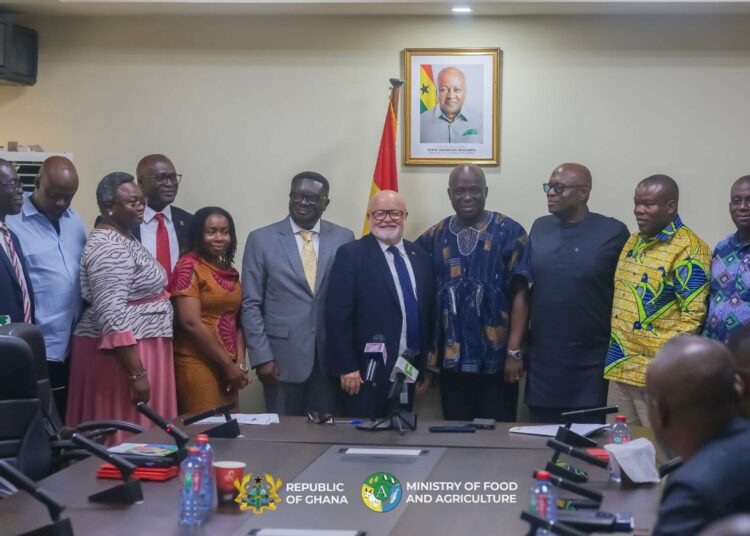
Ghana is moving to expand its agricultural storage infrastructure with plans to establish a 21,000-tonne grain storage facility in Wa, Upper West Region, following a partnership between the Ministry of Food and Agriculture (MoFA) and DMT Collateral Management Limited.
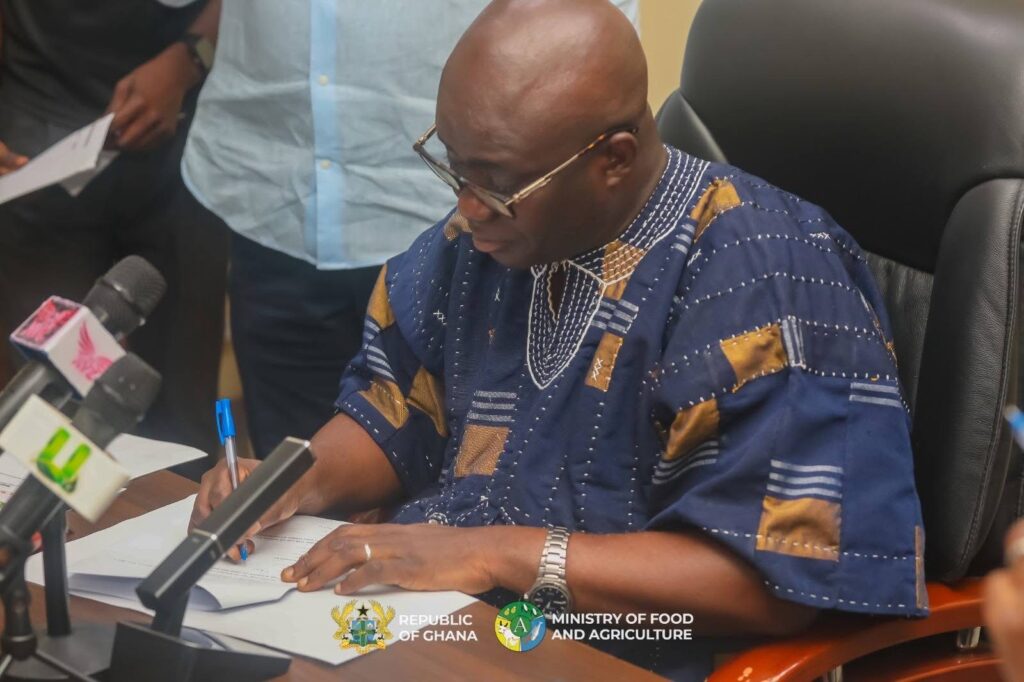
The agreement, formalised through a Memorandum of Understanding in Accra, forms part of the government’s Feed Ghana Programme, which seeks to strengthen domestic food production, improve agricultural value chains and reduce the country’s dependence on imported food commodities.
The project is expected to address longstanding constraints in Ghana’s agricultural supply chain, particularly inadequate grain storage, post-harvest losses and limited capacity to maintain strategic food reserves against production and supply disruptions.
The Minister for Food and Agriculture, Hon. Eric Opoku, commended DMT Collateral Management Limited and the Danish Embassy for facilitating the initiative, reaffirming the Ministry’s commitment to ensuring its successful implementation.
“The Ministry remains committed to supporting the successful implementation of the facility and strengthening Ghana’s capacity to preserve agricultural produce.”
Minister for Food and Agriculture, Hon. Eric Opoku
Storage Deficit Threatens Agricultural Returns
The investment comes against the backdrop of persistent post-harvest challenges that continue to undermine the economic value of agricultural production in Ghana.
The Ministry’s four-year Feed Ghana Programme document identifies maize post-harvest losses ranging between 14 and 20 per cent, largely attributable to inadequate drying and storage facilities. The programme also identifies poor drying practices and insufficient storage infrastructure as major constraints affecting rice production and marketing.
According to MoFA’s first-quarter 2025 Food Security and Nutrition Monitoring System report, provisional cereal production declined by 10.76 per cent, from approximately 5.66 million metric tonnes in the 2023/2024 season to 5.05 million metric tonnes.
Maize production decreased by 7.96 per cent, falling from 3.58 million metric tonnes to 3.29 million metric tonnes, while paddy rice production dropped by 21.82 per cent, from 1.44 million metric tonnes to approximately 1.13 million metric tonnes.
The report attributed the decline largely to prolonged dry spells that affected crop production, highlighting the vulnerability of domestic food supplies to climatic conditions.
Against this background, the proposed Wa facility is expected to provide additional capacity for preserving harvested grains, improving commodity management and strengthening the country’s ability to maintain food supplies beyond individual harvesting seasons.
Emergency Reserves Drive Investment
Beyond conventional grain storage, the project will operate as a Food Security Hub, incorporating an emergency grain reserve system known as the Hospital Bin.
The arrangement is designed to maintain essential food stocks for deployment during periods of national shortages, supply disruptions and other emergencies, strengthening Ghana’s capacity to respond to unexpected pressures on food availability.
According to the Chief Executive Officer of DMT Collateral Management Limited, Mr Paul Sannie Minlah, the emergency reserve component will ensure that grain stocks remain available when the country requires them.
“The Food Security Hub will incorporate an emergency grain reserve, known as the Hospital Bin, to ensure food stocks are available when the country requires them.”
C.E.O of DMT Collateral Management Ldt , Mr Paul Sannie Minlah
The financial structure of the project involves an export credit facility of approximately €4.8 million, facilitated by the Danish Embassy, alongside an additional investment estimated at US$5 million.
Feed Ghana Targets Local Capacity
The Wa investment forms part of the broader infrastructure ambitions of the Feed Ghana Programme, a four-year agricultural transformation initiative covering 2025 to 2028.
The programme seeks to increase agricultural productivity, strengthen food security, improve raw material supplies to local industries, promote value addition and create employment opportunities.
Its priorities include strengthening the production and commercialisation of strategic commodities such as maize, rice, sorghum and soybean, alongside investments in processing, storage and other agricultural support infrastructure.
The proposed facility is expected to complement these production interventions by providing the storage capacity needed to preserve increased agricultural output and improve the management of grain stocks.
Importantly, the project also incorporates a technical skills development component targeting National Service personnel, members of the Feed Ghana Brigades and Ghanaian technicians.
Participants are expected to receive practical training in silo operations, grain handling and maintenance, developing the local expertise required to operate and manage modern storage infrastructure.
“The project will provide opportunities for National Service personnel, Feed Ghana Brigades and Ghanaian technicians to develop practical expertise in grain storage operations and facility maintenance.”
Minister for Food and Agriculture, Hon. Eric Opoku
The training component is particularly significant as Ghana expands its agricultural infrastructure and seeks to build domestic technical capacity for the operation and maintenance of specialised facilities.
The project is expected to be completed and commissioned by August 2027, marking an important milestone in the government’s efforts to strengthen the country’s agricultural supply chain.
Its implementation will also provide an indication of how international financing and private-sector partnerships can support infrastructure development within the agricultural economy.
For Ghana, the strategic value of the investment will ultimately extend beyond the physical storage of 21,000 tonnes of grain. Its contribution will depend on how effectively the facility supports farmers, improves commodity preservation, strengthens emergency food reserves and connects agricultural production to commercial markets.
With the Feed Ghana Programme targeting higher domestic production, the development of reliable storage infrastructure remains essential to ensuring that increased harvests translate into reduced losses, improved food availability and stronger economic returns across the agricultural value chain.
READ ALSO:2027 Budget Promises New Economic Era as Ghana Targets Jobs