

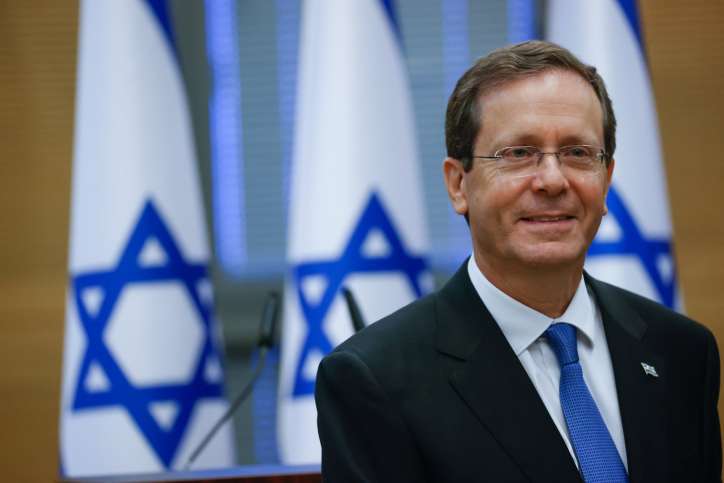
Israeli President Isaac Herzog has acknowledged growing calls within the United States for a reassessment of its relationship with Israel, following remarks by US Vice President JD Vance linking the issue to Republican losses in the midterm elections.
Herzog said that concerns about the relationship had been discussed in Washington for some time, while emphasising Israel’s efforts to maintain support across the American political spectrum.
“These are sentiments that have already been felt and discussed for some time within our greatest friend and ally.”
Isaac Herzog
He made the remarks during a meeting with a delegation from the opposition Yisrael Beiteinu party, where he also expressed respect for the leadership of the United States and its political parties. “And I have respect for President Trump, for Vice President Vance, and for the Democratic Party,” he said.
Herzog added that Israel had consistently sought to maintain bipartisan support in Washington. “Israel has always made every effort to be bipartisan,” he said.
His comments followed Vance’s statement that voters who had shifted their support away from Republicans wanted changes to Washington’s relationship with Israel.
The Vice President had identified US policy towards Israel as one of four issues raised by voters who had abandoned the Republican Party, alongside the war against Iran, the cost of living and the administration’s approach to prioritising American interests.
Eisenkot Pledges To Rebuild US-Israel Ties
Meanwhile, Israeli opposition leader Gadi Eisenkot has pledged to restore and deepen relations with Washington under his leadership, describing the partnership as one that extends beyond cooperation between governments.
In a statement, Eisenkot said that the relationship was rooted in longstanding ties between the two populations and shared democratic values.
“The bond between Israel and the United States is more than an alliance between governments. It is a partnership between peoples, built over generations, sustained by shared democratic values, and strengthened by the conviction that our nations are more secure and more prosperous when we stand together.”
Gadi Eisenkot
Eisenkot said that his leadership would focus on strengthening the relationship’s bipartisan foundations and expanding cooperation with Washington and other allies.
“Under my leadership, we will renew and deepen that partnership, strengthen the bipartisan foundations that have long sustained it, and work with our allies to advance a Middle East defined not simply by the absence of conflict, but by the presence of opportunity and cooperation.”
Gadi Eisenkot
He also described Israel as one of Washington’s most important strategic partners in the Middle East, arguing that the relationship benefits both countries.
Eisenkot expressed his intention to work with US President Donald Trump and his administration, praising their stated friendship and commitment to Israel. “I look forward to working closely and constructively with President Trump and his administration, whose friendship and commitment to Israel we deeply value,” he said.
He added that closer cooperation could help advance shared security interests, strengthen regional stability and create economic opportunities across the Middle East. “That is the Israel I believe in. And that is the future we intend to build,” Eisenkot said.
US Election Results Renew Debate Over Israel Policy
The remarks come amid renewed scrutiny of Washington’s relationship with Israel following the Republican Party’s poor performance in the midterm elections.
Vance said on Wednesday that voters who had previously supported Trump had identified changes to US relations with Israel among the issues that could persuade them to return to the Republican Party.
He also linked the party’s losses to the war against Iran, saying the conflict had contributed to voter dissatisfaction, although he maintained that the military campaign was justified.
Trump, who had endorsed Israeli Prime Minister Benjamin Netanyahu, also made an election-day pledge to end approximately $4 billion in annual US funding to Israel from 2027.
The announcement added to questions about the future direction of American assistance and the broader relationship between the two countries.
Herzog’s comments and Eisenkot’s statement reflect different responses within Israel to the debate in Washington. While the Israeli President stressed the importance of maintaining bipartisan support, Eisenkot presented closer cooperation with the United States as a priority under a future government.
The developments place renewed attention on the political and diplomatic foundations of the US-Israel relationship, particularly as American leaders debate the domestic implications of Washington’s policy towards the Middle East.
READ ALSO: Bulgaria Votes As Russia-Ukraine War Dominates Presidential Race