• About
  • Advertise
  • Privacy Policy
  • Contact
Sunday, May 3, 2026
  • Login
The Vaultz News
  • Top Stories
  • News
    • General News
    • Education
    • Health
    • Opinions
  • Economics
    • Economy
    • Finance
      • Banking
      • Insurance
      • Pension
    • Securities/Markets
  • Business
    • Agribusiness
    • Vaultz Business
    • Extractives/Energy
    • Real Estate
  • World
    • Africa
    • America
    • Europe
    • UK
    • USA
    • Asia
    • Around the Globe
  • Innovation
    • Technology
    • Wheels
  • Entertainment
  • 20MOBPL2DNew
  • Jobs & Scholarships
    • Job Vacancies
    • Scholarships
No Result
View All Result
The Vaultz News
  • Top Stories
  • News
    • General News
    • Education
    • Health
    • Opinions
  • Economics
    • Economy
    • Finance
      • Banking
      • Insurance
      • Pension
    • Securities/Markets
  • Business
    • Agribusiness
    • Vaultz Business
    • Extractives/Energy
    • Real Estate
  • World
    • Africa
    • America
    • Europe
    • UK
    • USA
    • Asia
    • Around the Globe
  • Innovation
    • Technology
    • Wheels
  • Entertainment
  • 20MOBPL2DNew
  • Jobs & Scholarships
    • Job Vacancies
    • Scholarships
No Result
View All Result
The Vaultz News
No Result
View All Result
in Securities/Markets, Sub Top Stories, Sub Top Stories2

T-Bills Oversubscribed By 72%; Gov’t makes GH¢1.37b

thevaultzby thevaultz
February 27, 2021
Reading Time: 3 mins read
T-Bills Oversubscribed but Gov’t Rejects GH¢531.09 million

This week’s auction of GH¢889 million Government Treasury bills has been oversubscribed by 72 percent with the government exceeding its target by gaining an additional GH¢484.54 million.

The bills, carrying a maturity of 91 days, 182 days, and 364 days are issued by the Central Bank on behalf of the government. A lot of investors showed interest in the short end of the market with most of them tendering more bids for the three-month bills. 

In total, bids worth GH¢1.53 billion were tendered at the Treasury auction. However, the Bank of Ghana, which manages the government’s borrowing programme accepted all bids for the 182/364-Day bills but rejected some bids worth GH¢154.68 million for the 91-Day bill. Analysts reveal that the rejection of the bids by the Central Bank can be attributed to investors lending at a higher rate than what the government is willing to borrow at.

Again, with level of investment geared towards shorter term securities, the three-month bills was highly patronized by investors at the treasury bill sales as they tendered in bids worth GH¢1.17 billion at rate ranging between 12.5 – 13.1 percent. The government, however, accepted a little over GH¢1.01 billion at an approximate average price of 12.84 percent with the lowest accepted price being 12.5 percent and the highest being 12.9 percent. 

ADVERTISEMENT

The government auctioned GH¢124.38 million for the six-month bills at an average discount rate of 12.99 for an allotted bid rate extending from 12.75 percent to 13.19 percent per annum.

Likewise, for the 364-Day bill, GH¢235.26 million was auctioned at an average price of 14.38 percent with the minimum discount rate accepted being 13.79 percent extending to a maximum rate of 14.5 percent. Also, the discount rate reflects that the bills sell for less than face value.

For some time now, the interest rates on short-term treasury bills continue to fall marginally following the decline in the rate of inflation. At this auction, except for the interest rate on the 91-Day bill which increased to approximately 13.27 percent from 13.11 percent, the average interest rate of both the 182- Day bills and 364-Day bills  dipped slightly by approximately 0.06 percent each to 13.89 percent and 16.8 percent respectively.
BoG 696x456 2
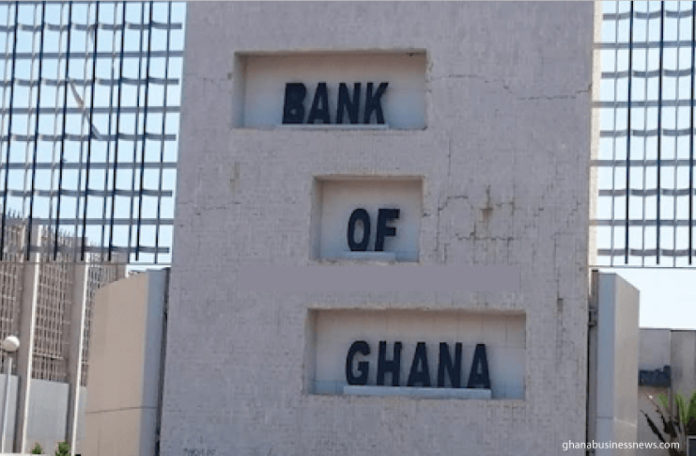
The Bank of Ghana

So far, there has been a consistent increase in demand for short term government securities with oversubscriptions recorded since the beginning of the year. This may signal a boost in investors’ sentiment. William Mensah, an Investment Banker and Non-Executive director for Ecobank Capital also hints that as a result of the second-wave of the coronavirus pandemic, investors are looking for a safe haven in times of uncertainty, and in our part of the world, this is translated into the purchase of government securities which carry lesser risk.

In the coming week, the government projects to borrow GH¢ 1252 million at its weekly securities auction starting, 1st – 5th March 2021 for 91/182/364-Treasury bills. Although, the government needs to borrow to finance its budget and maturing debt as well as cover its recorded budget deficits and as such fuelling its consistent borrowing from the domestic market, there are fears that this can crowd out the private sector’s access to loanable funds.

Mr. David Tetteh, a Financial Analyst and former Chief Executive Officer (CEO) of CAL Brokers reveals that if the government sticks to its borrowing calendar there will be enough funds channelled to the private sector for investment activities.


Sign Up to Our Newsletter

Fresh updates, Straight to your inbox

Tags: Bank of GhanaBanking sectordomestic marketGovernment borrowingGovernment of Ghana Securities Auctionmoney marketTreasury bills
Share4Tweet3Share1SendSend
Please login to join discussion
Previous Post

Importers struggle with Marine Insurance Policy

Next Post

Ghana ranks 5th among top ten African economies in UNCTAD E-commerce Index 2020

Related Posts

President John Dramani Mahama
General News

President Mahama Vows to Reset Ghana’s Salary and Pension Regime

May 1, 2026
Ghana Upstream Petroleum Sector
Extractives/Energy

From Peak to Plummet: Ghana’s 15-Year Oil Journey Faces Critical Turning Point

May 1, 2026
ZEN Petroleum Crushes Heavyweights in Surprise GSE Victory
Securities/Markets

ZEN Petroleum Crushes Heavyweights in Surprise GSE Victory 

May 1, 2026
Dr. John Osae-Kwapong, Democracy and Development Fellow, CDD-Ghana, and Project Director, the Democracy Project
General News

OSP Authorization Row: Supreme Court Urged to Act Fast

May 1, 2026

Sign Up to Our Newsletter

Fresh updates, Straight to your inbox

Recent News

Kojo Antwi's Show flyer

Maestro Kojo Antwi Set to Light Up Germany.

May 3, 2026
injustice

Kenya Faces Rising Political Violence as Election Tensions Mount

May 3, 2026
Benjamin Boakye, ACEP Executive Director

ACEP Boss Calls for Infrastructural Upgrade at Power Stations to Ensure Energy Resilience

May 3, 2026
WhatsApp Image 2026 01 07 at 4.05.38 PM

Gold Off-take Discounts Slashed to 1% Under DGPP to Boost Returns – BoG Head

May 3, 2026
President John Dramani Mahama

Plan to Construct 1200MW Power Plant Underway – President Mahama

May 2, 2026
Next Post
Ghana is fast becoming a regional hub for e-commerce and digital services as evidenced by the country’s position (5th) among the top ten African economies, and above its West African peers Nigeria and Senegal in the 2020 UNCTAD e-commerce index. Although this expansion would have otherwise been gradual, the spread of the COVID-19 virus across the country and the associated containment measures such as lockdowns and other restrictions accelerated this process. This would cause many businesses to digitize or risk collapsing as well as force consumers to explore purchases online. Furthermore, demand for digital services including online shopping, digital applications for remote work and on-line entertainment, inter alia, surged during the imposition of stay-at-home orders. And these changes have synced with people’s notion of a new normal environment for the next couple of years. Digital has come to stay! With majority of Ghanaian businesses within the category of Micro, Medium and Small Scale Enterprises (MSMEs), a rapid expansion of Ghana’s digital economy can improve the economic viability of these businesses. An increased use of digital technologies can enable MSMEs reduce costs and market goods and services to a broader range of potential buyers. Besides, e-commerce platforms serves to help businesses find potential business regardless of physical location. Still, compared with traditional retail, information and communication costs may be less expensive for MSMEs using digital technologies. All the economic benefits in a digital economy notwithstanding, there are yet some challenges that need to be addressed to avert a waning acceptance of this growing paradigm in the future. Digital illiteracy Digital illiteracy remains one of the fundamental problems that restricts the potential in achieving rapid digitalization. As advanced as technologies get, the more complex their uses become. For Ghana’s digital economy to thrive, there should be an intentional focus to train, educate, and invest in providing digital literacy. There should be greater efforts by the government to build an educational system which is directed towards scientific and technical learning. Again, the educational system should be modeled in such a way so as to link courses taught in the schools with the trend in digital technologies. Commitment to bridging the digital divide: Carrying rural folks along Digitalization is much less of a rural phenomenon than it is urban- urban bias. Although, there has been significant improvement in the last couple of years, there is still a great many people who are not captured in the digital economy who are predominantly in the rural areas. Available data suggests that the number of people who have access to the internet in the urban and peri-urban areas still far outweigh those in the rural areas. Therefore, there is need for more commitment to carry rural communities along in this digital economy. Without increasing commitment to bridge this divide, it has the tendency of worsening the gap of inequality in income between urban dwellers and rural dwellers. Data protection, cyber-attacks and fraud Alongside these challenges, data protection, cyber-attacks and fraud remains a threat to Ghana’s digital economy. There have been scores of incidences of cyber fraud and attacks on the financial sector which has contributed to several loss of funds. Mobile money fraud, for example was a worrying trend during the lockdown period and restrictions. There should be a coordinated response to building a more robust security system to protect data of users on e-commerce platforms and other digital platforms.

Ghana ranks 5th among top ten African economies in UNCTAD E-commerce Index 2020

The Vaultz News

Copyright © 2025 The Vaultz News. All rights reserved.

Navigate Site

  • About
  • Advertise
  • Privacy Policy
  • Contact

Follow Us

Welcome Back!

Login to your account below

Forgotten Password?

Retrieve your password

Please enter your username or email address to reset your password.

Log In
No Result
View All Result
  • Top Stories
  • News
    • General News
    • Education
    • Health
    • Opinions
  • Economics
    • Economy
    • Finance
      • Banking
      • Insurance
      • Pension
    • Securities/Markets
  • Business
    • Agribusiness
    • Vaultz Business
    • Extractives/Energy
    • Real Estate
  • World
    • Africa
    • America
    • Europe
    • UK
    • USA
    • Asia
    • Around the Globe
  • Innovation
    • Technology
    • Wheels
  • Entertainment
  • 20MOBPL2D
  • Jobs & Scholarships
    • Job Vacancies
    • Scholarships

Copyright © 2025 The Vaultz News. All rights reserved.

This website uses cookies. By continuing to use this website you are giving consent to cookies being used. Visit our Privacy and Cookie Policy.

Discover the Details behind the story

Get an in-depth analysis of the news from our top editors

Enter your email address