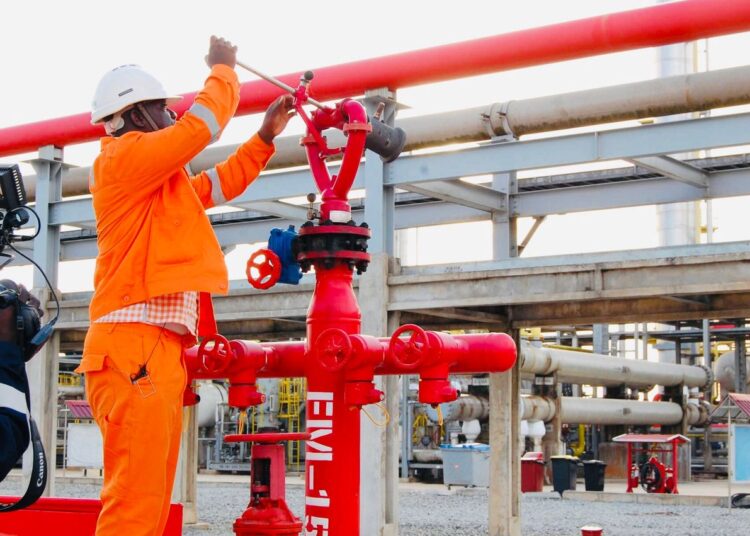
The Government of Ghana is back at the negotiation table with Italian energy giant ENI to expand the country’s gas output as part of efforts to revitalise the upstream petroleum sector.
Speaking at the Local Content Conference and Exhibition (LCCE) in Takoradi, the Western Region’s flagship event for Ghana’s upstream industry, the Acting Chief Executive Officer of the Petroleum Commission, Ms. Emeafa Hardcastle said the renewed negotiations are part of the government’s broader strategy to stimulate investment and restore confidence in the country’s oil and gas sector.
“The government negotiation team is currently in discussions with ENI again, production of oil and particularly more gas from its present level of 240 to 350 million standard cubic feet of gas per day by 2028.”
Ms. Emeafa Hardcastle, Acting Chief Executive Officer of the Petroleum Commission
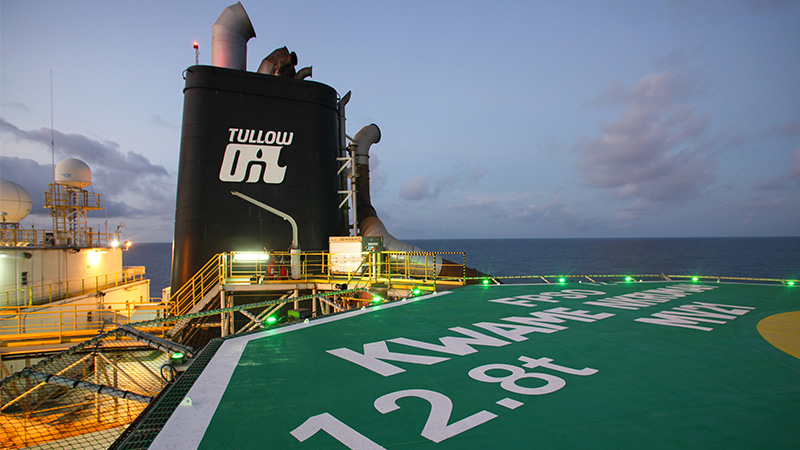
The Acting CEO highlighted that the government’s proactive engagement with international oil companies (IOCs) such as ENI, Tullow, and Kosmos Energy is already yielding positive results, as renewed confidence begins to take root in Ghana’s exploration and production (E&P) landscape.
The Petroleum Commission chief underscored that increasing gas production is not only an energy security priority but also a cornerstone for powering industries, improving domestic supply, and supporting the country’s long-term development goals.
Investor Confidence Restored

According to Ms. Hardcastle, President John Dramani Mahama’s administration has lived up to its 2024 election pledge to restore stability and credibility to Ghana’s petroleum governance framework.
She said that by resolving longstanding disputes between the government and upstream operators, the administration has successfully repositioned Ghana as a competitive and trusted investment destination.
“This, I can say, His Excellency has delivered on, and within a short period, the results are beginning to manifest.
“We are beginning to witness renewed E&P interest and confidence in Ghana.”
Ms. Emeafa Hardcastle, Acting Chief Executive Officer of the Petroleum Commission
Ms. Hardcastle noted that recent developments, including new investment commitments from global oil players reflect Ghana’s improved policy and regulatory climate.
“You have heard from ENI; you have heard from Tullow. We broadcast the Memorandum of Understanding and Memorandum of Intent signed by both of them in the investment of $1.2 billion and $2 billion into the sector.”
Ms. Emeafa Hardcastle, Acting Chief Executive Officer of the Petroleum Commission
New Deals and Investment Prospects
According to Ms. Hardcastle, the government has received expressions of interest from three super majors and one large independent company, signalling growing optimism among global investors.
“The government negotiation team is at an advanced stage of finalising a petroleum agreement with Shell for a South Deepwater (SDW) block.
“Two other operators I’ve just mentioned on Jubilee, Tullow partners, Kosmos and ENI also have interest in our OCTP block and four contract areas.”
Ms. Emeafa Hardcastle, Acting Chief Executive Officer of the Petroleum Commission
These developments, she said, signal renewed momentum in Ghana’s upstream petroleum activities and underscore the success of recent policy and regulatory interventions aimed at restoring stability and attracting investment.
Beyond investment attraction, Ms. Hardcastle highlighted the Petroleum Commission’s efforts to improve coordination across government agencies to resolve operational and fiscal challenges confronting contractors and subcontractors in Ghana’s upstream space.
She noted that regulatory cooperation is crucial to maintaining a transparent and supportive business environment.
To this end, the Commission, invited agencies such as the Ghana Revenue Authority (GRA), Bank of Ghana (BoG), and the Ghana Investment Promotion Centre (GIPC) to engage directly with international oil companies and local suppliers during the conference.
She further encouraged industry players to take advantage of the presence of these key institutions to raise concerns and share insights, assuring that the Commission will “continue to do advocacy on your behalf as well.”
The renewed engagement with ENI and other major operators signals a turning point for Ghana’s petroleum industry.
After several years of uncertainty marked by arbitration disputes and delayed field developments, the sector appears to be regaining its footing.
If realised, the projected increase from 240 million scf/d to 350 million scf/d by 2028 could significantly enhance Ghana’s domestic gas availability for power generation, industrial use, and export potential, strengthening the country’s energy independence and economic resilience in the years ahead.