
Ghana’s youth unemployment crisis has deepened, with official figures showing that more than one in five young people are unable to find work despite rising levels of education.
Addressing this growing concern at the State of the Youth Address in Accra, the Minister for Youth Development and Empowerment, Hon. George Opare Addo, outlined a comprehensive and ambitious roadmap aimed at reversing the alarming trend and equipping young people with the skills, support, and opportunities necessary for meaningful employment.
According to the minister, youth unemployment rates have surged from 16.9% in 2017 to 22.5% in 2022, with about 70% of the nation’s unemployed population falling within the 15 to 35 age bracket.
“This trend is significant for both the government and the ministry,” Hon. Opare Addo said, reaffirming the government’s commitment on behalf of President John Dramani Mahama to “address and reverse this development.”
Despite the improvements in literacy and educational attainment over the past decade, the minister expressed concern that the increase in school enrolment has not translated into job creation.
He noted that secondary school enrolment rose from 23% in 2015 to 35.9% in 2024, while tertiary education moved only marginally from 11.7% to 12.5% within the same period.
“Clearly, something is missing. When we delve deeper into the data, we realise that a lot of our secondary graduates stop there. Many are not interested in learning any vocation but rather seek white-collar jobs that are nonexistent. This must concern us.”
Minister for Youth Development and Empowerment, Hon. George Opare Addo
Vocational and Technical Pathways Remain Underutilised
Hon. Opare Addo revealed that the vocational and technical pathways remain underutilised, leaving a wide gap between academic learning and employable, work-ready skills.

“Each year, our education system produces over 400,000 unskilled and semi-skilled young entrants into the labour market, with less than 5,000 available job spaces,” he lamented, warning that the mismatch between education and employment poses a grave risk to the nation’s social and economic stability.
The minister further explained that the unemployment challenge is not uniform across gender and geography, adding that young women consistently experience higher unemployment rates than their male counterparts—reaching nearly 29% in 2021”.
“Urban areas also record greater unemployment levels than rural regions, largely due to the attractiveness of city life and the mismatch between job creation and urban migration.”
Minister for Youth Development and Empowerment, Hon. George Opare Addo
He attributed part of the problem to the limited opportunities in the formal sector. Although the economy has experienced marginal growth, that growth, he said, has not translated into significant employment creation.
“Paid employment among young people has increased by 10% since 2015, but nearly 60% of young workers remain in vulnerable employment. The informal sector’s share of youth employment has grown from 32% in 2015 to 43% in 2024.”
Minister for Youth Development and Empowerment, Hon. George Opare Addo
The minister described this situation as deeply concerning, disclosing that even though some jobs are being created, out of the ten young people in the country, only one holds a highly skilled job. “A lot more are in vulnerable or informal jobs,” he said.
“The question that begs is: how do we formalise the informal sector so we can convert those vulnerable jobs into sustainable and decent ones?”
Minister for Youth Development and Empowerment, Hon. George Opare Addo
A Bold and Multi-Pronged Policy Agenda
To address these challenges, the Ministry of Youth Development and Empowerment has set out a bold and multi-pronged policy agenda. Central to this plan is the expansion of high-quality apprenticeship and technical and vocational education training (TVET) for youth aged 15 to 24.
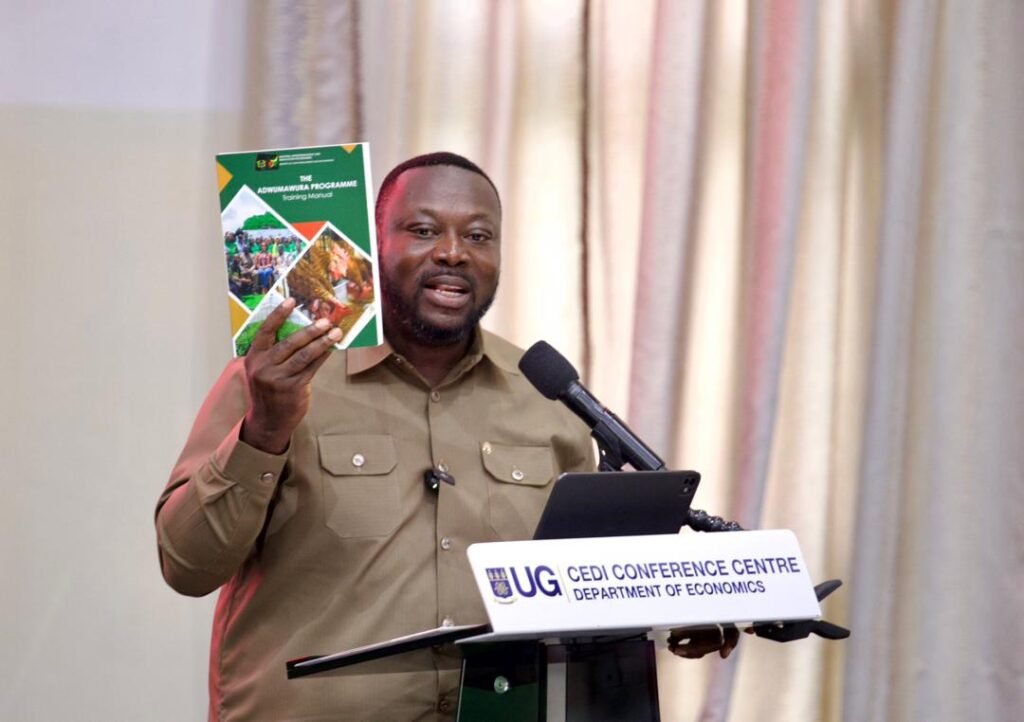
Hon. Opare Addo emphasised the need to dismantle the negative perceptions surrounding technical and vocational education, particularly among young people in the country
“We must change the sociocultural misconception that portrays vocational training as punishment. Agriculture, for example, has the potential to create many more jobs. We must change the mindset that working with the hoe and cutlass is a form of punishment.”
Minister for Youth Development and Empowerment, Hon. George Opare Addo
The ministry plans to collaborate with relevant ministries and agencies to standardise curricula and ensure that industrial input is embedded in educational design. Partnerships with the Association of Ghana Industries, Ghana Employers Association, and Private Enterprise Federation will help introduce structured workplace learning and graduate employment programmes.
In collaboration with the Ministry of Education, the government will make secondary and tertiary education more focused on employability, entrepreneurship, and digital skills to ensure that graduates transition smoothly into the labour market.
Hon. Opare Addo also announced plans to ease the process of business registration and compliance for micro, small, and medium enterprises (MSMEs) and startups. The ministry will coordinate with the Social Security and National Insurance Trust (SSNIT), the Registrar General’s Department, and the Ghana Revenue Authority (GRA) to simplify procedures and incentivise companies that train and retain graduates.
“Sometimes, registering a business is so cumbersome that a young person’s spirit is broken before they even begin. We are determined to lead reforms that make it easier for young entrepreneurs to start and sustain their businesses.”
Minister for Youth Development and Empowerment, Hon. George Opare Addo
Tackling Rising Urban Youth Unemployment
To tackle rising urban youth unemployment, the ministry plans to establish city-level skills hubs aligned with employer demands. These hubs will be implemented through agencies such as the National Entrepreneurship and Innovation Programme (NEIP), the Youth Employment Agency (YEA), the National Service Authority (NSA), and the National Youth Authority (NYA).

Successful execution of flagship programs like the National Apprenticeship Program and the Adwumawura Program is expected to equip youth with practical skills for gainful employment. In addition, Hon. Opare Addo announced a new initiative to create domestic care job opportunities for young women within Ghana.
“Our young women do not have to travel to Dubai or the Far East in search of domestic jobs. If we can formalise the domestic care sector here, it can create many jobs for our young females, ensuring they can work with dignity at home.”
Minister for Youth Development and Empowerment, Hon. George Opare Addo
The ministry will also intensify support for STEM education while maintaining a balance with the humanities. “We need both,” the minister said, “but we must align tertiary education and funding with sectors capable of employing graduates. Emphasis will be placed on soft skills, critical thinking, and problem-solving.”
He further disclosed that the ministry intends to institutionalise data collection and sharing to strengthen policy formulation and monitor outcomes across youth development initiatives. Hon. Opare Addo concluded his address with a message of hope and collaboration.
“Challenges exist in our schools, streets, and communities. But progress is also being made in education and youth entrepreneurship.
“The ministry will continue to work with all stakeholders—public agencies, the private sector, civil society, traditional authorities, and development partners—to close the skills gap, expand job opportunities, and improve youth well-being.”
Minister for Youth Development and Empowerment, Hon. George Opare Addo
He encouraged Ghana’s young people to actively participate in available programmes, invest in their personal growth, and adopt habits that foster discipline, integrity, and innovation.

“Whilst progress may take time, the collective effort is ongoing. Together, we can create a Ghana where every young person has access to opportunities, safety, and the tools to thrive.”
Minister for Youth Development and Empowerment, Hon. George Opare Addo
Hon. George Opare Addo’s address reaffirms government’s resolve to transform Ghana’s youth employment landscape through skills development, vocational empowerment, and entrepreneurship, ensuring every young Ghanaian finds meaningful work, contributes to national growth, and secures a sustainable future.
READ ALSO: October Inflation Falls to 8% – Boon for Consumers, Signal of Policy Success