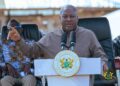

The Minister for Food and Agriculture, Hon. Eric Opoku, has clarified that the government’s Nkoko Nkitinkiti policy, which is to be launched, does not cover commercial poultry farmers, emphasizing that the government’s policy towards poultry production is multi-faceted and not just limited to Nkoko Nkitinkiti.
The minister emphasized that while the government is starting first with the Nkoko Nkitinkiti initiative, scheduled to be launched on Wednesday, November 12, 2025, the public must understand that it is just one aspect of the government’s poultry production plans that is purposely for households.
However, he noted that there are other policy directives that would be rolled out subsequently to cover large-scale and medium-scale commercial farmers.
“The poultry thing we are doing—people must get it clear. It is not just about Nkoko nkitinkiti. Nkoko-nkitinkiti is just the backyard poultry we are engaging in. We have another program under which we are targeting existing poultry farmers.”
Hon. Eric Opoku, Minister for Food and Agriculture.
As a government policy, the Nkoko Nkitinkiti initiative is targeted at boosting domestic poultry production and reducing reliance on imports. It aims to support 55,000 households by promoting backyard poultry farming, creating jobs, and enhancing food security.

The policy is part of the broader Feed Ghana strategy and includes training, access to feed, and improved breeding stock. Originally set for July, it was delayed to October for stakeholder engagement. By reducing the $300 million spent annually on poultry imports, the initiative seeks to revitalize agriculture, empower youth, and strengthen Ghana’s self-sufficiency in protein production.
The Minister for Food and Agriculture stated that technical staff from the ministry are engaging stakeholders in the poultry industry to gather data and information on how best the policy can be rolled out, noting that the information received from the field officers will guide them as to who gets to be selected to benefit from the policy rollout.
“What we are doing now is dealing with the backyard poultry farming. That has nothing to do with the commercial farmers. It has nothing to do with the commercial farmers. In fact, the technical people are already in the field. We are selecting the beneficiaries based on their capacities in their various places.
“So, in Bono Ahafo, for instance, the people have submitted their reports. They have gone to their places of work and have identified those people we can work with. Now, we have to engage with them based on the information that we have before we roll out that one.”
Hon. Eric Opoku, Minister for Food and Agriculture.
Support for Large-Scale and Medium-Scale Commercial Farmers
Hon. Opoku then noted that there are other plans underway that are purposely for large-scale and medium-scale commercial farmers, emphasizing the need for an overall increment in poultry production in the country in order to reduce imports.
The minister noted that there is an existing program from last year where some poultry farmers were provided the logistics and financial support with the understanding being that they will pay back after harvest.

However, he stated that these persons are yet to pay back after harvest, adding that the ministry has the list of all the persons involved and will engage them to pay back as was agreed. He further emphasized that this arrangement would be extended to the large-scale and medium-scale commercial farmers.
“We are extending that one to the extent that we want to identify 50 of the well-established, experienced poultry farmers in Ghana and then offer them the support they require to be able to expand because they have the experience, they have the capacity, they have the facilities, and they have everything to be able to engage in commercial farming.
“And then after that, we have what we call the medium-scale type. That is where we engage with those people who are doing from 1000 to 3000 beds, build their capacity, and ensure that they engage in sustainable production. All that we are doing is just to close the gap between supply and demand.”
Hon. Eric Opoku, Minister for Food and Agriculture.
He therefore emphasized that it is important for the public, especially poultry farmers, to understand the processes the ministry is going through to roll out these policy initiatives in phases, adding that stakeholders are able to attain valuable information from the ministry when a request is made through writing or visits to the ministry, as he reassured the ministry’s commitment to engaging industry players for effective policy implementation.
READ ALSO: GAEC Hosts Training on Nuclear Reactor Core Removal