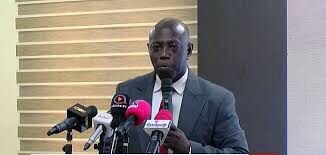
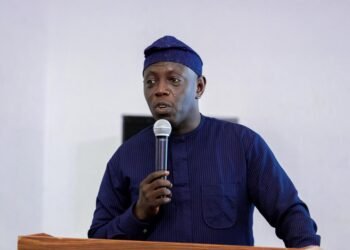
The Executive Director of the Africa Centre for Energy Policy (ACEP), Ben Boakye, has delivered a strong caution to government against pursuing state-led oil exploration and production, warning that persistent governance failures at the Ghana National Petroleum Corporation (GNPC) make such a move too risky for the country.
Speaking during an X Space discussion titled “Beyond the Headlines: Technical Evidence, Financial Exposure and Government Options on the Springfield WCTP-2 Block,” Mr Boakye argued that the Corporation’s track record over the past decade makes it unsuitable to lead Ghana’s next phase of oil development.
“From investment and technical understanding of what has happened in this space, coupled with the politics, mismanagement and inefficiencies, I would be really restrained from even advising government to ever get into hardcore oil production today.”
Ben Boakye, Executive Director of ACEP
ACEP Exposes GNPC’s Track Record

A key highlight of Mr Boakye’s concern stems from GNPC’s inability to demonstrate tangible progress despite receiving significant financial support over the years.
“Over the past decade, GNPC has not drilled a single well, despite receiving over $1.5bn to undertake such activities.
“The funds have been used to create layers of management positions and recruit politically connected individuals.”
Ben Boakye, Executive Director of ACEP
The funds, he said, included portions of Ghana’s carried interest revenue from partners such as Tullow, Kosmos and ENI, which were intended to build local capacity for future operatorship.
However, the ACEP boss said GNPC has repeatedly failed to use these resources for exploration. Instead, he alleged, the Corporation expanded its administrative structure by creating layers of managerial roles that add “no value” to its operational capacity.


Mr Boakye further questioned the prudence of GNPC’s spending on seismic acquisition, citing the $150 million used for 2D data acquisition in the Voltaian Basin as an example of poor financial judgment.
“What did they do with $150 million acquiring 2D data in this country? They just funnelled money that could have been used to advance the development of this country.”
Ben Boakye, Executive Director of ACEP
Another major issue raised was governance surrounding GNPC’s offshore subsidiary, Jubilee Oil Holdings Ltd (JOHL), incorporated in Jersey.
Mr Boakye alleged that revenues from JOHL’s petroleum interests, including an earlier 7% stake acquired in the Aker transaction, remain outside the national petroleum revenue management framework.
“If GNPC even produces oil today, the budget is not going to receive that money. They will be deciding what to do with the money.”
Ben Boakye, Executive Director of ACEP
He stressed that the arrangement deprives the national budget of needed revenue and undermines transparency.
Government eyes takeover of Springfield’s WCTP-2 Block

The debate gains significance as the Ministry of Energy and Green Transition engages Springfield Exploration and Production Ltd (SEP) over the future of the West Cape Three Points Block 2 (WCTP-2).
The Ministry recently confirmed that GNPC and its upstream subsidiary, Explorco, are exploring a possible government-led takeover of SEP’s stake.
WCTP-2 is home to the Afina discovery, estimated to contain more than 1.5 billion barrels of recoverable crude, making it one of Ghana’s most promising undeveloped oil assets.

Supporters of a state takeover argue it could give Ghana greater control over a major resource and unlock significant revenue. But Mr Boakye insists that without fixing GNPC’s governance challenges, any attempt to put the Corporation at the helm of such a major asset would expose Ghana to enormous financial and operational risks.
According to him, a poorly governed GNPC risks repeating past failures, in which huge sums were spent without measurable results. He stressed that the Corporation’s “inefficiencies, lack of accountability and political interference” make it unfit to manage a high-stakes asset like WCTP-2.
He warned that unless GNPC’s governance architecture is strengthened, the state could lose significant value through mismanagement.
Mr Boakye concluded that Ghana must prioritise governance reforms, operational efficiency, and accountability before considering any state-led exploration strategy.
As the government continues its engagement with Springfield, the ACEP boss’ remarks add fresh pressure for policymakers to rethink GNPC’s role, and to ensure that any future investment decisions safeguard Ghana’s long-term fiscal and energy security.
READ ALSO: IMANI’s Simons Alleges Procurement Scandal Behind 2026 SIM Re-registration: ‘Katanomics’ Again?