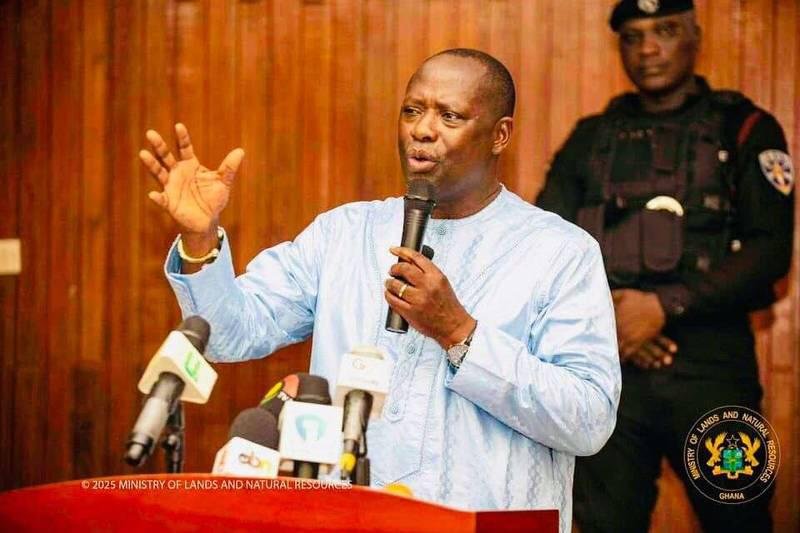
Hon. Felix Ofosu Kwakye, Minister responsible for government communications has reaffirmed that Government is advancing steps in its quest to realizing environmental protection through amendment of the Minerals and Mining Act, 2006 (Act 703).
This legislative overhaul aims to introduce a comprehensive, non-derogable ban on all forms of mineral extraction within the nation’s forest reserves, effectively closing the legal loopholes that previously allowed “sustainable” mining in sensitive ecosystems.
By upgrading mining in these protected enclaves from a regulatory infraction to a strictly criminal offense, the state seeks to reclaim its environmental sovereignty over territories once dominated by “non-state actors, bandits, and thugs.”
This move follows the successful repeal of Legislative Instrument (L.I.) 2462, a controversial regulation that had faced intense public backlash for granting the executive discretionary power to approve mining in forest reserves if deemed in the “national interest.”
The proposed amendment to the parent Act is designed to provide a more permanent, “definitive” solution to the galamsey canker, ensuring that no future administration can easily bypass forest protections through subsidiary legislation.
Beyond the total ban, the government is introducing stringent measures to curb the influx of excavators and heavy machinery, while establishing specialized courts to ensure a “much quicker way of dealing with these miscreants” who threaten the nation’s biodiversity and water security.
“An additional step of amending the Mining and Minerals Act will be taken to make it impossible for anybody to mine, whether legal or illegally, in a forest reserve. In addition to this, additional measures have been introduced to stop the influx of excavators whose use is not too clear to the authorities.“
Hon. Felix Ofosu Kwakye
“Arrests have been made, and special courts will be set up shortly to ensure that we have a much quicker way of dealing with these miscreants who engage in illegal mining,” Hon. Kwakye added.
Breaking the Siege: Reclaiming Sovereign Forest Territories

At the inception of the current administration, several of Ghana’s vital forest reserves had transitioned into “no-go areas” for state authorities.
Hon. Felix Ofosu Kwakye also alleged that nine critical reserves had previously been effectively annexed by armed syndicates who provided “security” for illegal mining operations. The government’s immediate tactical response involved a systematic re-entry into these zones to restore state authority.
While Kwakye admits the administration has “not achieved fully the objective of eradicating the calamity,” he maintains that the progress is “as government agents, who were once barred from entry, now operate freely to disrupt illegal activities.”
Legislative Gaps and the Path to Environmental Sovereignty

From an extractive industry perspective, the existing Minerals and Mining Act, 2006 (Act 703) has often been criticized for its “permissive” framework.
Section 4 allows the Minister to reserve land from mining, but the lack of an explicit, absolute prohibition for forest reserves created a vacuum that L.I. 2462 exploited.
By amending the Act to include a statutory ban, Ghana is shifting toward a model of “environmental sovereignty,” where the long-term health of the ecosystem takes precedence over short-term mineral gains.
This legislative fortification is essential to protect water bodies like the Pra and Ankobra, which have suffered “considerable public concern” due to toxic pollution from persistent illegal operations.
NAIMOS and the New Enforcement Frontier
The operational arm of this renewed onslaught is the National Anti-Illegal Mining Operations Secretariat (NAIMOS), which works on a “daily basis” to dismantle galamsey sites.
Unlike previous temporary task forces, NAIMOS is structured to provide continuous disruption, preventing miners from re-establishing camps once security forces depart.
The Minister emphasized that while the “pace at which we are going” is aggressive, the complexity of the “canker” requires both boots on the ground and the new legal “onslaught” to be successful.
The focus has now shifted to “definitively overcoming” the menace by cutting off the logistical supply of excavators and ensuring that the newly empowered special courts provide the deterrent needed to protect Ghana’s green heritage.
READ ALSO: MIIF CEO Vows to Consolidate 2025 Economic Gains as Fund Targets World-Class Status in 2026