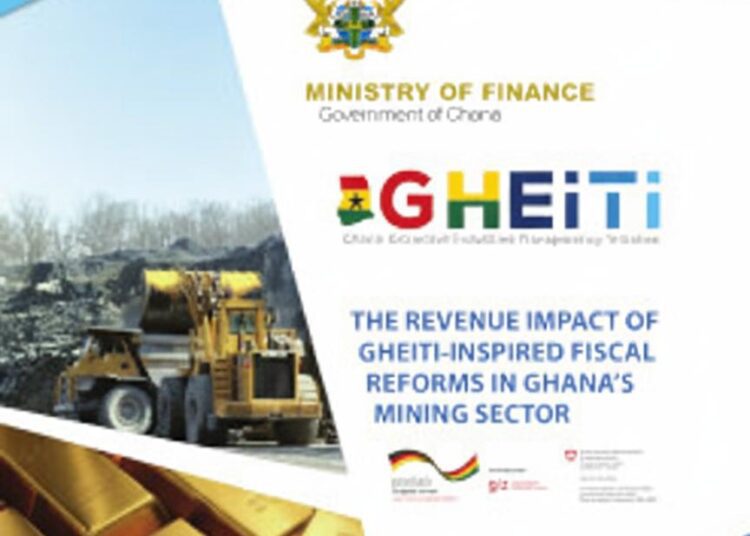
The latest 2023 Ghana Extractive Industries Transparency Initiative (GHEITI) mining report has revealed that Ghana’s mining and quarrying sector, excluding oil and gas, contributed a monumental GHS69.142 billion in gross value added (GVA) to the Ghanaian economy.
This staggering figure represents a massive leap from the GHS44.305 billion recorded in 2022, signaling a year-on-year growth rate of 56.1%.
This economic surge was propelled primarily by a revitalized gold sub-sector, which saw its value expand from GHS42.904 billion to GHS65.580 billion within a single year.
“This represents a year-on-year growth rate of 56.1 percent, driven largely by higher gold output, particularly from the Artisanal and Small-scale Mining (ASM) sector. The effective removal of the withholding tax on unprocessed gold significantly incentivised formal sales through licensed channels, leading to a substantial increase in officially recorded ASM production.”
GHEITI Report
Expanding on this fiscal milestone, the GHEITI report highlights that the mining and quarrying sector has now solidified its position as the third most valuable economic sector in Ghana, trailing only behind wholesale and retail trade and manufacturing.
The sector’s share of the national Gross Domestic Product (GDP) climbed from 7.7 percent in 2022 to 8.3 percent in 2023. When including the petroleum sub-sector, the collective contribution of the extractive industry reached 12.8 percent of total GDP.
Despite a slight decline from the 13.4 percent combined share seen in 2022, the “mining and quarrying sector as a whole ranked as the third largest contributor to GDP,” outperforming several other traditional pillars of the economy.
This growth trajectory underscores the successful formalization efforts within the ASM sub-sector, which recorded a 52.9 percent expansion in value.
Catalyzing National Development and Fiscal Stability
The significance of this GHS69.1 billion contribution cannot be overstated in the context of Ghana’s current macroeconomic recovery.
As the largest source of direct domestic tax revenue, the mining sector provides the critical fiscal space needed for the government to meet its debt obligations and fund essential public services.
The surge in GVA translates directly into higher corporate tax payments, mineral royalties, and employee income taxes (PAYE), which are the lifeblood of the national budget.
By accounting for over 58 percent of total merchandise export earnings, gold production acts as the primary shield for the Ghana Cedi, providing the foreign exchange reserves necessary to stabilize the local currency against the US Dollar and other major currencies.
Furthermore, the “third most valuable economic sector” status ensures that the government can continue to prioritize infrastructure projects that have been stalled by fiscal constraints.
The revenue generated from this 56.1 percent growth allows for the construction of roads, hospitals, and schools, particularly in mining-affected regions where the need for development is most acute.
In a year where global supply chains faced immense pressure, the mining sector’s ability to post record-breaking value-added figures provided a much-needed buffer for the Ghanaian economy, preventing a more severe contraction and supporting a “reserve position of 2.9 months of import cover,” which is vital for national economic security.
Empowering Livelihoods and Local Communities

Beyond the high-level macroeconomic data, the mining sector’s growth has a profound and tangible impact on the lives and livelihoods of ordinary Ghanaians.
The ASM sector, which was the primary engine of the 2023 growth, currently employs an estimated one million people directly and supports over 4.5 million individuals indirectly.
The formalization of this sector, spurred by tax incentives, means that more miners are operating within a regulated framework that offers better safety standards and fairer pricing for their gold.
This transition from “unofficial” to “officially recorded” production ensures that the wealth generated from the land is distributed more equitably through local supply chains and community development funds.
The benefits also extend to the large-scale mining workforce, which remains over 99 percent Ghanaian. In 2023, mining companies injected billions into the local economy through the procurement of goods and services, supporting thousands of small and medium-sized enterprises (SMEs) that provide everything from catering to heavy machinery maintenance.
This “nexus between the mining and non-mineral sectors” creates a multiplier effect where every mining job supports several others in the services and manufacturing industries.
For the ordinary Ghanaian, this means more stable employment, better vocational training opportunities, and improved social investments in clean water, sanitation, and education within the host communities, truly making the extractive sector a “reliable driver of socio-economic transformation.”
The Future of Ghana’s Extractive Governance
As Ghana moves into 2026, the insights from the GHEITI report serve as a roadmap for sustainable resource management.
While the 2023 figures are celebratory, the report also hints at the need for continued vigilance in balancing growth with environmental stewardship.
The shift toward geospatial technologies, such as drones for monitoring and real-time data analytics, is already beginning to enhance safety and efficiency across the pits.
By focusing on “local content and local participation,” the government and industry players are ensuring that the GHS69.1 billion isn’t just a number on a ledger, but a foundation for a more resilient and inclusive Ghanaian economy.
READ ALSO: Ten Convicted In Cyberbullying Case Targeting Brigitte Macron