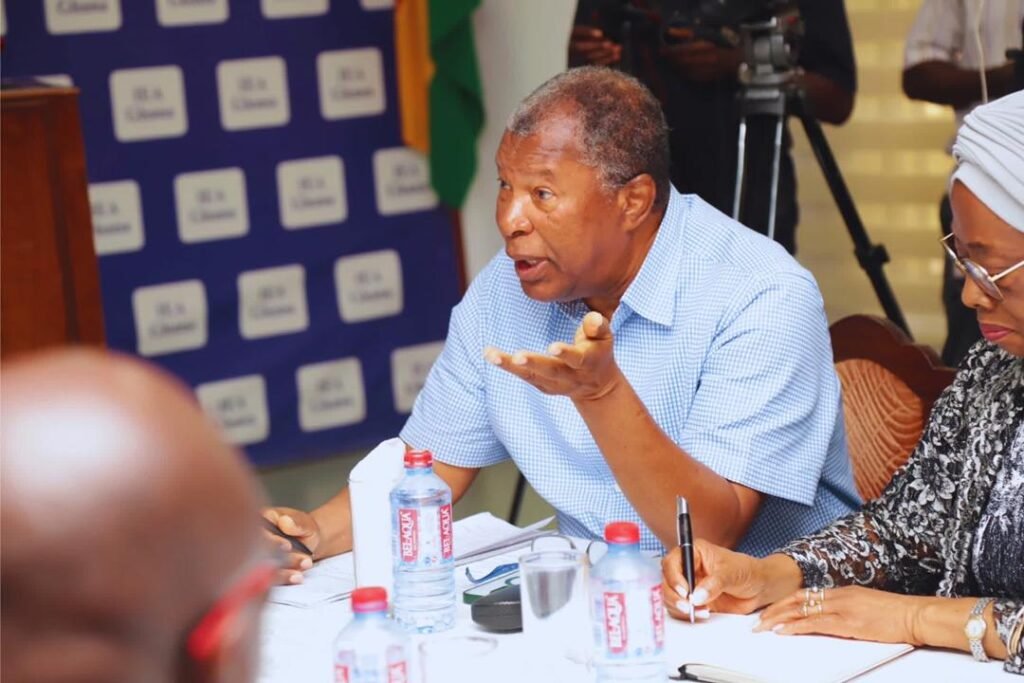
Chairman and founder of the Institute of Economic Affairs (IEA), Dr. Charles Mensa, has called for a strategic expansion of the Domestic Gold Purchase Programme (DGPP) to include major industry players such as large-scale miners in the country.
In an interview with Vaultz News, Dr. Charles Mensa argued that the current framework, which primarily focuses on small-scale production, represents a form of “policy discrimination” that allows large-scale miners to export the nation’s primary wealth while the state misses out on critical reserve-building opportunities.
“The idea of a gold board is excellent; it should be spread across, and we should buy all gold. There’s nothing wrong with the Central Bank buying gold, and I don’t think we should listen to the IMF telling us don’t buy too much gold. We should do what developed countries do they have gold in their vaults, yet they tell you not to keep it.”
Dr. Charles Mensa
By broadening the mandate of the Gold Board (GoldBod), Dr. Mensa envisions a future where the state acquires all gold produced within its borders to shore up national reserves.
This move would signify a shift away from reliance on foreign instruments like British Treasury bills, which he views as inferior to the tangible security of bullion. “Gold is the future,” Mensa asserted, suggesting that the state should consider taking over mining operations entirely when existing leases for multinational firms expire.
Economic Sovereignty and the IMF Critique

In a scathing critique of international financial institutions, Institute of Economic Affairs’ (IEA) founder suggested that the International Monetary Fund (IMF) often provides advice that serves the interests of its “clientele” rather than the developing nations it advises.
He pointed to the example of Botswana’s diamond industry as a parallel, where international pressure discouraged state acquisition of mineral assets.
Dr. Mensa argued that keeping African nations in a perpetual state of borrowing what he termed the “Intensive Care Unit” (ICU) of the IMF serves to maintain the jobs of global bureaucrats while keeping resource-rich nations poor.
Strengthening the Cedi Through Domestic Retention

This aggressive accumulation serves as a “natural hedge” against currency volatility. By paying for gold in local Cedis, the central bank reduces the immediate demand for US Dollars, effectively stabilizing the exchange rate and curbing the “policy-driven” inflation that has historically plagued the economy.
Strategic Reserves: Lessons from the Gold Standard
Reflecting on the pre-1973 global economy, Dr. Mensa reminded stakeholders that the world was once anchored to gold until the “Nixon Shock” removed the US Dollar from the gold standard. He maintained that the intrinsic value of gold remains the ultimate safeguard for national wealth.
While acknowledging potential operational losses in the short term, such as the reported GH¢ 5.6 billion loss in 2024, he dismissed these as minor hurdles compared to the “big issue” of amassing long-term reserves.
For Ghana, “doing what developed countries do” means ignoring external warnings and prioritizing the vault over the bond.
READ ALSO : Agriculture Minister Launches Kpone Poultry Processing Hub