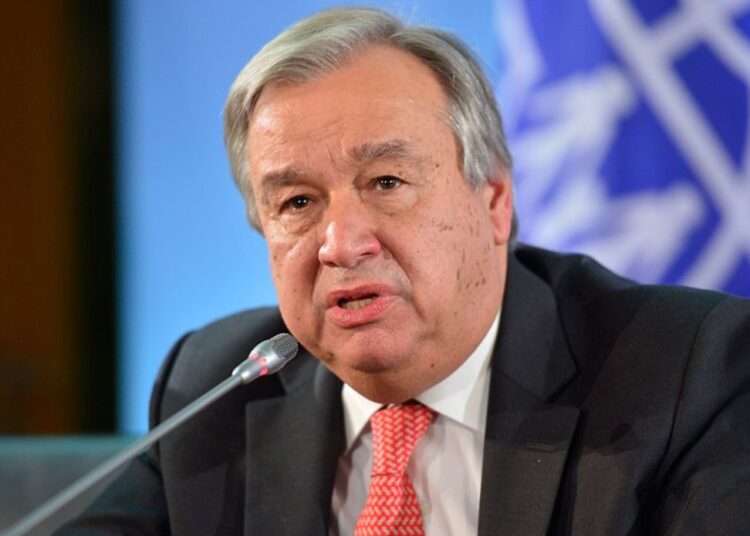
United Nations Secretary-General Antonio Guterres has warned that human rights are facing what he described as a “full-scale attack around the world,” accusing powerful actors of trampling on international law and undermining the foundations of global order.
Speaking at the opening of the annual session of the United Nations Human Rights Council in Geneva, Guterres painted a stark picture of a world in which fundamental protections are being steadily eroded.
His remarks set a somber tone for the Council’s session, which convenes at a time of mounting geopolitical tensions, armed conflicts, and widening inequalities that have placed civilian populations at risk and tested the effectiveness of international mechanisms designed to safeguard rights. By framing the situation as a “full-scale attack,” Guterres signaled that he believes the challenges are systemic rather than isolated incidents.
Guterres noted in his address, “The rule of law is being outmuscled by the rule of force,” stressing that the deterioration of human rights protections is neither hidden nor accidental.
“This assault is not coming from the shadows or by surprise. It is happening in plain sight – and often led by those who hold the greatest power.
“Around the world, human rights were being pushed back deliberately, strategically, and sometimes proudly. The consequences were devastating, and as written in the lives of people who suffer twice: first from violence, oppression, or exclusion – and then again from the world’s indifference. When human rights fell, everything else tumbled.”
Antonio Guterres
He did not mention specific situations, although he did voice outrage at Russia’s war in Ukraine, where he said more than 15,000 civilians had been killed in four years of violence.“It is more than past time to end the bloodshed,” he said.

Guterres also highlighted the “blatant violations of human rights, human dignity and international law in the occupied Palestinian territory.” He charged that the trajectory in the conflict-torn territory under Israeli occupation was “stark, clear and purposeful: The two-state solution is being stripped away in broad daylight.” “The international community cannot allow it to happen,” he insisted.
In his final in-person address to the UN’s top rights body, Guterres, who will complete his second five-year term at the end of this year, said that the worst conflict-hit areas were not the only places where rights were eroding.
“We are living in a world where mass suffering is excused away, where humans are used as bargaining chips, where international law is treated as a mere inconvenience.”
Antonio Guterres
Moreover, Guterres appealed to the international community not to let the erosion of human rights become the accepted price of political expediency or geopolitical competition, and not to let “power write a new rulebook in which the vulnerable had no rights and the powerful had no limits.” He called for the Human Rights Council to be the voice and shield for all those in need; a place that helped end the broad and brutal assault on human rights.
Turk Echoes Guterres’ Concerns
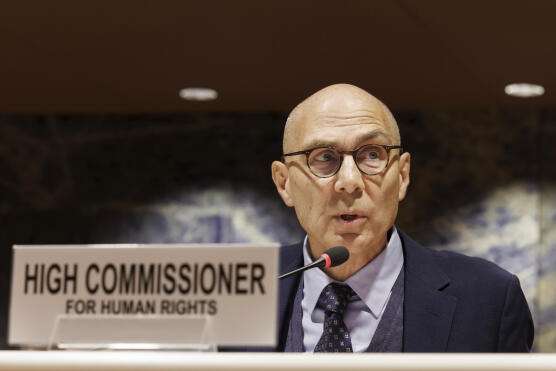
UN High Commissioner for Human Rights Volker Turk echoed the concerns, saying, “Developments around the world point to a deeply worrying trend: Domination and supremacy are making a comeback.”
“A fierce competition for power, control and resources is playing out on the world stage at a rate and intensity unseen for the past 80 years. The use of force to resolve disputes between and within countries is becoming normalised.
“Inflammatory threats against sovereign nations are thrown about with no regard to the fire they could ignite. The laws of war are being brutally violated. Mass civilian suffering – from Sudan to Gaza to Ukraine to Myanmar – is unfolding before our eyes.”
Volker Turk
Turk highlighted how “the gears of global power are shifting”, calling for people to band together to protect human rights and create “a strong counterbalance to the top-down, autocratic trends we see today.”
Guterres’ warning is likely to resonate in discussions about accountability, protection mechanisms, and international cooperation. Whether his appeal will translate into concrete measures remains to be seen, but his message stresses that the global human rights framework is under strain, and its defense requires resolve from those entrusted with power.
By situating human rights at the center of global stability, Guterres sought to remind member states that these principles are not abstract ideals but practical safeguards for human dignity. His address framed the current moment as a test of commitment to the values enshrined in international agreements and institutions. In his view, the outcome of that test will shape not only the future of human rights but the broader trajectory of the international system.
READ ALSO: ECG Revenue Challenges Threaten Energy Sector Stability – Ben Boakye