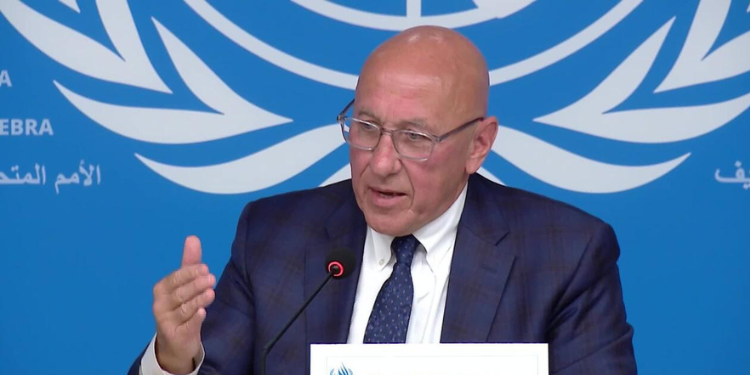
United Nations Human Rights Expert Tom Andrews has warned that more than 20,000 Cambodian civilians remain displaced months after deadly border clashes with neighbouring Thailand, with thousands still unable to return to their homes because conflict-affected areas remain inaccessible.
The assessment was delivered by Tom Andrews, the UN Special Rapporteur on the situation of human rights in Cambodia, at the conclusion of his first official mission to the Southeast Asian nation.
Andrews called on both Cambodia and Thailand to work together to facilitate the safe, voluntary and dignified return of civilians who fled the violence, while also addressing broader humanitarian and human rights concerns that continue to affect communities along the border.
The warning comes as the aftermath of last year’s armed confrontation continues to cast a shadow over relations between the two neighbouring countries. Although active fighting has subsided, many communities remain caught in the consequences of the conflict, with border crossings still closed, livelihoods disrupted and thousands of displaced families living in temporary relocation centres.
According to Andrews, approximately 650,000 Cambodian civilians were displaced in border regions during the fighting that erupted late last year. While the overwhelming majority have since returned home, more than 20,000 people remain displaced because several towns and villages have yet to be safely reopened.
“It is a matter of international law that those displaced by armed conflict have the right to return to their homes,” Andrews stated, urging both governments to cooperate in creating conditions that would allow affected families to resume their normal lives.
For many of those still displaced, the prolonged uncertainty has extended far beyond the immediate dangers posed by armed conflict. Families continue to rely on temporary shelters while facing limited access to employment, education and healthcare. The continued closure of border crossings has further complicated the situation by disrupting trade and cutting off communities that depend heavily on cross-border economic activity for their livelihoods.
Border commerce has historically served as an important source of income for thousands of residents living on both sides of the Cambodia-Thailand frontier. Markets, transport services and small businesses that rely on the daily movement of goods and people have all been affected by the restrictions, placing additional pressure on households already struggling with displacement.
Thailand has rejected allegations that its military is illegally occupying Cambodian territory, maintaining that its forces are operating in accordance with a bilateral ceasefire agreement reached after the fighting.
Despite the cessation of major hostilities, border checkpoints between the two countries remain closed, preventing many residents from resuming normal economic activities and family connections across the frontier.
UN Calls for Stronger Action on Cybercrime and Greater Protection of Political Freedoms
In addition to the humanitarian concerns surrounding the border conflict, Andrews identified transnational cyber scam operations as one of Cambodia’s most pressing human rights challenges, warning that organised criminal networks continue to exploit vulnerable people across the region.
He stated that cyber scam compounds have become closely linked to human trafficking, forced labour and other forms of exploitation, with victims often lured into fraudulent employment schemes before being subjected to abuse and coercion.
While acknowledging recent efforts by Cambodian authorities to dismantle these criminal enterprises, Andrews encouraged the government to maintain and strengthen its crackdown on the networks.
According to the UN expert, Cambodian authorities have already shut down more than 600 scam compounds, suspended or revoked the licences of 29 casinos and initiated criminal proceedings involving approximately 3,000 suspected operators connected to scam activities.
The operations have attracted growing international attention in recent years, with several Southeast Asian countries intensifying cooperation to combat criminal syndicates that target victims through online fraud, romance scams and cryptocurrency investment schemes.
Andrews also expressed concern over the state of political freedoms in Cambodia, saying information received by his office suggested that more than 100 individuals may currently be detained for peacefully exercising their fundamental rights..
He added that Cambodian authorities had assured him they would continue engaging with his office while reviewing the cases.
The remarks come as Cambodia prepares for commune elections scheduled for 2027, followed by general elections in 2028. Andrews indicated that these electoral milestones present an opportunity for the government to strengthen democratic participation by expanding civic space and protecting the rights of opposition parties, journalists, activists and civil society organisations.
READ ALSO: BTS Rejects 2027 Grammys Over New Asian Music Category