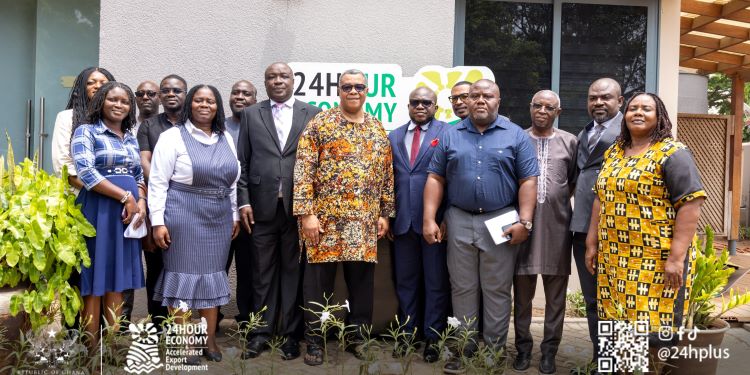
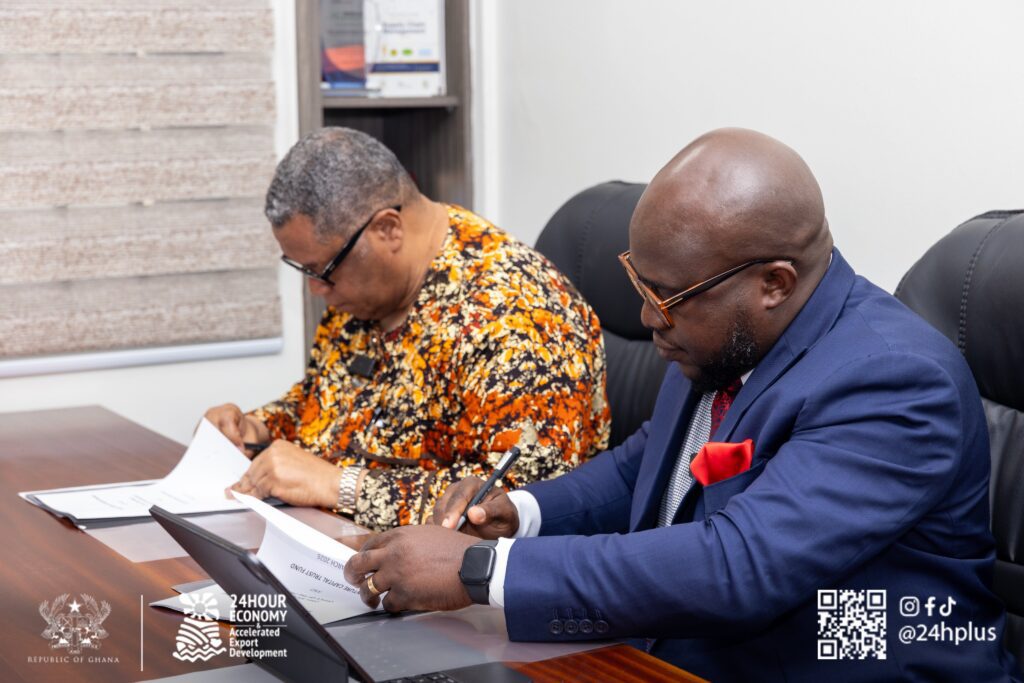
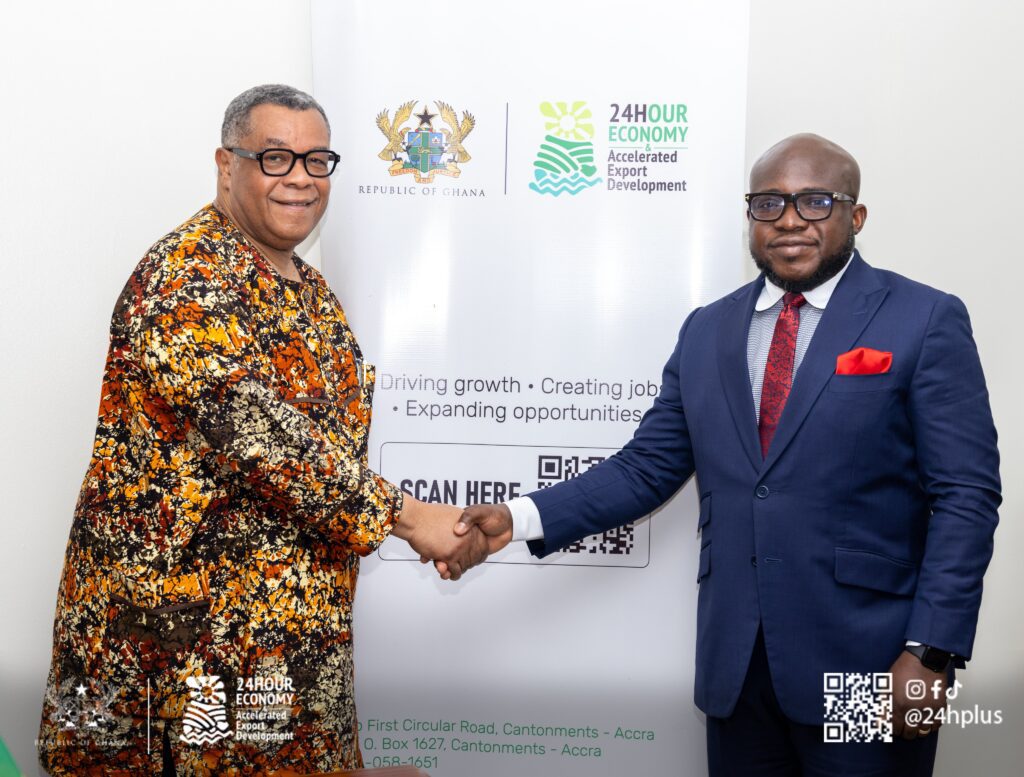
In a decisive move to bridge the liquidity gap for Ghana’s emerging industrial class, the 24-Hour Economy Secretariat and the Ghana Venture Capital Trust Fund have finalized a strategic partnership.
This collaboration is designed to inject the “patient capital,” necessary for local businesses to transition from standard operating hours to a full-scale, three-shift system. By aligning policy incentives with equity financing, the partnership aims to transform the nation’s productivity ambitions into tangible, operational enterprises that can compete on the global stage.
“The 24-Hour Economy Secretariat and the Ghana Venture Capital Trust Fund have formalised a partnership to support Ghanaian businesses with the kind of capital needed to scale, expand operations, and create jobs.
“The focus is on patient financing, investment readiness, and stronger coordination between policy and capital, especially for SMEs positioned to operate at scale under the 24-Hour Economy”
24-Hour Economy Secretariat
According to the Secretariat, the “Economic Reset,” championed by the Administration, has consistently identified the lack of affordable, long-term financing as a primary bottleneck for Small and Medium-Sized Enterprises (SMEs), especially with traditional commercial lending often characterized by high interest rates, and short repayment cycles.
This makes them ill-suited for the structural changes required to run a 24-hour operation. The entry of the Ghana Venture Capital Trust Fund into the 24-hour ecosystem provides a sustainable alternative, offering equity-based financing that prioritizes growth and job creation over immediate interest extraction.
At the core of this partnership is the concept of “Patient Financing.”
Unlike conventional loans, venture capital investments under this framework are designed to stay within the business for an extended period, allowing companies to invest in heavy machinery, automated production lines, and the additional labor force required for night shifts.
This type of capital is essential for sectors like Agriculture processing and Industrialization, where the return on investment is realized over years rather than months. The 24-Hour Economy Secretariat will act as a primary funnel, identifying high-potential businesses that have the capacity to operate at scale.
By vetting these enterprises for their alignment with national industrial goals, the Secretariat ensures that the Ghana Venture Capital Trust Fund is deploying resources into sectors that offer the highest “multiplier effect” for the economy. This coordination ensures that capital is not just distributed, but strategically invested in the pillars of the 2026 industrial agenda.
Strengthening Investment Readiness
The Secretariat noted that a significant hurdle for many Ghanaian Small and Medium-Sized Enterprises is the “readiness gap,” – where to attract venture capital, a business must demonstrate robust corporate governance, transparent financial reporting, and a clear path to profitability.
The new partnership addresses this by launching an Investment Readiness Program. Through this initiative, the Secretariat and the Trust Fund will provide technical assistance to help business owners professionalize their operations.
This program is not merely about paperwork; it is about readiness. For a firm to qualify for 24-hour financing, it must prove it has the management depth to oversee multiple shifts and the supply chain resilience to keep production moving around the clock.
By raising the bar for investment readiness, the partnership is effectively upgrading the quality of Ghana’s entire private sector, making it more attractive to both domestic and foreign institutional investors.
For the first time, there is a direct, formal link between the government’s flagship economic policy and the nation’s primary venture capital vehicle. This “Policy-Capital Coordination,” ensures that the fiscal incentives offered to 24-hour businesses – such as electricity tariff rebates and tax credits – are matched by the necessary capital expenditure (CAPEX) funding.
“This collaboration is about turning productivity ambitions into investable, operational enterprises,” the Secretariat stated, emphasising that this holistic approach prevents a common pitfall where businesses have the policy “permission” to expand but lack the “fuel” to do so.
Under the leadership of the Mahama Administration, this synergy is expected to spark a wave of industrial expansion across the Volta Economic Corridor and the Northern Development Zone.
As businesses in these regions gain access to equity partners through the Ghana Venture Capital Trust Fund, they will be better positioned to acquire the technology needed to process raw materials locally, thereby adding value to Ghana’s Agriculture exports and reducing the national import bill.
The ultimate metric of success for the 24-Hour Economy Secretariat is the creation of high-quality, sustainable jobs. By facilitating the scaling of Small and Medium-Sized Enterprises, the partnership is effectively doubling or tripling the labor demand of the participating firms.
A factory moving from an 8-hour day to a 24-hour cycle naturally requires three times the workforce, including supervisors, technicians, and logistics officers. The Ghana Venture Capital Trust Fund’s involvement ensures that these jobs are not just temporary but are supported by businesses with the financial backing to survive market fluctuations.
As these “investable enterprises,” grow, they contribute to a more stable and resilient middle class, fueling domestic consumption and further driving the “Economic Reset.” The partnership signals to the market that the 24-hour economy is no longer just a policy concept but a fully-funded industrial reality.
READ ALSO: US To Continue Military Offensive In Iran