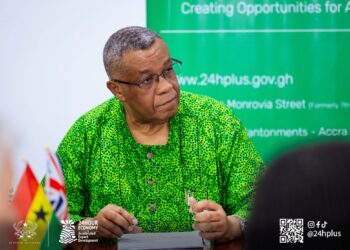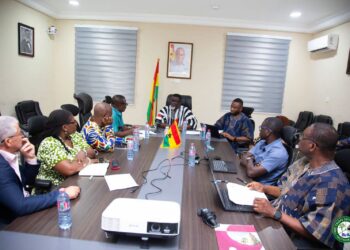
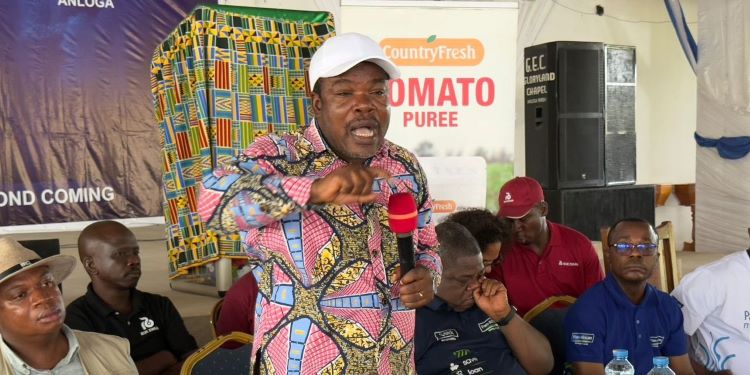
The industrialization of Ghana’s Agriculture sector has taken a major leap forward as the Feed Ghana Programme officially commenced its operational rollout in the Anloga District, to transform the livelihoods of vegetable farmers by integrating them into a global value chain.
Led by the Program Coordinator, Hon. Bright Edward K. Demordzi, a high-level delegation consisting of technical experts, financial partners, and international seed breeders arrived in the Volta Region to launch the National Vegetable Development Project (NVDP).
According to Feed Ghana, this initiative represents a cornerstone of the Administration’s strategy to achieve food sovereignty and reduce the nation’s dependence on imported vegetables, particularly tomatoes.
“The Feed Ghana Coordinator and team undertook farmer engagement and stakeholder consultations to commence the registration of farmers for the major tomato production season. The initiative is a partnership between Feed Ghana and Farm Mate, in collaboration with their financial partners and seed breeders”
Feed Ghana Programme
The mission began with a courtesy call on the District Chief Executive (DCE) for Anloga, followed by intensive farmer engagement and stakeholder consultations, where Hon. Demordzi noted that the NVDP is not merely a distribution exercise but a structured, end-to-end commercial model designed to “transform the livelihoods of vegetable farmers.”
He explained that by combining Dutch seed technology with local technical expertise and guaranteed financing, the Feed Ghana Programme is “setting a new standard for sustainable agricultural development in Ghana.”
Central to the success of the NVDP is the partnership between the Feed Ghana Programme and Farm Mate, the designated technical operator for the project. In Anloga, the delegation included the CEO of Farm Mate, Mr. Sena Amevor, and a team of specialized seed breeders from the Netherlands.

This inclusion of international breeders is a strategic move to address the long-standing challenge of low yields and poor disease resistance in local tomato varieties. These breeders are introducing climate-resilient, high-yielding seeds tailored specifically for the Ghanaian soil and climatic conditions.
During the engagements, Honorable Demordzi emphasized that the project is built on the principle of “Precision Agriculture.” This involves providing farmers with more than just seeds, to include a comprehensive input package and real-time technical monitoring that ensures every hectare under cultivation reaches its maximum potential.
This data-driven approach is a key component in ensuring that state resources are utilized efficiently to produce measurable industrial outcomes.
Post-Harvest Loss
For decades, tomato farmers in the Anloga District and beyond have been plagued by the twin crises of price volatility and post-harvest loss. The NVDP solves this by installing Farm Mate as the primary off-taker.
Under the project’s contractual framework, Farm Mate is legally obligated to purchase the entire produce of every participating farmer at a pre-negotiated, fair market price. This “Guaranteed Market,” removes the risk from the farmer and places the responsibility of logistics and processing on the technical operator.
According to the Feed Ghana Coordinator, this model is a direct application of the Administration’s 24-hour economy logic. By securing the raw material through a dedicated outgrower scheme, local processing factories can operate on multiple shifts, confident in a steady supply of high-quality tomatoes.
This synergy between the farm and the factory is the essence of Industrialization, turning seasonal harvests into a year-round economic engine that supports both rural incomes and national food security.
Capital Support
Citing the lack of credit as a critical barrier to commercial farming, the Feed Ghana Programme noted the integration of Pan African Savings and Loans into the NVDP framework, with the financial team also on the ground in Anloga to facilitate the registration process.
For the Programme, this approach not only ensures that qualified farmers have access to the credit required to manage their operations but allows them to focus on production without the immediate pressure of high-interest commercial debt.
However, the financial partners are not just providing loans; they are part of a tri-partite agreement where the inputs are provided upfront as a credit facility, and the repayment is settled during the off-taking phase.
This de-risked financial model ensures that even smallholder farmers can participate in the National Vegetable Development Project without fear of falling into a debt trap. It is a social-equity model that ensures the benefits of the “Agriculture Reset” are felt at the grassroots level.
The launch of the NVDP in Anloga signals the end of the era of subsistence farming and the beginning of a new chapter in commercial Industrialization.
With the technical expertise of Dutch breeders, the financial backing of Pan African Savings and Loans, and the guaranteed market provided by Farm Mate, the tomato farmers of the Volta Region are being repositioned as industrial entrepreneurs.
Honorable Bright Demordzi reaffirmed the government’s commitment to ensuring that the Feed Ghana Programme becomes the most successful agricultural intervention in the nation’s history.

As the major production season begins, the eyes of the nation are on Anloga, where the future of Ghana’s food security is being cultivated, one seedling at a time.
READ ALSO: Major Interest Rate Cuts Loom for Borrowers As GRR Plunges to 11.71%